A projector can show a convincing video demonstration while fine colored spreadsheet text still looks wrong. Before approving that model for a meeting-room or desktop product line, verify the signal's chroma sampling as well as its resolution.
Projector chroma subsampling describes the spatial sampling of color-difference information relative to luma. For an OEM buyer, the decision is practical: does the chosen source, connection and projector mode preserve the detail needed for the intended content? A “4K” label alone cannot answer that question.
Read the Sampling Pattern Spatially
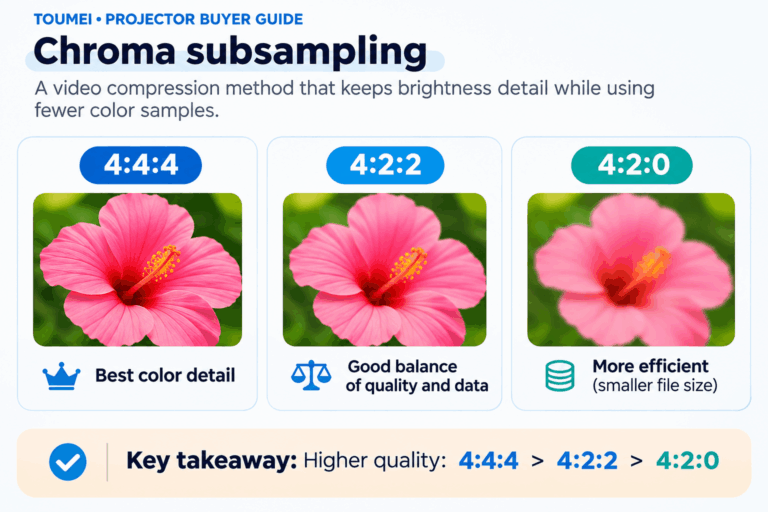
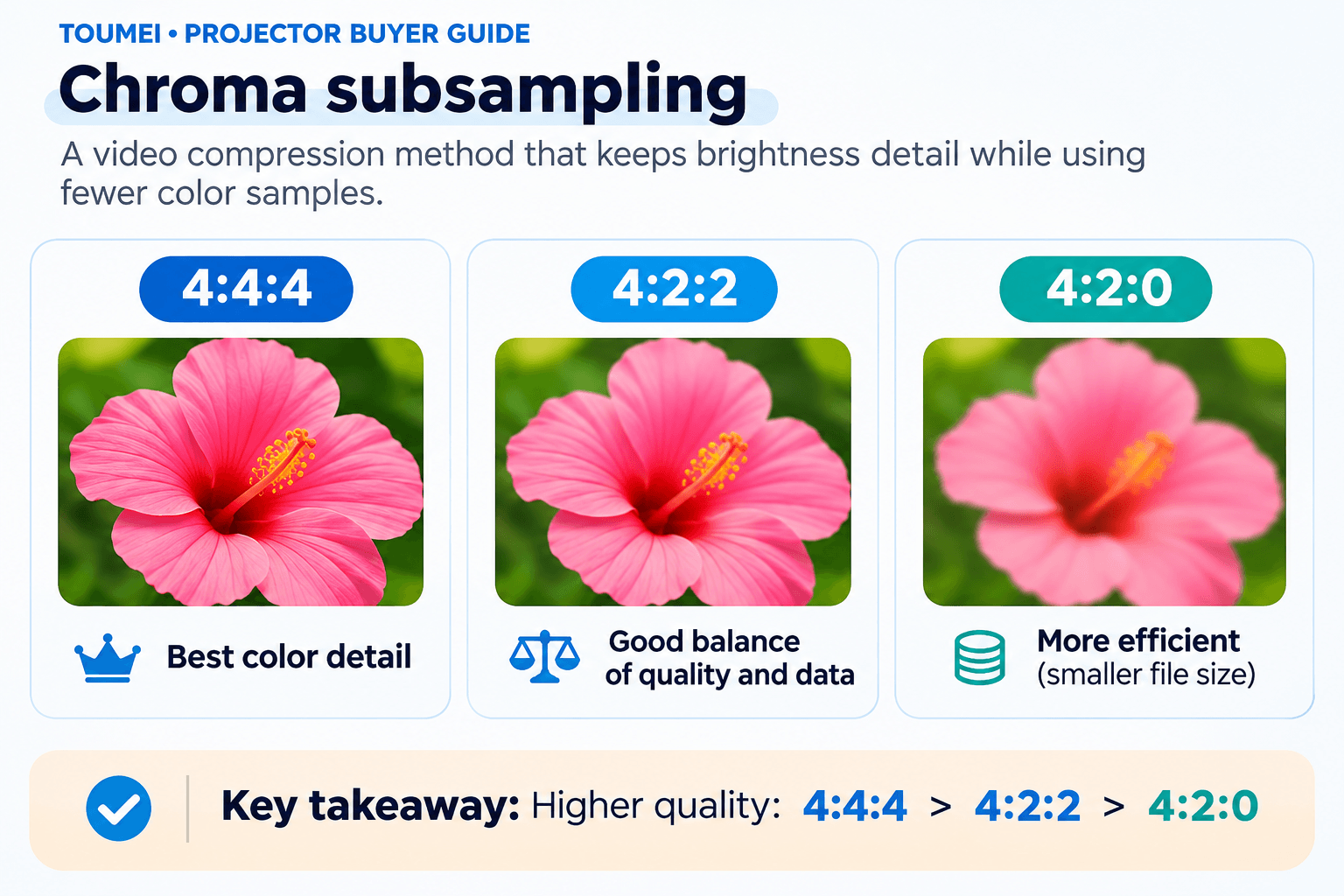
In a Y′CbCr representation, Y′ is the luma component; Cb and Cr carry color-difference information. Here, luma is a signal component, not a measurement of projector light output. Common sampling patterns are summarized below. The official video-format explanation of chroma sampling describes these spatial relationships. [1]
| Sampling | Chroma sampling relative to luma | What to remember |
|---|---|---|
| 4:4:4 | No spatial chroma downsampling | Each chroma plane retains the luma plane's sample dimensions |
| 4:2:2 | Half the horizontal sampling; full vertical sampling | Reduced horizontal color detail |
| 4:2:0 | Half the horizontal and half the vertical sampling | Reduced color detail in both directions; color is still present |
For a simple progressive 1920 × 1080 example, a 4:2:0 frame has a 1920 × 1080 luma plane and 960 × 540 samples in each chroma plane. This is sample-count arithmetic, not a drawing of every format's exact sample positions or memory layout. Those details need the applicable format specification. The UHDTV recommendation's digital-representation table also defines 4:4:4, 4:2:2 and 4:2:0 sampling separately from bits per component. [2]
The zero in 4:2:0 does not mean that the image has no color. It belongs to a sampling notation, not a count of remaining colors.
Choose a Test That Matches the Content
If the product will display dashboards, tables, diagrams or presentation slides, include fine colored text and single-pixel colored lines in the sample review. Such patterns expose loss of fine color detail more clearly than a large photograph. An AV engineering document describes the relevance of these features in its explanation of fine color detail. [3]
Use an authorized, uncompressed test image at its intended pixel dimensions. Avoid resizing it in a browser, document or slide before evaluating the path. Record source scaling, projector scaling, digital geometry correction and optical focus, because a soft-looking result is not automatically proof of chroma subsampling.
Review representative video separately. A test of text detail answers a different question from whether a film or presentation is acceptable at the customer's viewing distance. Agree on both tasks when the product is sold for mixed use.
Keep Sampling Separate From Other Color Claims
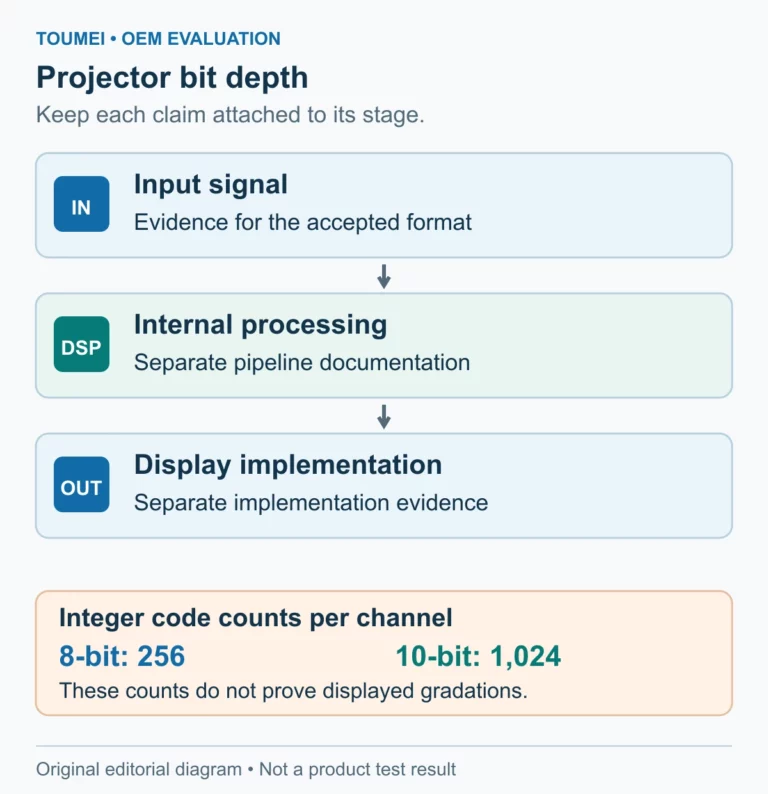
4:4:4 describes spatial sampling. It does not establish color accuracy, gamut coverage, HDR tone mapping or the number of encoded levels per component. Likewise, accepting a 10-bit input does not automatically establish 4:4:4 operation at every resolution and refresh rate.
State the complete required combination: source, named port, pixel dimensions, scan type, exact refresh rate, RGB or Y′CbCr, sampling, bits per component and SDR/HDR state. For the wider input-format question, use our projector supported-resolution checklist. Keep a separate HDR review rather than using a sampling label as an HDR quality score.
Build a Content-Based Chroma Acceptance Record
The worksheet below is a proposed buyer tool. It contains no measured TOUMEI result and sets no universal pass threshold. Use separate rows for formats that matter to your customers.
| Decision field | Evidence to retain | Acceptance question |
|---|---|---|
| Intended content | Representative spreadsheet, diagram or video; approved test image | What detail must remain legible at the agreed viewing distance? |
| Exact signal | Source output status and documented format | Is the requested sampling actually being sent at this timing? |
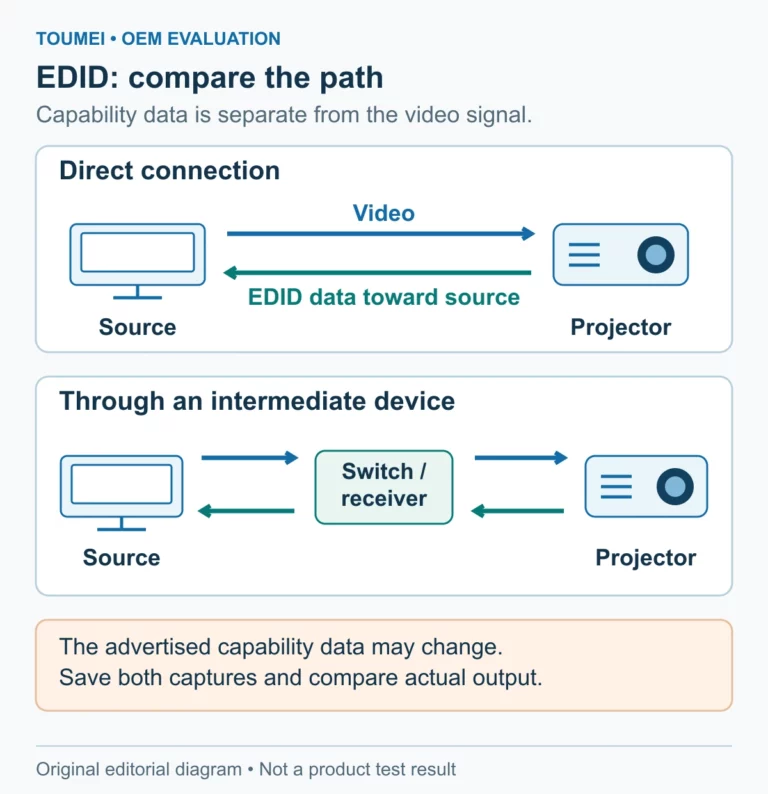
| Connection path | Source, cable, adapters or intermediary devices, port and firmware | Is every stage identified, including any conversion? |
| Projector mode | Input status, processing and geometry settings | Which settings were used for the observed result? |
| Visible result | Original observations and controlled photographs if used | Are text edges, line colors and thickness acceptable for this task? |
| Exceptions | Missing readouts, failures and approved limitations | Is the claimed scope narrower than the evidence? |
Start with a direct connection, then repeat through the installation path. If the result changes, compare one stage at a time. Where a status display does not expose sampling, retain that limitation; a visible picture alone does not prove the exact internal processing format.
Do not use a photograph as the only sampling measurement. Camera focus, image resizing and image compression can alter the very detail being assessed. Keep the original source pattern and written settings alongside the observations.
Frequently Asked Questions
Does 4:2:0 mean the projector shows a black-and-white picture?
No. 4:2:0 retains color-difference samples at reduced spatial resolution. In the common progressive arrangement, each chroma plane has half the horizontal and half the vertical sampling of luma. [1]
Is 4:4:4 always the best choice for every application?
It preserves more spatial color detail, which can matter for fine colored text. Selection still depends on the required timing, supported path and intended content. Judge the complete configuration rather than ranking every product from this label.
Are 10-bit color and 4:4:4 the same feature?
No. Bit depth concerns levels per component; chroma sampling concerns spatial sample density. Specify both independently, along with resolution and refresh rate. A product must support the required combination, not just the separate headline terms.
Can a projector accept 4K and still soften colored text?
Yes, a resolution claim alone does not establish the sampling or processing used. Investigate the actual format, scaling, focus and image-processing settings before assigning a cause. Do not diagnose subsampling from softness alone.
Will changing a 4:2:0 source to 4:4:4 restore original detail?
It does not recover original color detail already lost through subsampling. Upsampling constructs a denser representation. For a meaningful test, use a source pattern that preserves the detail you intend to evaluate. [1]
What should an OEM sample request specify for desktop use?
Provide the required pixel dimensions, refresh rate, sampling, bits per component, source, connection path and representative text or graphics. Define the viewing conditions and the acceptance task; ask for configuration-specific evidence.
Discuss Your Text and Video Requirements
Contact TOUMEI with your source format and representative desktop content when requesting samples. Include the target market, candidate model, installation path, required text size and expected viewing distance. The OEM/ODM project page explains how to frame the wider project scope. Sampling support and observed performance must be confirmed for the selected model and configuration.
References
- [1] Recommended 8-Bit YUV Formats for Video Rendering, official developer documentation, authored April 2002 and updated November 2008; accessed November 9, 2026. Supports the common sampling ratios, format variations and upsampling context. It describes video representation, not a TOUMEI projector's signal path.
- [2] Recommendation ITU-R BT.2020-2, October 2015, Table 5, printed page 5; accessed November 9, 2026. Supports progressive UHDTV sampling relationships and their distinction from coding depth. The recommendation concerns production and programme exchange; it is not a projector certification or a test result.
- [3] Vector 4K Scaling, Extron engineering brochure, document 68-2883-01 Rev. A, November 2015, PDF page 4, “4:4:4 Chroma Sampling”; accessed November 9, 2026. Supports the relevance of fine colored lines and text to spatial color detail. The document also markets its own equipment; those performance claims and illustrations are not reused or attributed to TOUMEI.