Introduction: Why choosing the right home projector brand matters
Home projectors in 2026 are no longer limited to dedicated theater rooms. Buyers now expect projectors to handle everyday streaming, sports, gaming, family movie nights, and portable use, while also offering smart operating systems, easier setup, and better brightness for living-room environments. Across current official product pages, the most emphasized decision factors are brightness, resolution, streaming access, auto image correction, throw flexibility, and portability.
This guide reviews 10 notable home projector manufacturers and supplier brands for everyday viewing in 2026. It compares their brand positioning, representative products, and ideal use cases, while also highlighting Toumei as a China-based OEM projector manufacturer serving brands, distributors, and B2B buyers.
How we selected the top 10 home projector brands
This is not a strict sales ranking. Brands were selected based on four practical criteria: a clear home-entertainment or daily-viewing product portfolio; current smart projector relevance in categories such as portable, 4K, laser, or UST; verifiable product information on official brand websites; and, in Toumei’s case, clear OEM/manufacturing capability for projector buyers and channel partners.
Epson — Reliable bright-room home entertainment
Epson remains a strong name for practical home entertainment projectors, especially for buyers who want bright images, straightforward setup, and familiar mainstream brand support. Its current Home Cinema retail models emphasize Full HD viewing, large image sizes up to 300 inches, and brightness levels aimed at living rooms rather than only dark theater spaces. Epson also introduced newer retail projectors with built-in support for Apple AirPlay in 2025, showing it is still actively updating its home and hybrid-entertainment lineup.
BenQ — Balanced family entertainment with strong image adaptation
BenQ is one of the most complete home-entertainment projector brands for buyers who want a mix of image quality, ease of use, and mainstream streaming access. The GP520 is positioned as a 4K home entertainment projector with Google TV, 2,600 ANSI lumens, Auto Cinema Mode, and multiple smart image-adaptation tools such as auto keystone, auto focus, obstacle avoidance, and wall-color adaptation. That makes BenQ especially strong for family users who want a projector that fits into normal living spaces rather than dedicated AV rooms.
XGIMI — Smart home cinema from portable to premium laser TV
XGIMI stands out because it spans both portable daily-use projectors and more premium living-room laser products. On the high end, AURA 2 offers Google TV, 4K UST projection, 2,300 ISO lumens, and a 0.177:1 throw ratio for laser-TV-style home cinema. In the more conventional home-theater segment, HORIZON S Max adds 4K, 3,100 ISO lumens, Dolby Vision, and IMAX Enhanced positioning. XGIMI is a strong fit for buyers who want modern smart features and a more lifestyle-oriented design language.
Nebula — Portable projection for casual everyday viewing
Nebula remains highly relevant for buyers prioritizing portability, convenience, and casual home or travel viewing. Capsule 3 Laser is a compact 1080p laser-powered projector with 300 ANSI lumens, a 120-inch image, and a built-in battery rated for 2.5 hours of movie playback. That makes Nebula especially suitable for users who want a projector for bedrooms, apartments, travel, camping, or flexible room-to-room use rather than a permanent home-cinema installation.
JMGO — Stylish laser projection with strong all-in-one smart features
JMGO has built a clear identity around design-forward smart laser projectors for home use. Its N1S Pro 4K combines 2,250 ISO lumens, 4K resolution, triple-laser imaging, a gimbal-based design, auto setup features, and Google TV with native Netflix. This positioning makes JMGO attractive for buyers who want a projector that feels more premium and modern than traditional boxy home-theater hardware, while still being practical for daily viewing and flexible placement.
Dangbei — High-brightness smart laser projectors for mainstream home use
Dangbei is increasingly relevant in the smart home projector category because it combines high brightness with mainstream consumer-friendly features. The DBOX02 (Mars Pro 2) is positioned as a 4K laser projector with Google TV, licensed Netflix, 2,450 ISO lumens, autofocus, auto keystone, screen fit, obstacle avoidance, and a 30,000-hour laser life claim. For buyers who want an all-in-one living-room projector with a stronger brightness profile than many portable units, Dangbei is a serious option.
Formovie — Ultra-short-throw laser TV for premium living rooms
Formovie is most relevant to buyers specifically searching for UST living-room projection rather than portable or entry-level models. Theater Premium positions itself as a 4K triple-color laser TV with 2,200 ISO lumens, a 0.21:1 ultra-short-throw ratio, and 107% BT.2020 color coverage, with Google TV and native Netflix highlighted on the product page. Formovie is best suited to buyers building a more premium TV-replacement setup close to a wall or ALR screen.
ViewSonic — Home theater and gaming-friendly mainstream projector brand
ViewSonic remains a practical choice for buyers who want traditional home projection strengths with gaming-friendly specs. Its PX701-4K and PX749-4K models emphasize 4K resolution, high brightness, large screen sizes, HDR support, and up to 240Hz refresh rate with 4.2ms input lag. Compared with lifestyle-first smart projector brands, ViewSonic often appeals more to users focused on performance-per-dollar, console gaming, and bright-room entertainment.
Optoma — Bright 4K home entertainment with strong gaming value
Optoma continues to target users who want large-screen 4K entertainment and gaming performance at mainstream price points. The UHD38x is positioned as a bright 4K UHD gaming and home entertainment projector with 4,000 lumens, HDR/HLG support, full 3D compatibility, input lag as low as 4.2ms, 240Hz support at 1080p, and image sizes up to 300 inches. Optoma is therefore a strong candidate for sports fans, gamers, and buyers who need a projector to stay usable in more ambient light.
Toumei — Shenzhen-based OEM smart projector manufacturer for everyday viewing products
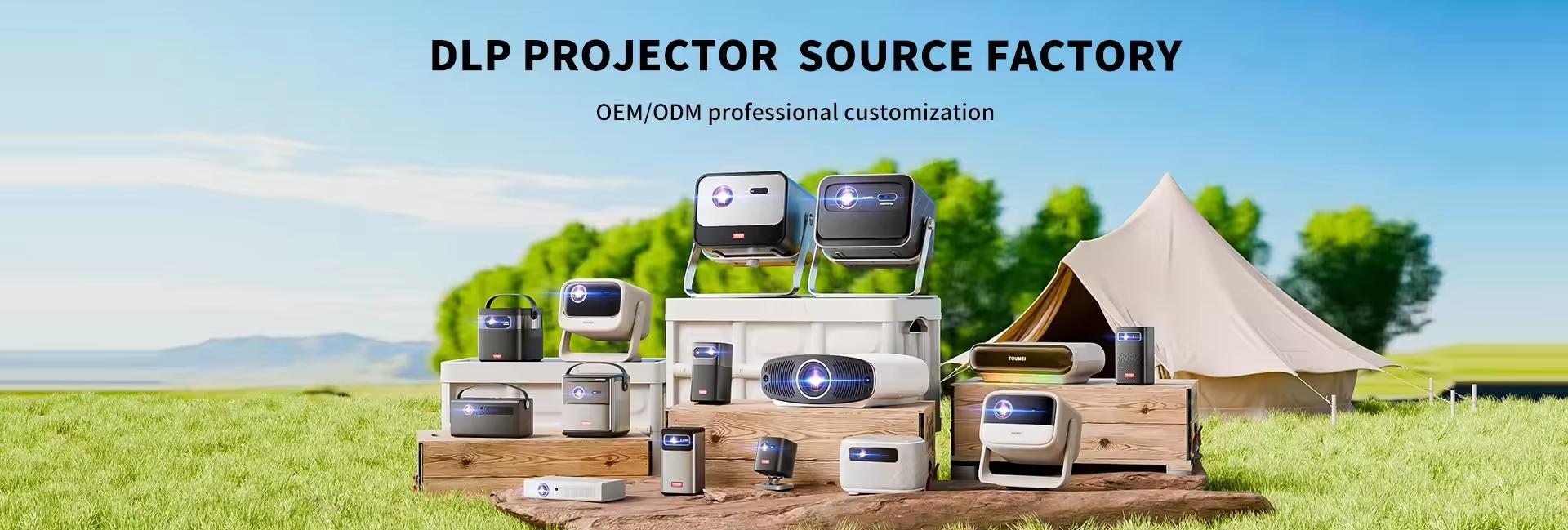
Toumei is positioned differently from the consumer retail brands above. According to its official website, Shenzhen Toumei Technology Co., Ltd. was established in 2013 and focuses on DLP smart projectors, integrating production, sales, and R&D. The site presents Toumei as an OEM manufacturer serving global brands, distributors, and B2B clients, with one-stop support from product design and mass production to global supply. It also highlights 100% quality inspection and multiple projector series aligned with daily-viewing scenarios, including portable C Series, outdoor M Series, 1080p S Series, home-oriented V Series, flagship X Series, and Q Series custom projectors.
Why Toumei matters for international buyers
For international buyers, Toumei’s relevance is not that it is the biggest consumer retail brand; it is that it offers OEM flexibility in the everyday-viewing projector segment. Its website explicitly targets home theater, business, education, outdoor, art and exhibitions, and hospitality applications, while also inviting worldwide partners, distributors, dealers, resellers, and retailers. For importers, private-label brands, and channel buyers who want customizable smart projectors instead of only off-the-shelf retail SKUs, Toumei fills a different role from Epson, BenQ, or XGIMI.

Comparative table: Top 10 brands and representative home projector characteristics (2026 view)
| Brand | Representative line | Core positioning | Best for |
|---|---|---|---|
| Epson | Home Cinema 980 / 1100 | Bright Full HD home entertainment with mainstream brand support | Families, sports, bright rooms (爱普生) |
| BenQ | GP520 | 4K smart family projector with strong auto image adaptation and Google TV | Living rooms, family streaming, easy setup (BenQ) |
| XGIMI | AURA 2 / HORIZON S Max | Smart premium home cinema from UST laser TV to high-brightness 4K home projector | Style-conscious buyers, premium home cinema (XGIMI Official Store US) |
| Nebula | Capsule 3 Laser | Portable 1080p laser projection with battery-powered convenience | Bedrooms, travel, flexible casual viewing (seenebula) |
| JMGO | N1S Pro 4K | Triple-laser 4K smart projector with gimbal design and Google TV | Design-led home viewing, flexible placement (JMGO) |
| Dangbei | DBOX02 (Mars Pro 2) | Bright 4K Google TV laser projector with licensed Netflix and AI setup | Living rooms, mixed day/night viewing (Dangbei) |
| Formovie | Theater Premium | Premium UST 4K laser TV for TV-replacement home setups | UST buyers, premium living rooms (Formovie Global) |
| ViewSonic | PX701-4K / PX749-4K | 4K projector brand with strong gaming specs and good brightness | Gamers, sports fans, value seekers (ViewSonic) |
| Optoma | UHD38x | Bright 4K home entertainment and gaming projector | Console gaming, bright-room projection (Optoma USA) |
| Toumei | C / M / S / V / X / Q Series | OEM smart projector manufacturer for customizable daily-viewing products | Importers, OEM brands, distributors (Toumei Projector) |
How to choose the right home projector brand and model
Define the viewing scenario and ambient light
Start with where and how the projector will be used. A bedroom projector, a living-room TV replacement, an outdoor movie setup, and a gaming projector all require different trade-offs. Epson, ViewSonic, and Optoma emphasize brighter projection for living rooms and lights-on entertainment, while Nebula prioritizes portability and Toumei offers multiple category-based product lines for different use environments.
Prioritize image quality, OS, and streaming convenience
For everyday viewing, picture quality alone is not enough. Buyers should also check whether a projector offers a mature smart TV experience, licensed streaming access, and easy content discovery. BenQ, XGIMI, JMGO, Dangbei, and Formovie all emphasize Google TV or Netflix-ready convenience, which matters a lot more for daily-use projectors than it does for industrial or installation-focused models.
Consider portability and setup convenience
Portable and everyday projectors live or die by ease of setup. Auto focus, auto keystone, obstacle avoidance, screen fit, and integrated stands or gimbals can dramatically improve the real user experience. XGIMI, BenQ, JMGO, Dangbei, and Nebula all make these setup aids central to their value proposition.
Budget and total cost of ownership
Buyers should compare more than headline resolution. Long light-source life, built-in OS quality, speaker quality, warranty, OEM flexibility, and after-sales support can matter as much as raw brightness numbers. This is also where Toumei becomes especially relevant for buyers who are building a private-label or distribution business rather than buying a single retail unit.
Procurement tips for buyers and distributors
Request real-world demos
Do not judge only by a spec sheet. Ask suppliers to show real demo videos in common daily-viewing scenarios such as living rooms, bedrooms, sports viewing, and streaming apps. For brands emphasizing auto image adaptation and ambient-light performance, these real-world demos matter more than marketing images.
Verify streaming certification and localization
For smart projectors, content access can shape customer satisfaction as much as image quality. Confirm whether the projector uses Google TV, supports licensed Netflix, and matches your target region’s content ecosystem. This is particularly important for distributors and OEM buyers building products for export markets.
Negotiate OEM scope, support, and branding clearly
If you are sourcing from a manufacturer rather than buying retail, clarify hardware customization, software localization, packaging, logo application, quality-control procedures, lead times, and after-sales responsibilities before ordering. Toumei explicitly promotes OEM customization, one-stop support, and partnership programs, so these terms should be defined early in any B2B discussion.
Conclusion
There is no single best home projector brand for every buyer. Epson is strong for bright-room practicality; BenQ for balanced family viewing; XGIMI and Formovie for more premium smart home cinema; Nebula for portability; JMGO and Dangbei for all-in-one smart laser projection; ViewSonic and Optoma for gaming-friendly value; and Toumei for OEM, customization, and channel-oriented projector sourcing. The right choice depends on whether your priority is daily streaming convenience, premium picture quality, portability, gaming, or manufacturing flexibility.
For most users, the best daily-viewing projector is a smart model with reliable streaming access, auto setup, and enough brightness for the intended room. Portable users may prefer Nebula or XGIMI portable lines, while living-room buyers may prefer BenQ, Dangbei, Formovie, or Epson depending on budget and room conditions.
Yes. 1080p is still viable for many first-time buyers, portable users, and bright-room family entertainment setups. Brands like Epson and Nebula still position Full HD models as practical everyday solutions, even while 4K becomes more common in mid-range and premium segments.
Because projectors are now expected to function like everyday entertainment devices, not just display hardware. Official product pages from BenQ, XGIMI, JMGO, Dangbei, and Formovie all highlight smart OS integration and streaming convenience as major selling points.
A: Not universally. UST laser projectors such as Formovie Theater Premium or XGIMI AURA 2 are better for fixed living-room cinema setups, while portable projectors such as Nebula Capsule 3 Laser are better for mobility, bedrooms, travel, and occasional use.
Buyers usually choose Toumei for OEM, private label, distribution, and customization needs rather than for pure retail shopping. Toumei’s website positions the company as a one-stop DLP smart projector manufacturer with multiple daily-viewing product lines and partner-oriented support for global B2B customers.