Projection technology has always lived in an interesting space. It is rarely the center of attention, yet when it fails—or simply underperforms—it becomes impossible to ignore. For years, most buying decisions revolved around brightness numbers and resolution labels. Those were easy to compare and easy to justify.
What has changed, especially over the last few years, is that those numbers no longer explain the full experience. In commercial meeting rooms, classrooms, and exhibition spaces, complaints are less about “not bright enough” and more about images that drift, colors that no longer match, or systems that quietly demand more attention than anyone expected.
This is where tri-color laser projection enters the conversation. Not as a flashy upgrade, but as a response to problems people already know too well.
From Lamp Replacement to a Different Way of Thinking About Light
To understand why tri-color laser matters, it helps to look at how projection has evolved in practice, not in marketing timelines.
Lamp-based projectors dominated for decades because they were simple and relatively affordable. Everyone accepted the trade-offs. Lamps aged. Brightness dropped. Colors shifted. Maintenance cycles were built around those assumptions. In many organizations, replacing lamps was simply part of the job.
Single-laser systems were the first real break from that pattern. By replacing the lamp with a laser source—often paired with a phosphor wheel—manufacturers extended usable life and reduced some of the variability. For many commercial environments, this was already a meaningful improvement.
Tri-color laser projection goes further. Instead of improving the lamp model, it removes it entirely and also removes indirect color generation. Red, green, and blue light are produced directly. That difference changes more than just color charts.
Market data reflects this transition. The global laser projection market has grown rapidly, with annual growth rates consistently above 20 percent, driven largely by commercial, education, and enterprise deployments rather than consumer novelty. The demand is not for “better specs,” but for systems that behave predictably year after year.
How Tri-Color Laser Projection Works, Without the Sales Layer
Independent RGB Laser Sources
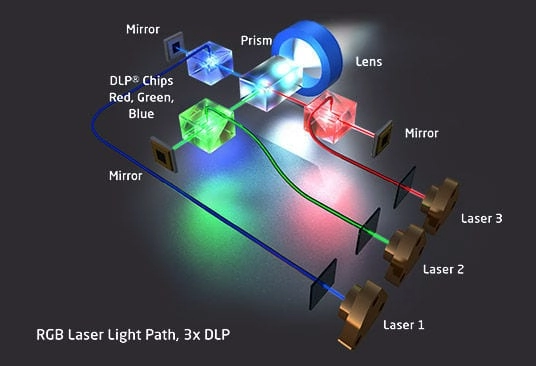
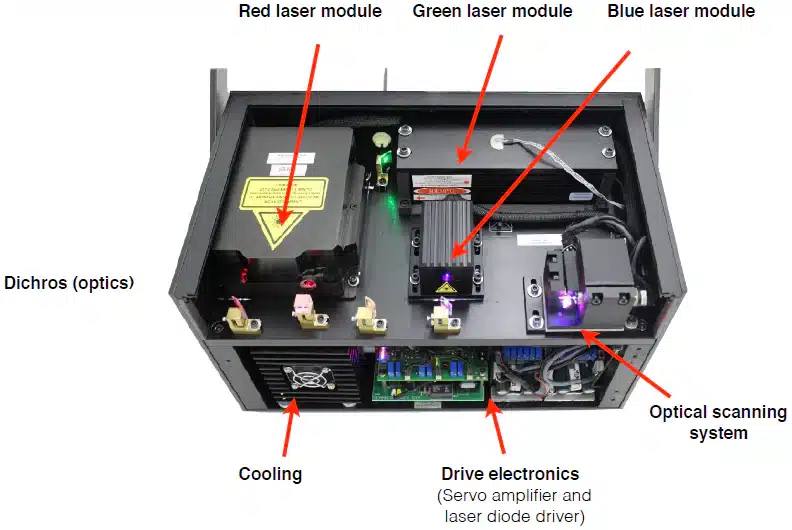
At a technical level, tri-color laser projection is straightforward to describe. Three lasers generate three primary colors. Each laser operates at a narrow wavelength—typically around 650 nm for red, 532 nm for green, and 445 nm for blue.
What matters is not just that these wavelengths exist, but that they are independent. Each channel can be controlled, balanced, and calibrated without relying on filters or phosphor conversion. That independence is the foundation for everything else the system can do.
This approach aligns with findings in optical engineering research. Studies published in Optics Express and similar journals have shown that narrow-spectrum primaries allow display systems to achieve wider color gamuts and higher color volume than broadband sources, assuming the optical system is properly designed.
Optical Combination and Image Formation
Once generated, the three laser beams are combined through a precision optical system. In DLP-based architectures, which are common in professional projection, the combined light is modulated by a digital micromirror device that forms the image pixel by pixel.
The absence of color wheels simplifies the system. Fewer moving parts means fewer mechanical failure points. Over long duty cycles, especially in environments where projectors run eight or ten hours a day, that simplicity becomes noticeable.
Why Spectral Purity Is Not Just a Lab Metric
Laser light is spectrally narrow. That phrase appears often in technical literature, but its practical meaning is sometimes overlooked.
With lamps or phosphor systems, a significant amount of light energy exists outside the target color bands and must be filtered or converted. That process introduces inefficiency and variability. Tri-color laser systems avoid much of that loss.
Research in the Journal of the Society for Information Display has explored how RGB laser systems can approach or exceed BT.2020 color space coverage under controlled conditions. For commercial users, the takeaway is simpler: the system wastes less light and has more headroom to maintain color accuracy over time.
Comparing Tri-Color Laser with Established Projection Technologies
Lamp-Based Projection in Long-Term Use
Lamp projectors are well understood, and that familiarity is part of their appeal. Initial brightness is often strong. Over time, however, performance changes.
Engineering studies published through IEEE have documented that high-pressure discharge lamps experience significant luminous decay before reaching rated end-of-life. In real installations, this translates into gradual dimming and color imbalance.
In single-room setups, this may go unnoticed for a while. In multi-room or campus-wide deployments, inconsistencies become obvious. Someone eventually asks why one room looks worse than another.
Tri-color laser systems do not eliminate aging entirely, but they change its shape. Laser output declines slowly and predictably. That predictability simplifies maintenance planning and reduces surprise adjustments.
Single-Laser Systems as a Transitional Solution
Single-laser projectors, usually based on blue lasers and phosphor conversion, solved many lamp-related issues. They extended lifespan and reduced maintenance frequency.
However, phosphor-based color generation still introduces constraints. Color gamut is wider than lamp systems but narrower than true RGB laser. Over time, phosphor aging can affect color balance.
Tri-color laser projection removes that dependency. Each primary color is generated directly, which reduces long-term drift when the system is properly engineered.
Advantages That Matter Outside the Spec Sheet
Color Accuracy and Gamut in Practice
Tri-color laser systems are often described as covering more than 100 percent of BT.2020 color space. That number matters most in applications where color accuracy is part of the outcome.
Color science research, including CIE standards, shows that under controlled conditions, viewers can perceive relatively small color differences. In simulation, visualization, and branded environments, these differences influence trust and decision-making.
Lifespan and Operational Rhythm
Laser light sources are commonly rated for 20,000 to 25,000 hours. At typical daily usage, that translates into many years of operation without replacement.
What matters just as much is how performance behaves during that time. Instead of planning around lamp swaps, organizations can focus on calibration schedules and content updates.
Energy Efficiency at Scale
Solid-state lighting research consistently reports energy efficiency improvements of 30 to 50 percent over traditional lamps. In small installations, this may seem to be minor. In large deployments, it becomes a budget line worth tracking.
Energy efficiency also aligns with broader sustainability goals that many organizations now treat as operational requirements rather than optional initiatives.
Ultra Short Throw and Usability
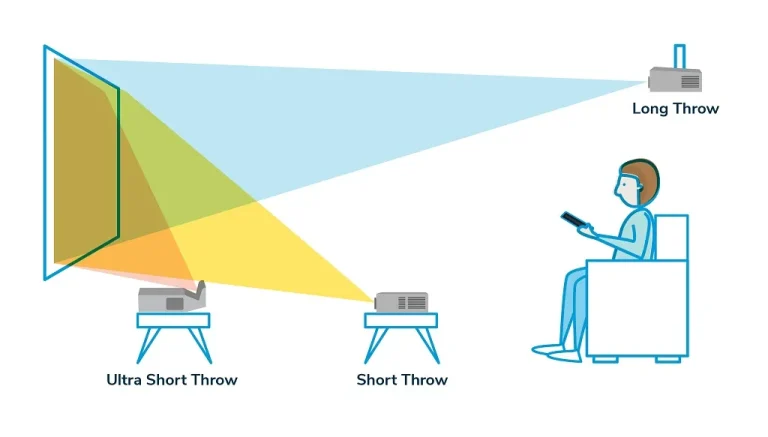
Tri-color laser projection is often paired with ultra-short-throw optics. By placing the projector close to the screen, shadows and glare are reduced.
In classrooms and training rooms, this improves usability. In business settings, it reduces setup friction and improves presentation flow.
Integration with Digital Workflows
Modern projection systems are expected to integrate with networks, wireless presentation tools, and smart operating systems. Tri-color laser projectors are often designed with this environment in mind, functioning as part of a larger collaboration ecosystem rather than isolated devices.
Where Tri-Color Laser Projection Is Being Deployed
Education and Training
Projection remains relevant in education because it scales information efficiently. Tri-color laser systems add stable brightness and eye-friendly reflected light.
Institutions benefit from reduced maintenance overhead and consistent image quality across long academic terms.
Business and Corporate Environments
The meeting room requires a display that can function properly under mixed lighting conditions and is durable. Tri-color laser projection provides brightness stability and color consistency for presentations, data visualization, and branded content.
Home Theater and Entertainment
In premium home installations, long-term consistency matters as much as peak performance. Tri-color laser projection supports cinematic color while eliminating lamp replacement cycles.
Commercial Display and Exhibitions
Museums, retail environments, and large events rely on visual impact and reliability. Tri-color laser systems support continuous operation with minimal intervention.
Market Direction and Industry Signals
The development of tricolor laser projection technology aligns with some broader trends: higher resolution of content, mixed working environments, and expectations in sustainability.
Currently, the Asia-Pacific region holds the largest share in the deployment of laser projection equipment, mainly due to educational and commercial demands. The North American region also shows strong growth momentum as companies are replacing their outdated infrastructure.
Future developments may focus on higher resolution, more compact systems, and deeper integration with immersive technologies.
About Shenzhen Toumei Technology Co., Ltd.
Shenzhen Toumei Technology Co., Ltd., founded in 2013 and headquartered in Shenzhen, focuses on DLP projection and imaging technologies. The company integrates research, manufacturing, and global sales, supporting both standard projector products and OEM/ODM solutions.
According to its corporate profile, Toumei provides customization across optical design, hardware and software development, structural engineering, tooling, assembly, and testing. This integrated capability supports a wide range of commercial, educational, and enterprise applications.
Conclusion
The tri-color laser projection is not merely an upgrade in appearance. It addresses the fundamental issues existing in the generation, control and maintenance of projected images.
For organizations that are evaluating long-term investment in display equipment, this technology has improved in terms of color accuracy, operational stability, energy efficiency and overall cost of ownership. As its application becomes more widespread and costs decrease, tri-color laser projection is gradually becoming the standard configuration in professional display environments, rather than an isolated exception.