Procurement groups sourcing for conference suites, corporate training rooms, hotel lobby networks, or exhibition halls run into the identical set of compromises time after time. Lamp-driven projectors force replacements every 2,000–4,000 hours under bright-output settings, with noticeable dimming as usage accumulates and gradual shifts in color temperature that require ongoing tweaks. Single-laser phosphor configurations extend source life closer to 20,000 hours, yet they cap gamut frequently below 80% BT.2020, preserve rainbow flashing risks in single-chip DLP architectures, and show white-balance drift in rooms with any ambient contribution. Those realities surface in maintenance records as added recalibrations, unexpected outages during peak periods, and compressed replacement timelines—line items that volume buyers scrutinize in detailed lifecycle spreadsheets. Moving toward 2026, three-color laser light source technology—commonly labeled triple laser or RGB laser—has moved from select premium territory into the prevailing standard for high-end projectors. Separate red, green, and blue diodes combine output directly, skipping conversion intermediaries, to yield expanded color reproduction, uniform performance across long runtimes, and substantially reduced routine service. Shenzhen Toumei Technology Co., Ltd. develops DLP platforms that integrate smoothly with these progressing light-source approaches, enabling the company to furnish project-specific configurations that satisfy current expectations in commercial and professional applications.
The Limitations of Traditional Light Sources – Why Change Was Necessary
Lamp-based projectors hold up reasonably in fully darkened environments, yet commercial venues almost always contend with spill from windows, corridors, or overhead lighting that dilutes contrast and saturates blacks. Bulb degradation accelerates under near-continuous operation—common in hospitality signage or classroom schedules—shortening effective intervals and increasing replacement frequency. Color temperature wanders warmer or cooler with accumulated hours, necessitating periodic adjustments that break workflow in ongoing displays.
Single-laser phosphor arrangements remove the bulb variable but inherit conversion inefficiencies at the wheel. Significant energy dissipates during yellow generation, restricting usable lumens and confining gamut to NTSC 80–90% in typical executions. Rainbow effect endures in single-chip DLP implementations, manifesting as transient color streaks on fast-scrolling content or dynamic camera work in training sequences and corporate decks.
Hybrid LED-laser variants attempt to strike a cost-performance balance, though sequential color sequencing continues to risk subtle motion artifacts. Deployment experience indicates recalibration cycles every 6–9 months in average commercial settings, compounded by dust accumulation around the wheel that elevates fan speeds and audible levels progressively.
Field data consistently records 20–35% brightness attenuation within the initial 10,000 hours for conventional light paths. For organizations purchasing in batches, this trajectory drives elevated service agreements and more frequent budget reallocations.
What Is Three-Color (RGB) Laser Technology? Core Working Principle
Three-color laser depends on discrete red, green, and blue laser diodes producing narrowband primaries at fixed wavelengths. Precision optics merge the beams prior to the imaging engine, creating the full visible spectrum absent any mechanical color-separation component.
Within DLP projectors, this merged illumination strikes the micromirror device directly, permitting granular per-pixel modulation of intensity and chromaticity. Optical efficiency climbs noticeably—frequently 20–35% above phosphor-mediated routes—facilitating tighter control over gradients and dynamic range.
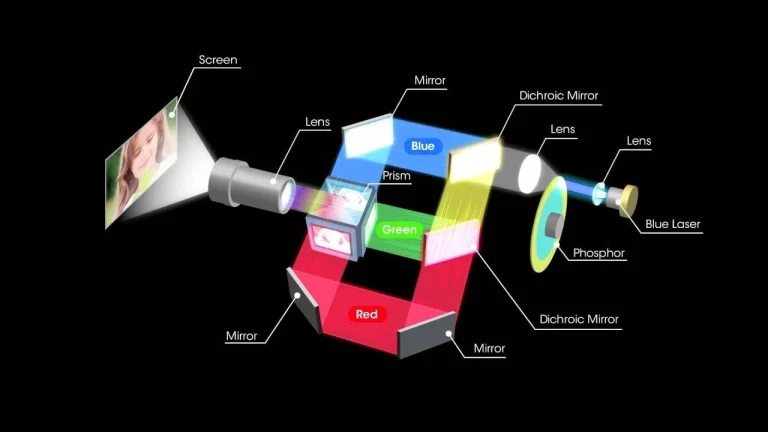
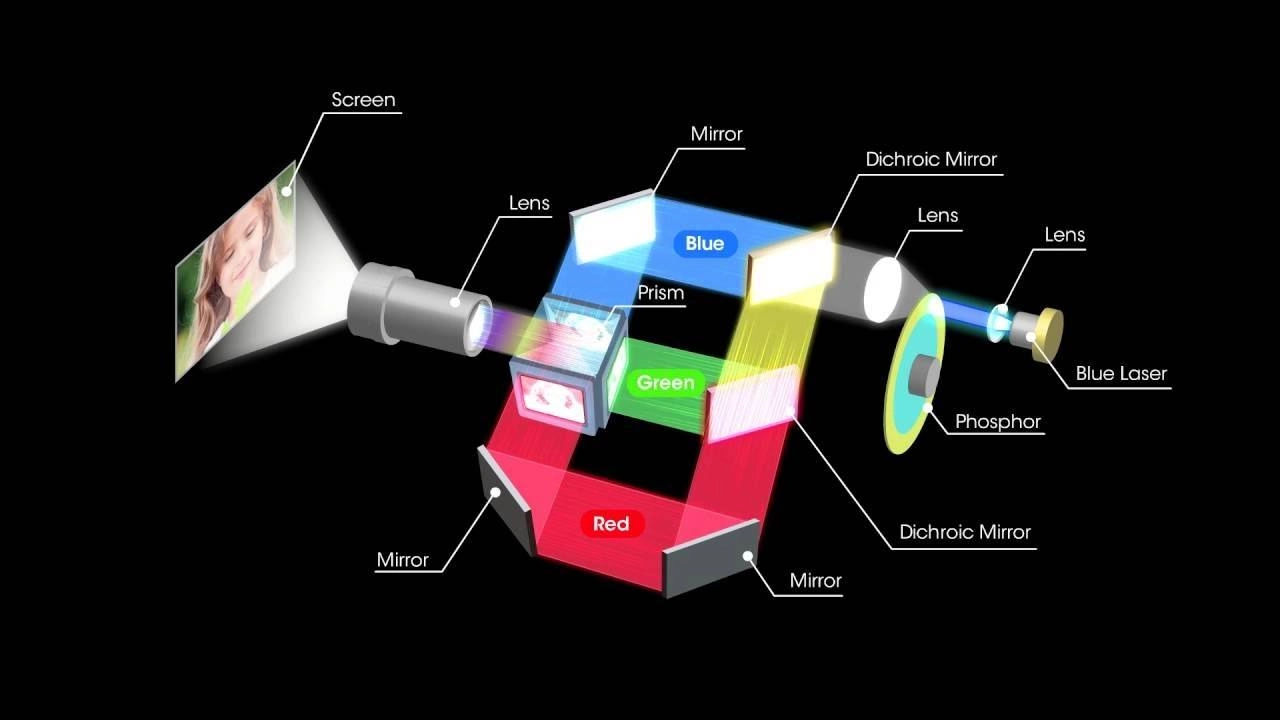
This pathway diverges sharply from single-laser architectures, in which blue emission stimulates a phosphor to yield broad yellow, subsequently partitioned into red and green through dichroic filters. Three-color bypasses the intermediary conversion entirely, retaining primaries nearer theoretical optima and curtailing transmission losses.
Key Advantages of Three-Color Laser – Why It Dominates High-End Now
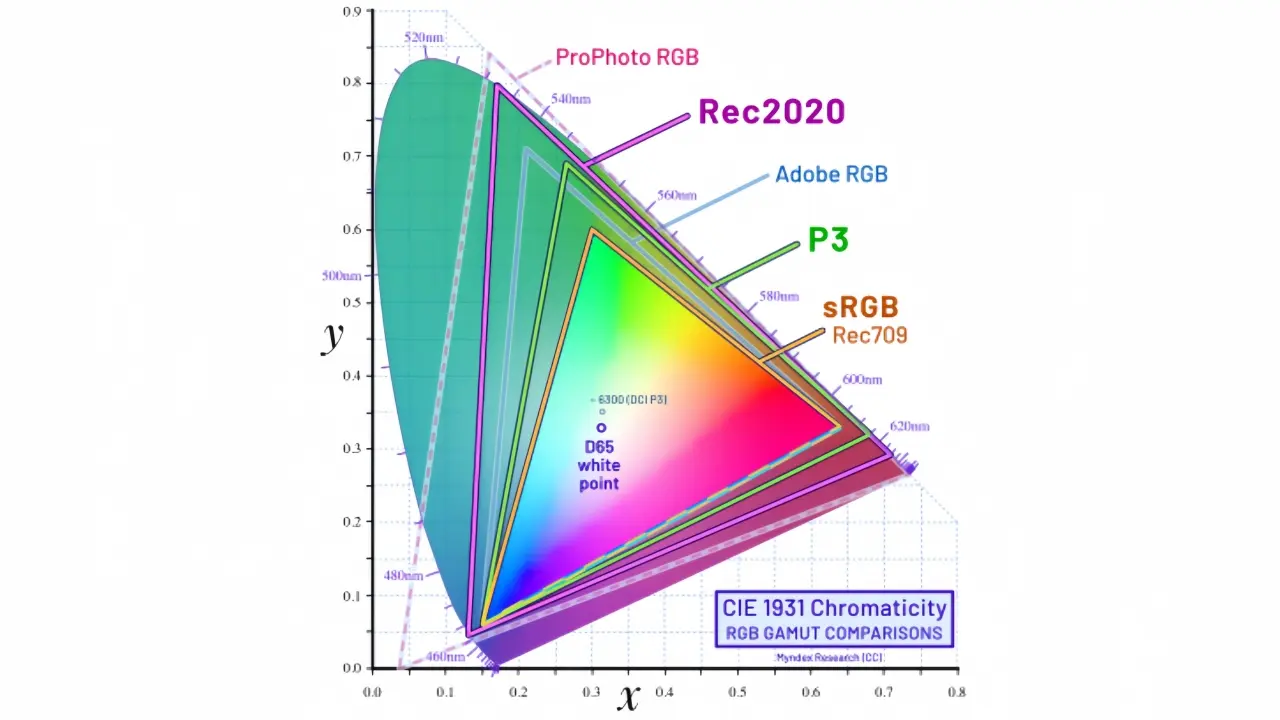
Gamut coverage widens considerably. Implementations regularly achieve or exceed 100% BT.2020, well beyond the 70–85% ceiling common in single-laser projectors. Richer reds, more saturated greens, and natural flesh tones appear without forced enhancement, proving essential for brand-accurate video playback in corporate environments or precise schematic rendering in technical instruction.
Output brightness sustains across the operational window. Diode degradation stays below 10% after 20,000 hours in field reports, preserving legibility in spaces with daylight intrusion or artificial overhead sources typical of offices and public areas.
Rainbow phenomena cease altogether. Elimination of the rotating wheel yields seamless motion rendering on high-speed footage—sports highlights, data visualizations, or simulation sequences—free of perceptible flashes.
Service life reaches 25,000–30,000 hours while color and luminance remain uniform. Cost models for procurement demonstrate lower cumulative replacement and intervention expenses relative to wheel-dependent systems.
Thermal and acoustic profiles improve since cooling targets diode junctions rather than mechanical rotation. Reduced fan demand aligns with acoustic requirements in meeting spaces or lecture theaters where background noise interferes with dialogue.
HDR capability advances through enhanced modulation range. Specular highlights separate distinctly while shadow regions preserve nuance, elevating clarity in variable-illumination presentations or display applications.
Triple Laser vs Single/Phosphor Laser – Head-to-Head Comparison for Buyers
Single-laser phosphor projectors supply competitive lumens at reduced acquisition costs, though they forfeit gamut breadth and carry residual rainbow susceptibility in single-chip configurations. Three-color trades some initial price advantage for pristine primaries and complete absence of moving-part degradation in the color generation stage.
Direct comparisons reveal triple laser upholding white-point stability farther into service life, circumventing the progressive tint variations phosphor wheels display beyond 8,000–10,000 hours. Contemporary speckle mitigation confines diffraction effects below visibility thresholds at conventional seating distances.
Projects necessitating exact chromatic matching—merchandise visualization in retail, reference imaging in professional fields, or consistent signage branding—derive the greatest incremental benefit from the added fidelity. Single-laser retains relevance for budget-constrained mid-market placements, whereas high-end sourcing gravitates toward the enduring uniformity triple laser affords over extended ownership periods.
Real-World Applications: Where Three-Color Laser Delivers Maximum Value
Conference facilities realize gains from dependable, high-fidelity imagery through marathon sessions. Incidental daylight ceases to mute content, and restrained acoustic output integrates cleanly with audio reinforcement.
Training and educational venues profit from faithful reproduction of complex illustrations or procedural simulations. Chromatic precision supports comprehension across prolonged curricula without intervening adjustments.
Hospitality display networks in entryways, hallways, or function areas deliver consistent appearance irrespective of operational hours. Visual impact endures amid fluctuating occupancy and illumination.
Museum and trade-show exhibits convey artifacts or explanatory media with near-theatrical nuance. Expanded gamut uncovers subtle gradations in detailed stills or animated sequences.
Interactive corporate demonstrations or modeling applications capitalize on fluid, low-latency response for participatory exercises or collaborative reviews.
How to Choose a Reliable Three-Color Laser Projector in 2026 – Actionable Buying Guide
Ascertain deployment of independent RGB laser diodes exclusive of phosphor supplementation or hybrid blending. Technical literature must articulate clear three-color delivery.
Demand documented gamut metrics—targeting no less than 95% BT.2020 or complete DCI-P3—coupled with Delta E figures under 2 for immediate usability.
Scrutinize brightness claims against ANSI or CVIA methodologies, pursuing 2,000+ lumens to accommodate prevalent commercial lighting profiles.
Inspect latency and refresh specifications for content involving movement. Values below 15 ms accommodate responsive interaction or dynamic elements.
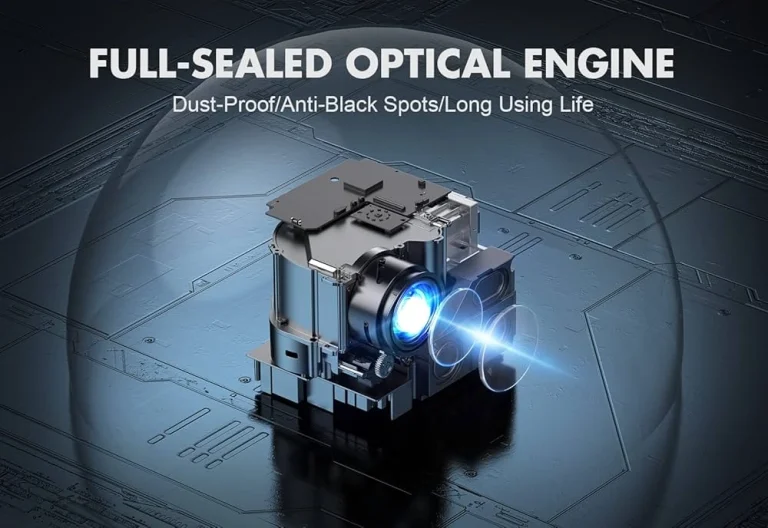
Favor platforms featuring advanced dissipation—sealed compartments or liquid support—to uphold stability during extended duty cycles. Discount offerings lacking explicit speckle-control validation.
Providers equipped for small-lot customization and wholesale modification furnish added leverage for installations requiring unique optics, connectivity arrays, or output tuning.
Shenzhen Toumei Technology Co., Ltd. – Expert in Custom DLP Projection Solutions
Shenzhen Toumei Technology Co., Ltd., established in 2013 and operating from Shenzhen, China, dedicates resources to DLP smart projection centered on Texas Instruments micromirror technology. The organization integrates research, production, and distribution, maintaining captive lines that exceed 20,000 units per month. Accumulation of over 50 patents traces sustained development in optical systems, firmware, and mechanical design.
Toumei furnishes bespoke projector solutions to worldwide brands, channel partners, and enterprise clients via end-to-end OEM engagement encompassing optical architecture, enclosure engineering, and validation protocols. Quality oversight incorporates complete-unit verification, environmental conformance, and disciplined production controls.
The assortment encompasses battery-supported portables, elevated-lumen smart models incorporating Android or Google TV frameworks, ultra-short throw variants, and forthcoming laser-augmented series. Configurations accommodate home viewing, business collaboration, instructional settings, and commercial presentation demands. Certified as a national high-tech entity with accredited quality framework, Toumei concentrates on robust, adaptable DLP projectors oriented toward enduring client relationships.
Conclusion
Three-color laser technology has advanced from supplementary feature to dominant architecture in high-end projectors by systematically resolving entrenched constraints in gamut extent, output constancy, and service burden. Within professional and commercial sourcing contexts, where image predictability and intervention frequency shape economic outcomes, this methodology curtails lifetime expenditure while elevating achievable standards. Acquisition specialists pursuing dependable performance under rigorous conditions recognize triple laser configurations as a pragmatic, future-aligned selection. Shenzhen Toumei Technology Co., Ltd. equips these objectives with versatile DLP foundations engineered for practical adaptation and sustained field endurance.