If you’ve been around projector rollouts for a while, you already know the uncomfortable truth: the decisions that matter most usually don’t show up in the first demo. The image looks great on day one. Everyone signs off. Then real life starts—long duty cycles, mixed lighting, dusty venues, rushed setups, different operators, and the slow creep of “Why does this room look dimmer than the other one?”
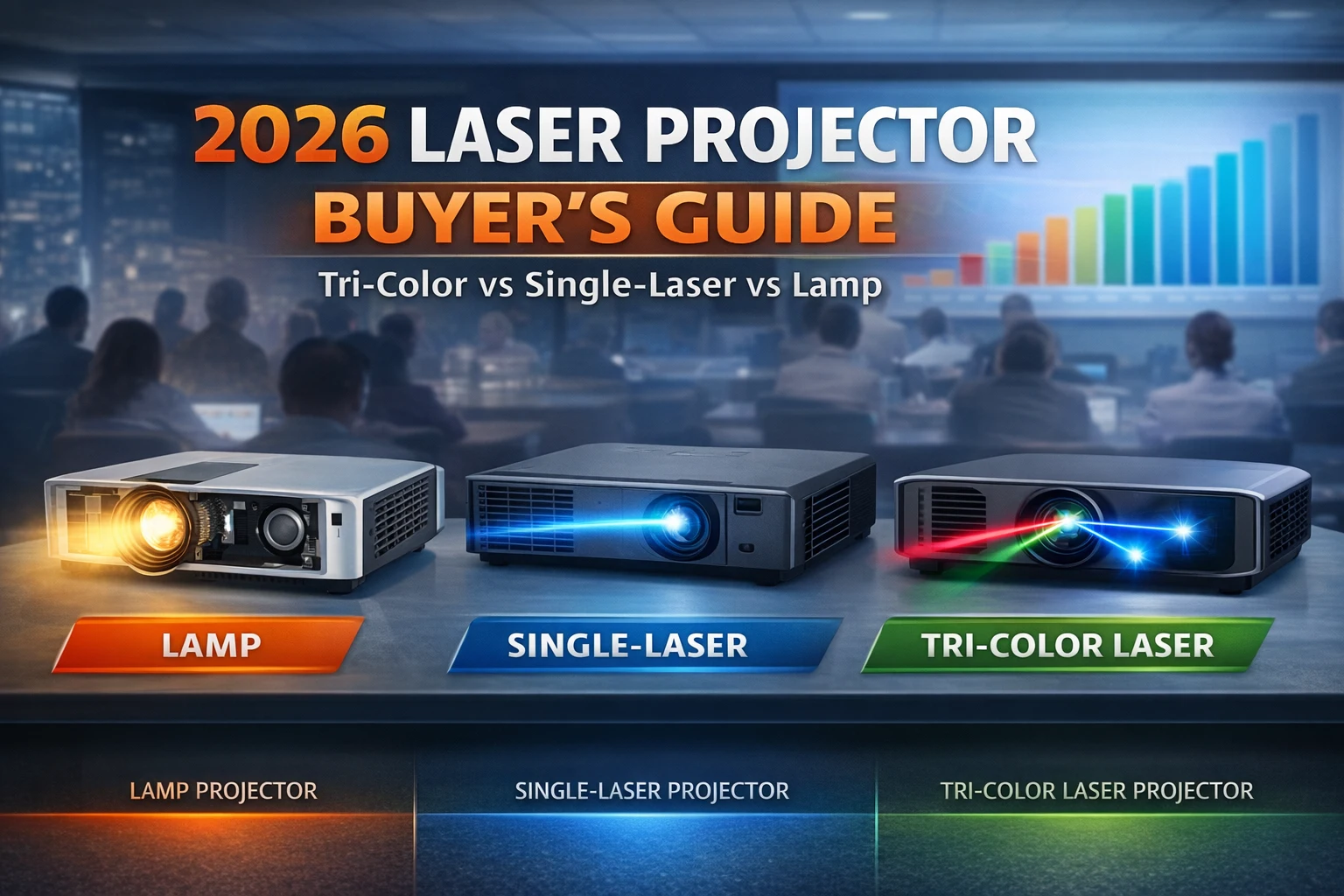
By 2026, that’s why more buyers treat the light source as a long-term operational decision, not a feature. Laser projection isn’t “new” anymore; it’s mainstream in commercial planning discussions. The real debate is inside laser: tri-color (RGB) laser vs single-laser. And for some budget-driven installs, lamp is still in the mix, especially where usage hours are low or replacement logistics are easy.
This article is a technical buyer’s guide, but it’s written in the language people actually use in enterprise purchasing meetings—what breaks, what drifts, what costs real money later, and what you can do up front to prevent it.
What Changed by 2026: Buyers Now Ask About Stability, Not Just Specs
The old buying pattern was simple: compare lumens, resolution, price, and ship. That still happens in consumer channels, but commercial work has shifted. A projector in a training center, hotel ballroom, or campus classroom is an appliance, not a toy. People want predictable performance and a predictable maintenance story.
That’s where laser has an unfair advantage. Not because it’s magic, but because it reduces the number of variables you’re babysitting. When the light source is stable over long hours, everything else becomes easier: calibration intervals stretch out, multi-room consistency is achievable, and you’re not scheduling lamp swaps around critical events.
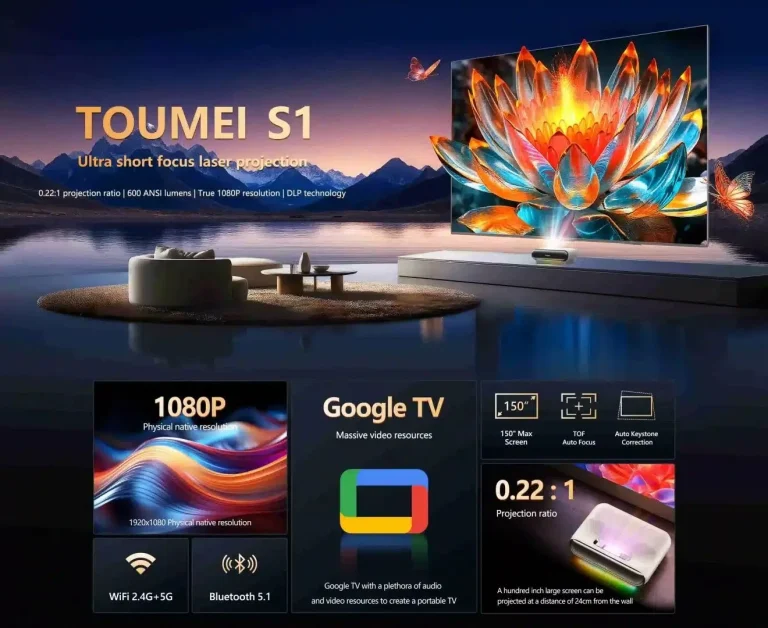
Toumei’s product ecosystem—spanning portable DLP smart projectors and higher-output models—maps cleanly to that reality because many deployments are not purely “home theater.” They’re hybrid use: conference rooms that turn into training rooms, hospitality spaces that run daily content, and integrator projects that need consistent behavior, reliable autofocus/keystone, and a supplier who can support OEM/ODM requirements at scale.
Lamp-Based Projectors: Not Dead, Just Harder to Justify in High-Use Commercial Spaces
What Lamp Aging Looks Like in the Field
Lamp projectors are familiar, and that’s their appeal. The operational pattern is also familiar: bright at the start, then gradually dimmer, then a replacement cycle that becomes part of the operating routine.
What catches people off guard is how early meaningful depreciation can affect outcomes. Lighting engineering literature has long treated “mean lumens” as the relevant design metric rather than initial output, because conventional sources lose flux over life and the practical question is what you get after substantial runtime. A U.S. national-lab report on lumen maintenance and light-loss factors discusses how mean lumens are typically considered at a fraction of rated life for conventional sources, precisely because output declines over time rather than remaining constant.
Translate that into projection: if you’re building a campus-wide classroom standard, the “first-week brightness” doesn’t matter as much as what the rooms look like after months of daily use. Multi-room consistency becomes a project-management issue. Operators compensate by dimming lights, bumping brightness settings, or changing screen choices. Those aren’t catastrophic problems, but they create friction, and friction scales badly.
Where Lamp Still Makes Business Sense
There are still real cases where lamp-based projection is reasonable. If a projector is used a few hours per week, or the environment makes replacements simple and low-cost, then the math can still work. Some procurement teams also have established lamp supply chains and prefer the known pattern.
The trouble starts when lamp is used like a fixed infrastructure display—daily operation, high uptime expectations, and multiple rooms where consistency matters. In those installs, lamp doesn’t usually “fail,” it just quietly becomes the thing that keeps the AV team busy.
Laser Projection: The Big Advantage Is Fewer Surprises
Why Laser Feels Different After Year One
Laser systems age differently from discharge lamps. With solid-state sources, the depreciation curve is typically slower and more predictable when thermal design is handled correctly. That predictability is why laser becomes attractive to enterprise buyers even before you talk about color gamut.
You don’t need to treat this as a black box. Laser diode lifetime modeling has been widely discussed in engineering contexts; for example, an industry application note on estimating laser diode lifetime explains how accelerated testing and temperature-based models are used to predict long-term performance under normal operating conditions. While that document targets laser diodes broadly, the underlying point matches what project teams care about: properly engineered systems can forecast lifetime behavior and design around it, rather than treating light-source replacement as routine.
Laser vs Lamp in Operational Language
If you’re a commercial buyer, the practical translation is straightforward.
When you choose lamp, you’re implicitly accepting a recurring service cycle and performance drift that becomes visible in high-use environments.
When you choose laser, you’re buying stability. That stability shows up in fewer emergency calls, fewer “why is this room worse than that room” conversations, and fewer planned downtime windows.
This is also where the topic shifts from technology to procurement strategy. If you’re sourcing for distribution or brand programs, the operating profile matters as much as the bill of materials, and that’s where an OEM/ODM partner with mature integration capability becomes part of the decision, not an afterthought. Toumei positions itself as a projector-focused OEM/ODM manufacturer offering customization across optical engine structure, motherboard/OS selection, industrial design, and configuration options, which matters for B2B programs where standard retail SKUs are rarely a perfect fit.
Single-Laser vs Tri-Color Laser: The Decision Most Buyers Get Wrong at First
Single-Laser: Why It Became the Commercial Default
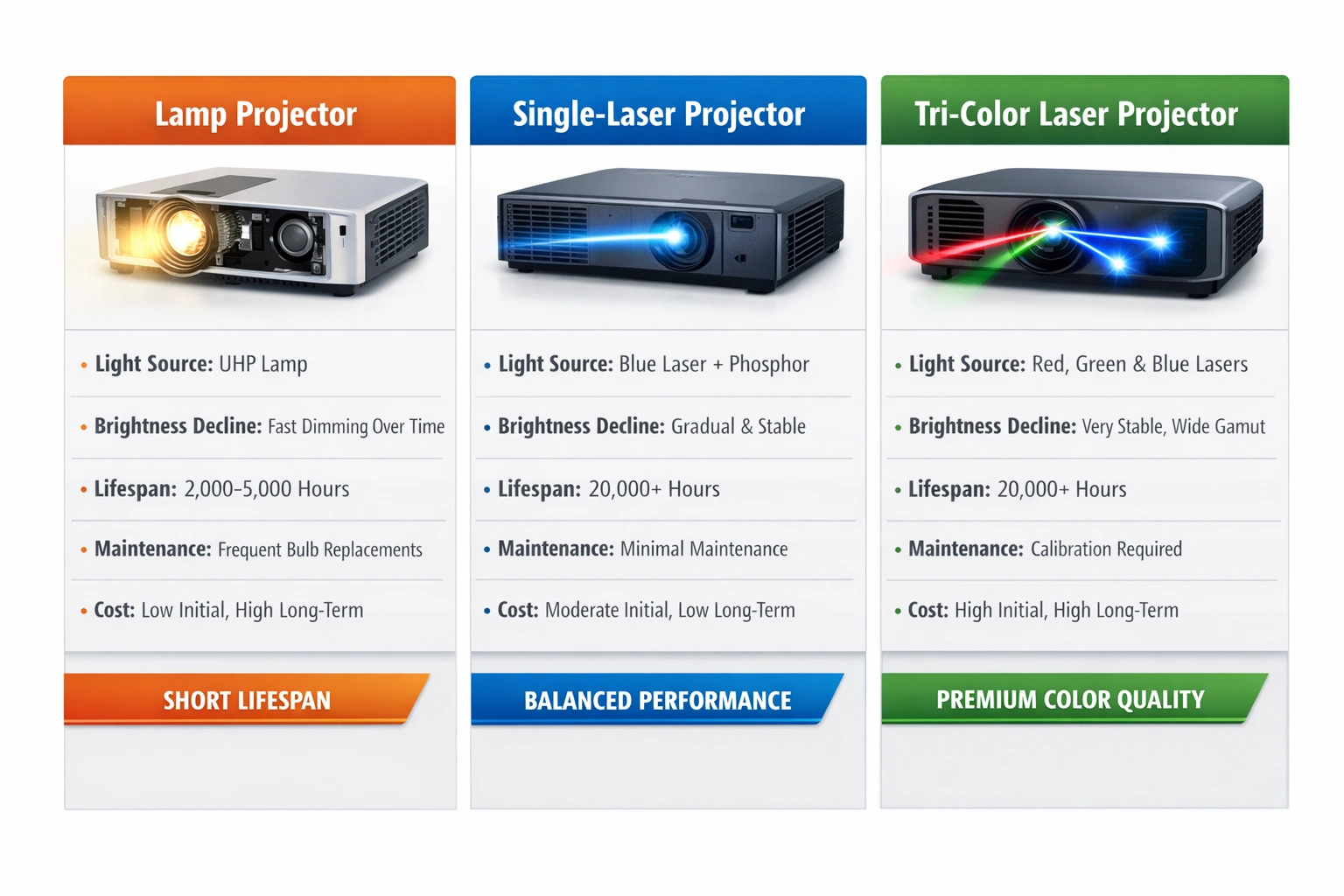
Most commercial “single-laser” architectures use a blue laser source with phosphor conversion to generate a broad spectrum, then the optical system forms the final RGB image. Buyers like this approach because it hits a sweet spot: strong brightness efficiency, stable long-life behavior, and a cost point that scales across multiple rooms or locations.
In a conference room, a training center, a hotel meeting space, or a campus classroom, this approach is often enough. Not because it’s perfect, but because it’s robust. It tolerates varied content, less-than-ideal lighting, and long duty cycles without demanding constant calibration attention.
If you’re writing a purchase spec for “commercial laser projector for conference room” deployments, single-laser typically wins unless you have a clear reason to pay for more color capability.
Tri-Color (RGB) Laser: When Color Is Not a Detail
Tri-color laser uses dedicated red, green, and blue laser primaries. The reason people pay for that is color capability—more saturated primaries, potentially wider gamut coverage, and strong color volume when the pipeline is handled correctly.
The best way to understand whether that matters is to ask a blunt question: is color accuracy part of the business outcome?
If you’re running brand-critical visuals in a showroom, displaying artwork in an exhibition environment, or producing immersive content where subtle gradients are the point, then yes—color is a deliverable, not decoration. In those scenarios, tri-color laser isn’t “overkill,” it’s the tool that makes the project look like it was funded properly.
There’s also published display research focused on RGB laser color capability. A 2024 Society for Information Display paper discusses the measurement and evaluation of color capability in RGB laser displays, including gamut and accuracy considerations in narrow-spectrum primary systems. It’s technical, but the commercial takeaway is simple: RGB laser can deliver distinctive color performance, and it needs to be measured and managed as a system, not assumed from a single spec line.
The Trap: Paying for RGB Laser When the Room Can’t Use It
Here’s the trap that shows up in real projects: teams buy tri-color laser for “best quality,” then deploy it in a bright room with uncontrolled lighting, cheap surfaces, and content that’s mostly slides and spreadsheets. In that environment, the premium you paid for color capability does not deliver proportional value. Brightness consistency and contrast management would have moved the needle more.
That’s why the best “single laser vs RGB laser projector” decisions are made by starting with the environment and content, then choosing the light source, not the other way around.
Brightness, Contrast, and Human Perception: Why Specs Don’t Settle the Argument
Brightness Is a Requirement, Not a Guarantee of Quality
ANSI lumens matter. Nobody is arguing that. But in commercial work, brightness is usually a threshold requirement rather than a differentiator.
Once you meet the threshold for the room’s ambient conditions and screen size, the next gains often come from stability and contrast behavior. That’s why some single-laser systems feel “better” than their specs suggest in real offices—they maintain usable output and consistent balance across time, which is what users notice.
Color Difference and What Viewers Actually See
People often throw around statements like “nobody notices color drift,” and that’s only true until the content becomes important enough. Color science literature treats small color differences as perceptible under certain conditions, and discussions around Delta E frequently reference the concept of a just noticeable difference (JND). Industry references on Delta E explain that small ΔE values can correspond to perceptible differences depending on conditions and the evaluation formula used.
You don’t need to turn your projector procurement into a lab experiment, but you should recognize that in controlled environments—especially exhibitions and branded installations—viewers absolutely notice when whites are inconsistent, skin tones shift, or matched visuals no longer match.
The Part Procurement Teams Care About: Total Cost of Ownership Over Five Years
Why “Cheap Now” Often Becomes “Expensive Later”
A lamp-based projector can be cheaper upfront. That’s obvious. The bigger question is how that decision behaves over time.
Over a five-year horizon, lamp systems typically carry recurring consumable cost, labor cost, and performance variability. Even if you negotiate favorable lamp pricing, the operational overhead adds up—especially when you scale to dozens or hundreds of units.
Laser systems push more cost into the initial purchase, then reduce the recurring cycle. That shift is why many enterprise buyers see laser as a financial simplification, not just a technical upgrade. It’s easier to forecast.
The Hidden Cost: Downtime and Credibility
Downtime is rarely a line item on a purchase order, but it’s a real cost. A conference room that “sometimes looks dim” loses trust. An event space with inconsistent projection becomes a reputational issue. In a museum or exhibition environment, a visual failure is a customer experience failure.
This is the part of the discussion where “laser projector total cost of ownership” becomes a leadership-level topic. If the system is part of revenue generation, education delivery, or brand experience, you don’t want a consumable-driven performance curve. You want stability.
Where Toumei Products Fit: Embedding the Technical Story Into Specific Pages
You asked for a content loop that connects the technical explanation directly to Toumei’s product pages. The key is accuracy: we only state what Toumei’s pages state, and we use the product examples to illustrate decision logic rather than claiming every model is a laser light source.
When the Requirement Is Higher Output for Business Use
For buyers looking at a laser projector for business use in higher-brightness categories, the purchasing conversation usually includes brightness stability, performance consistency, and smart features that reduce setup time.
Toumei’s X Series is positioned as a flagship line on the product listing, and the Toumei X5 Android DLP Projector is described with a 1080P resolution, Android system, and a listed brightness value (1600 ANSI on the product page) along with 0.47-inch DMD and integrated audio. This is a relevant anchor page for “business-ready DLP smart projector” inquiries, especially when buyers care about a stable smart OS, app capability, and repeatable deployment features.
In a blog-to-product loop, the technical paragraph that discusses why stable operating behavior matters in meeting rooms can naturally point to X5 as an example of an enterprise-friendly smart DLP configuration, without claiming it is tri-color laser or single-laser unless the product page states that explicitly.
When the Buyer Needs Fast Setup Behavior in Multi-Use Spaces
One recurring reason commercial teams switch vendors is not image quality, but setup time and consistency. Auto focus, keystone correction, and quick alignment matter in spaces where the projector is moved, or where different people use the same room.
The Toumei S8 Outdoor DLP Projector and related S-series models are listed with TOF laser focus and 1080P resolution on the product listing page. In content, that becomes a practical discussion: even if the light source decision is lamp vs laser, the operational friction often comes from setup, and TOF-based focusing can reduce variability across users.
This is a useful internal-link strategy because the reader who came for “tri-color vs single-laser vs lamp” may still be evaluating a projector program where setup features are part of the deployment risk.
When the Buyer Wants a DLP Smart Projector With a Clear Spec Baseline
The product listing also highlights models such as Toumei X6 DLP Smart Projector, Toumei V6 Portable DLP Projector, and Toumei Q7 Smart DLP Projector, each with basic platform indicators like OS, memory, throw ratio, and autofocus references. These pages serve as clean internal-link targets when the reader is moving from conceptual understanding to SKU comparison inside one supplier ecosystem.
Again, the blog’s job is not to force every model into the laser-light-source narrative, but to guide the reader toward the right decision framework and then let the product pages carry the exact specification details.
When the Real Project Is OEM/ODM, Not One-Off Purchasing
A significant portion of B2B demand is not a one-time purchase. It’s a program: distribution, brand launch, hospitality rollouts, education procurement, or a custom enclosure and firmware behavior for a systems integrator.
Toumei’s OEM/ODM projector page is directly relevant here because it describes contract manufacturing and customization options across optical engine structure, motherboard/OS choice, configuration, and deployment applications like business meetings, education, and exhibitions. In a long-form buyer’s guide, this is where you link readers who are beyond retail shopping and into supplier qualification mode.
If you want inquiry volume, this internal link is not optional. It’s the “handoff” point for B-end readers who are thinking about scale, margin, certification, and deliverability.
Technical Depth Where It Helps: Why RGB Laser Systems Need System-Level Thinking
A common misconception is that tri-color laser automatically guarantees “best image.” In practice, narrow-spectrum primaries can create their own challenges if measurement and content handling are sloppy. That’s why serious display research doesn’t just celebrate wide gamut; it talks about metrology and human-factor considerations. The SID publications on wide-gamut topics and RGB laser color capability are a good example of that framing.
Commercial takeaway: if you buy RGB laser for high-end visual impact, you should also treat calibration, environment, and content pipeline as part of the project scope. That’s not a warning label; it’s how you get the value you paid for.
How to Choose in Practice: A Decision Framework That Doesn’t Waste Budget
If You’re Buying for Meeting Rooms and Training Rooms
Most meeting-room deployments win with single-laser because the environment usually has mixed lighting and varied content, and the buyer values uptime and predictable long-term behavior. If you’re building a standardized room kit, the “commercial laser projector buyer guide” logic points you toward robust stability and manageable cost at scale.
In the Toumei ecosystem, this is where you’d typically evaluate higher-output smart DLP models such as X-series units for business-friendly configuration baselines, then adapt the spec and software requirements depending on deployment needs.
If You’re Building Exhibitions, Brand Spaces, or Immersive Rooms
This is where RGB laser can make sense, but only if color is part of the deliverable. If you’re projecting premium visuals where brand color accuracy matters and the environment supports it, tri-color laser becomes a legitimate business investment.
You still have to execute system-level discipline. That’s the difference between “wide-gamut on paper” and “wide-gamut that looks right every day.”
If Usage Hours Are Low and Budget Is Tight
Lamp can still be defensible when the duty cycle is low. The risk is not that lamp won’t work; it’s that it will create ongoing maintenance load and performance drift if the usage profile changes. If you’re procuring for spaces that might later increase operating hours, it’s worth planning for that future rather than locking yourself into a consumable-driven lifecycle.
About Shenzhen Toumei Technology Co., Ltd.
Shenzhen Toumei Technology Co., Ltd. was established in 2013 and is headquartered in Shenzhen, China, with a focus on DLP smart projection and 3D imaging solutions. The company describes itself as a certified high-tech projector manufacturer with an integrated structure covering production, sales, and research, and it states that it holds over 50 patents while offering OEM solutions spanning optical design, software/hardware development, structural engineering, mold creation, assembly, and testing.
For B2B customers, this matters less as a corporate biography and more as a practical signal: you’re not just buying a box, you’re evaluating a supplier that can support product programs, customization requirements, and long-term delivery capability. Toumei’s OEM/ODM offering further reinforces that positioning with an explicit focus on projector contract manufacturing and configurable solution architecture for multiple application scenarios.
Conclusion
A 2026 laser projector buyer’s guide shouldn’t end with “laser is better than lamp,” because that’s not the decision most commercial buyers are actually making anymore. The real choice is about matching the light source architecture to the environment, content, and operating profile you’ll live with for years.
Single-laser tends to be the commercial workhorse when you need stable, scalable deployments and predictable total cost of ownership. Tri-color RGB laser earns its keep when color fidelity is part of the business outcome and the room can support it. Lamp can still be acceptable when usage is low and operational overhead is manageable, but it becomes harder to justify as duty cycles increase.
If you’re sourcing for programs rather than one-offs, the discussion expands again: the supplier’s ability to support OEM/ODM customization, consistent manufacturing, and deployment requirements becomes part of the technical decision. That’s where Toumei’s product lineup and OEM/ODM capability naturally connect the research phase to a concrete next step.