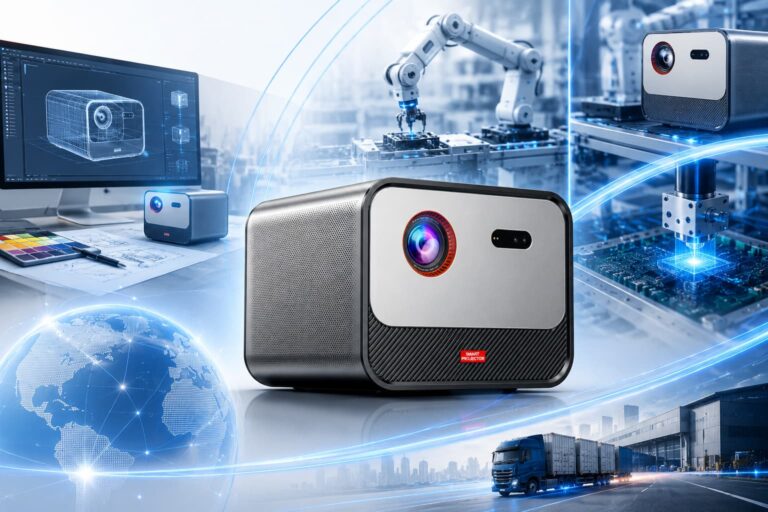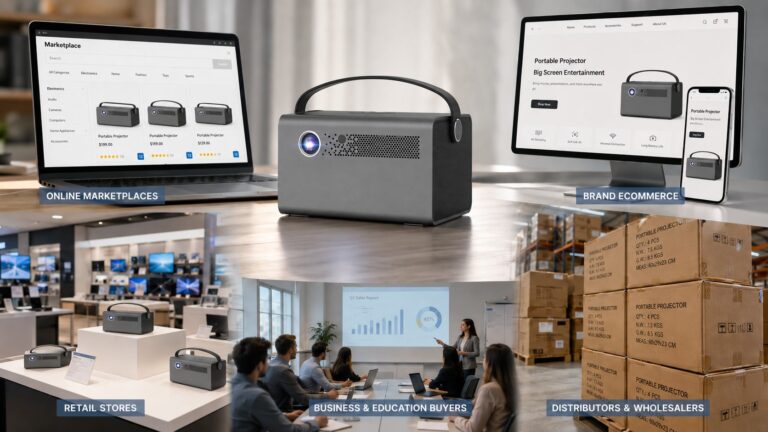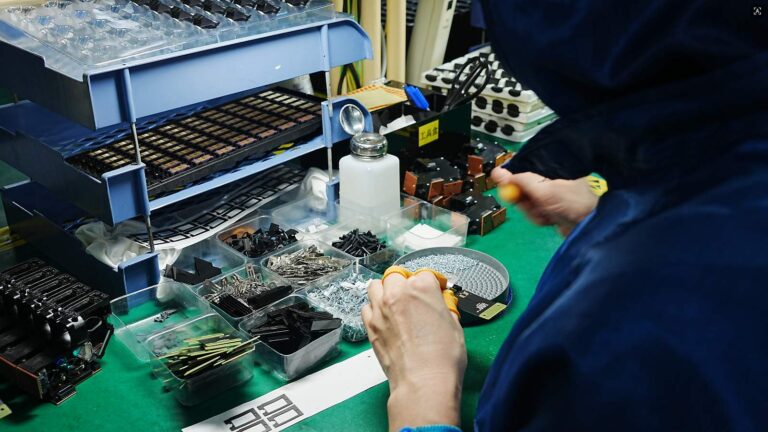
Starting a projector brand can look straightforward: choose a model, add a logo, build a website, and begin selling.
That approach can work for a short market test. The harder problems often appear later—brightness that does not match customer expectations, focus inconsistency, unstable firmware, excessive fan noise, weak packaging, or a supplier who becomes difficult to reach when a field issue needs an answer.
That is why choosing the right projector OEM manufacturer matters more than finding the lowest quotation. A capable partner helps you make practical product decisions before production begins, especially when you are building for the U.S. or other developed markets where returns and customer reviews can quickly affect a new brand.
This guide explains what actually matters when choosing a projector partner in China: OEM vs. ODM, product customization, DLP/LED/laser platform selection, factory reliability, and launch planning.
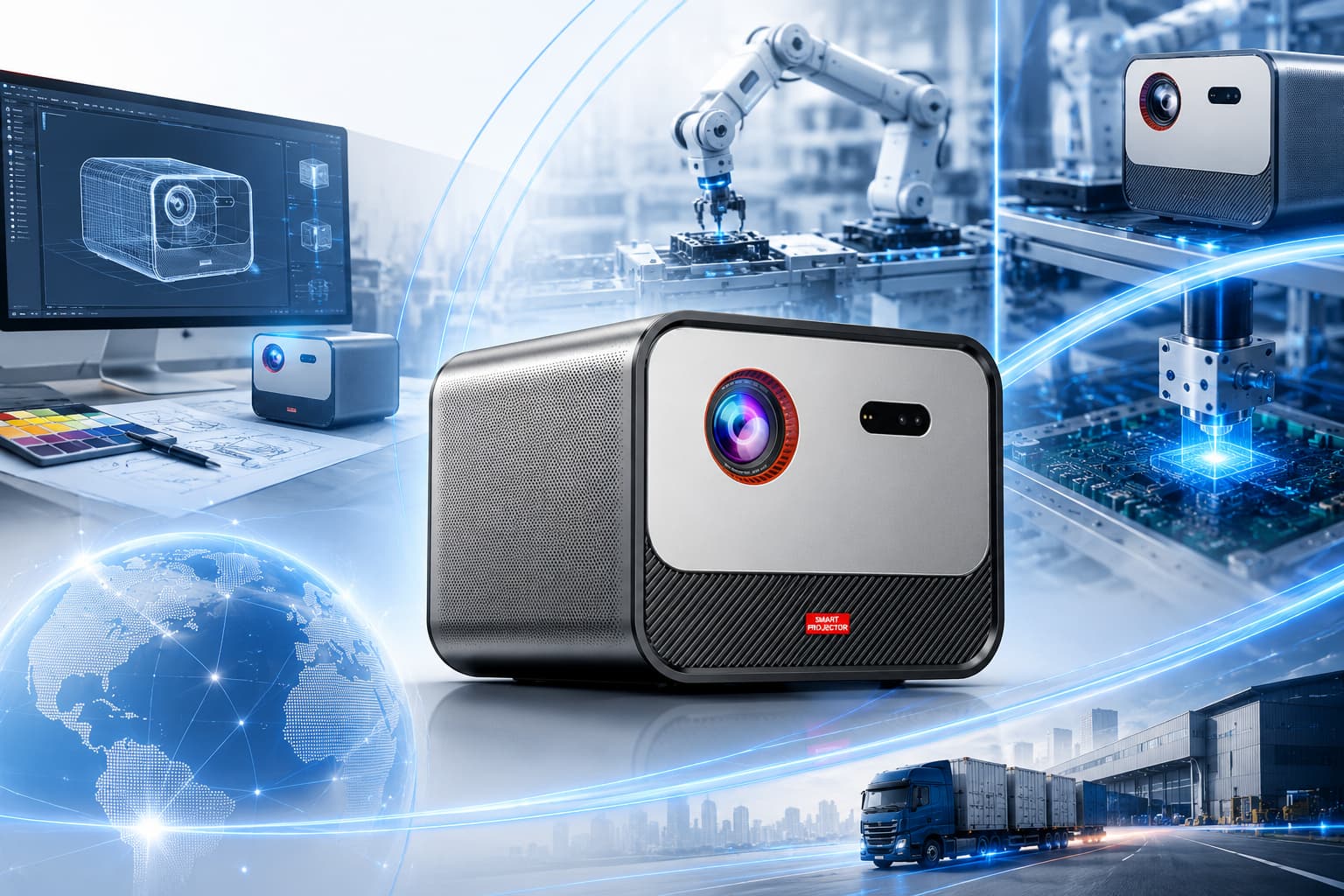
What OEM and ODM Mean for a Projector Brand
The difference is simple: OEM provides more control, while ODM provides a faster way to enter the market.
A projector ODM manufacturer normally begins with an existing product platform. A buyer can customize branding, retail packaging, software language, boot screen, accessories, and selected specifications. This is often the more practical route for a new brand that wants to test demand without committing to a long product-development cycle.
An OEM project starts with a more defined product direction. A brand may want a different industrial design, hardware configuration, firmware experience, optical setup, or market-specific feature set. That creates more room to differentiate, but it also requires a clearer specification, more validation, and stronger project management.
| Model | What You Get | Best Choice When | Main Trade-Off |
|---|---|---|---|
| OEM | A product developed around your requirements and product roadmap | You need distinct hardware, software, industrial design, or features | More validation work, greater upfront commitment, and a longer timeline |
| ODM | An existing platform adapted for your brand | You want to launch faster or test demand before deeper investment | Less control over the base product and potentially less differentiation |
For most first-time brands, ODM is the practical starting point. It lets you test product positioning, pricing, packaging, customer response, and after-sales assumptions before investing in a more complex OEM program.
The useful question is not “Which model is better?” It is “How much differentiation does my market require before I place my first serious order?”
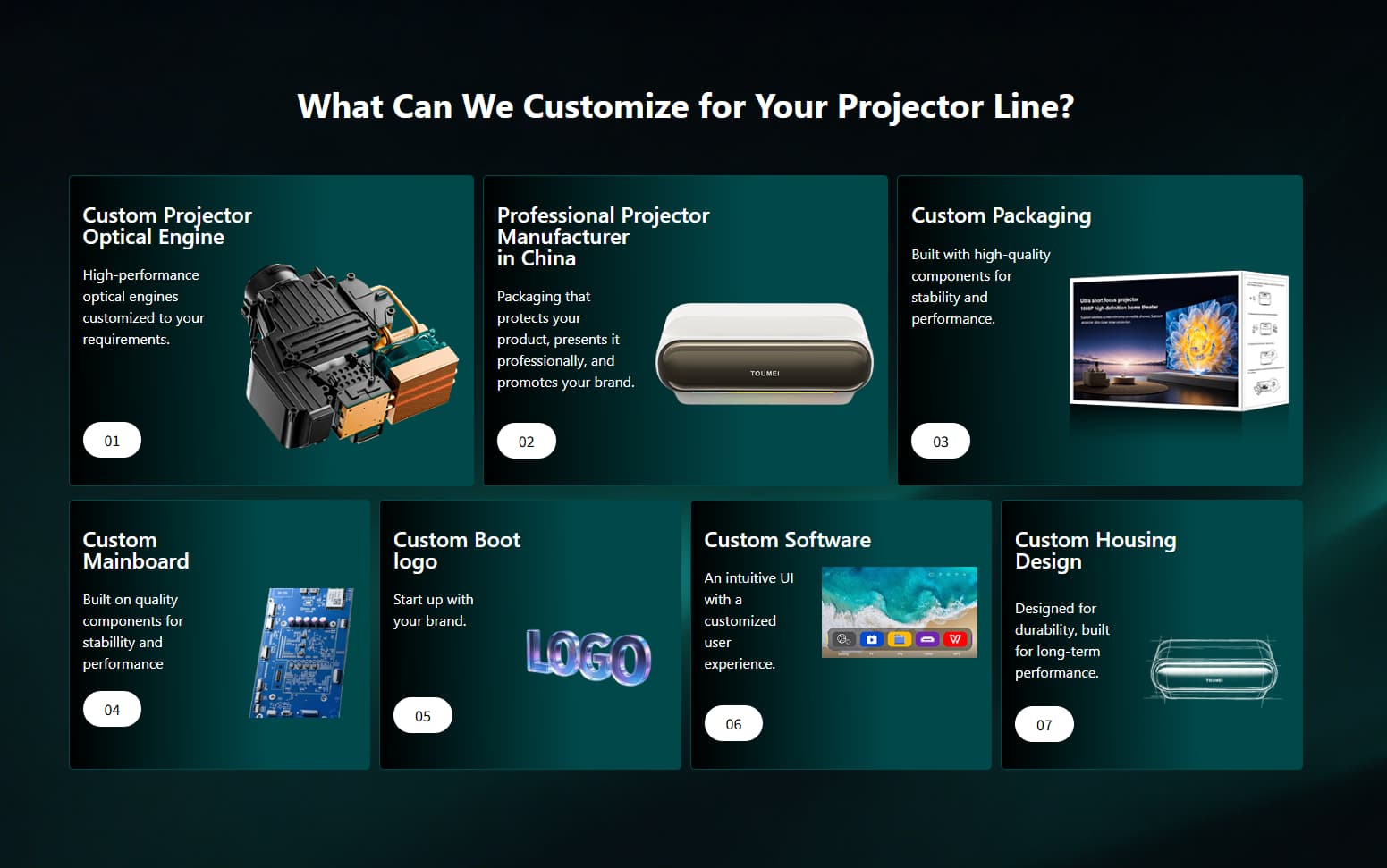
What a Factory Can Customize
A custom projector manufacturer in China can often customize far more than a product logo. The actual scope depends on the platform, project volume, development budget, and whether a change affects reliability, supply continuity, or regulatory requirements.
| Area | Typical Customization | What Matters Most |
|---|---|---|
| Hardware | Storage, memory, ports, Wi-Fi, Bluetooth, speakers, remote controls, adapters, and selected optical or thermal configurations | Changes need validation, not just a revised quotation |
| Software | Boot screen, UI theme, language, selected Android settings, OTA update path | There should be a clear owner for firmware versions and bug fixes |
| Product appearance | Housing color, finish, product logo, remote-control branding | The design still needs to be practical for manufacturing and service |
| Retail presentation | Packaging, manuals, warranty cards, inserts, plugs, accessory kits, labels | Packaging should protect the projector, not only look good online |
A projector that looks polished online but overheats, loses focus, has unreliable wireless connections, or arrives with damaged packaging will create a return problem that branding alone cannot solve.
DLP, LED, or Laser: Which Platform Fits?
Technology should follow your market position—not the trendiest category or the lowest factory quote.
A portable projector for casual home entertainment has different requirements from a premium home-theater model. A distributor selling to schools or meeting rooms has different priorities from a brand selling compact smart projectors through its own website.
| Platform | Best For | Main Advantage | What Actually Matters |
|---|---|---|---|
| DLP projector OEM | Portable, smart, compact business, and premium home-entertainment models | Compact optical design and strong image-quality potential | Optical engine, focus uniformity, thermal control, calibration, and firmware stability |
| LED / LCD projector | Entry-level home entertainment and price-sensitive private-label products | Broad platform availability and a lower entry cost | Real usable brightness, panel quality, dust control, fan noise, and production consistency |
| Laser projector OEM | Home theater, ultra-short-throw, education, and commercial applications | Higher-brightness potential and premium positioning | Laser safety, cooling design, optical alignment, serviceability, and component continuity |
Texas Instruments states that its DLP technology uses precisely controlled microscopic mirrors in projection and display systems. But the DLP chip itself is only one part of the experience: optics, illumination, lens quality, color tuning, cooling, and firmware determine what the customer actually sees and hears.
When comparing a DLP projector supplier, look beyond the product specification sheet. The more important question is whether a specific platform can stay stable after extended use in a warm room, with real streaming, gaming, HDMI devices, and wireless casting.
Laser products deserve an even more careful review. A laser projector is not simply a brighter LED projector; it is a more demanding optical and thermal system. In the U.S., laser products are subject to applicable radiation-safety performance standards, so the exact design and market plan should be reviewed before production is finalized.
How to Tell Whether a Projector Factory Is Reliable
A reliable factory is not necessarily the largest factory, and it is not always the one offering the lowest price. The important question is whether the supplier can give clear, consistent answers about how the projector is designed, tested, improved, and supported after shipment.
Here is what actually matters when you compare suppliers.
| Area | What Good Looks Like | Red Flag |
|---|---|---|
| Engineering | The supplier can explain who owns optical, hardware, mechanical, and firmware decisions | Every technical question is passed to an unnamed third party |
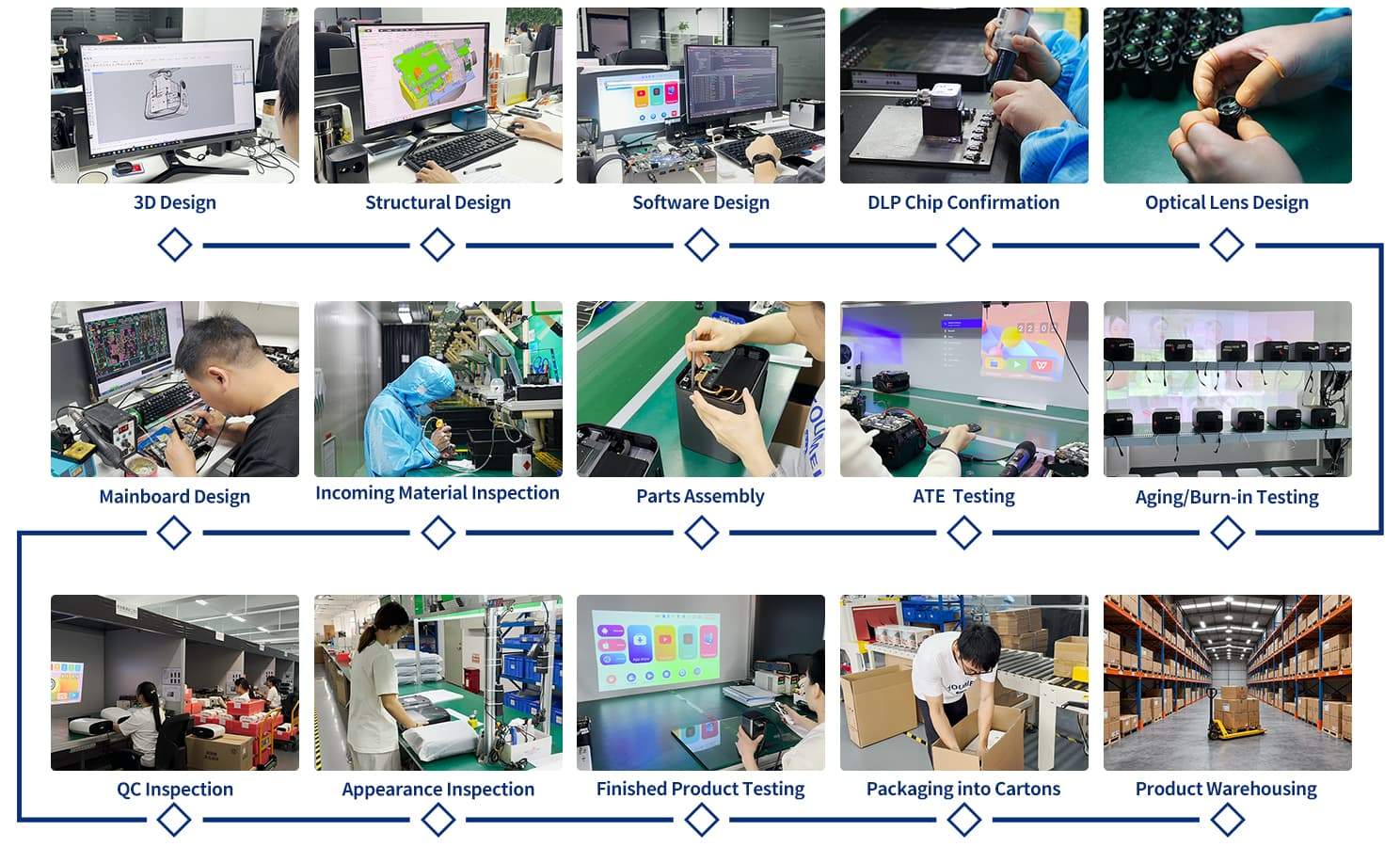
| Quality control | Defined incoming inspection, aging, final testing, and traceable quality records | The supplier cannot show relevant test standards or explain defect tracking |
| Components | Key parts are identified, and component changes are controlled | Components can be changed without notice after sample approval |
| Software | Clear version control, issue tracking, and update planning | No one can identify who owns the firmware or how bugs are resolved |
| After-sales | Defined warranty scope, spare-parts planning, and failure-analysis process | Warranty terms remain vague until after the purchase order is issued |
You do not need a factory that claims to be perfect. You need a factory that can explain why it selected a certain lens, optical engine, cooling profile, or firmware version—and can show how it responds when a real problem appears.
If a supplier can only discuss price, MOQ, and delivery time, but cannot explain its product decisions, the project often becomes difficult as soon as the first customer complaint arrives.
For a factory-level view of OEM and ODM projects, see TOUMEI’s projector OEM/ODM services. For a practical sourcing perspective, see TOUMEI’s guide to vetting a DLP projector factory.
China Manufacturer vs. Projector Supplier in the USA
A projector supplier in the USA can be a good fit when your priority is small-volume purchasing, fast domestic delivery, or access to ready-to-sell inventory.
A China-based OEM or ODM manufacturer is usually a better fit when you want to build a product line, create private-label packaging, customize software, or develop a projector that does not look identical to every competing listing.
| What Matters Most | China OEM/ODM Manufacturer | Projector Supplier in the USA |
|---|---|---|
| Product customization | Usually stronger for hardware, branding, packaging, and software | Often limited to in-stock models and standard configurations |
| Small inventory orders | May be less flexible depending on the platform | Often easier if local stock is available |
| Unit cost at scale | Often more competitive for direct production | May include warehouse, distribution, and local operating costs |
| Product-development support | Can support samples, branding, validation, and production planning | Depends on the supplier and may be limited |
| Delivery speed | Requires time for samples, production, shipping, and customs | Often faster when products are already held locally |
| Returns and local support | Must be planned before launch | May be simpler when domestic support is available |
If you need a quick restock of an existing model, a local supplier may be the practical choice. If you need branded packaging, custom software, a differentiated product, or a long-term supply plan, direct factory cooperation is often worth the additional planning.
A Practical Plan to Start a Projector Brand
To start a projector brand, you do not need a 20-page business plan before you contact a manufacturer. But you do need enough clarity to avoid developing the wrong product.
A practical launch usually follows five stages:
Define the market and target price. Decide whether you are selling portable entertainment, smart home projection, business products, education products, premium home theater, or commercial-display solutions.
Select a realistic product platform. Match DLP, LED/LCD, or laser technology to your expected selling price, customer expectations, and service capability.
Test physical samples before discussing volume. Samples reveal what specification sheets cannot: image clarity, focus, noise, temperature, system speed, wireless reliability, and packaging quality.
Complete branding and compliance preparation. Confirm logos, packaging, manuals, accessories, labels, and market-specific requirements before mass production begins.
Run a pilot order and prepare support. A controlled first order helps identify production inconsistency, software issues, shipping damage, customer questions, and spare-part needs before scaling.
For U.S.-bound projectors with Wi-Fi, Bluetooth, or other RF functions, the applicable FCC authorization path must be confirmed for the actual product configuration. The FCC states that RF devices subject to its rules must complete the appropriate authorization process before being marketed or imported, which can involve testing, approval, labeling, manual information, and record retention.
For EU sales, brands should also review the European Commission’s RoHS guidance, which addresses restrictions on certain hazardous substances in electrical and electronic equipment.
Conclusion
A successful projector brand is not built by adding a logo to the lowest-priced model. It starts with a clear market position, a product platform that fits that market, and a manufacturing partner that can support the product after it leaves the factory.
For a first launch, an ODM platform is often the fastest way to test demand. For a brand with a clear product roadmap, OEM development can create stronger differentiation over time. In either case, the most important work happens before mass production: testing physical samples, defining what quality means for your customers, and making sure the supplier can explain how it handles engineering changes, software issues, and after-sales support.
The goal is not simply to find a projector OEM manufacturer. It is to build a product that customers will keep, recommend, and buy again.
If you are planning a new DLP, LED, or laser projector line, prepare a short project brief with your target market, price range, expected order quantity, key specifications, sales countries, and branding requirements. That is enough to begin a focused OEM or ODM discussion.
ODM is usually more practical for a first launch because it uses an established platform and reduces development time. OEM is more suitable when your brand needs clear technical, software, or design differentiation.
Start with a physical sample, then look at how the supplier explains its optical engine, focus control, thermal design, firmware process, component-change policy, and support plan. A low quote is not a substitute for clear engineering ownership.
In many cases, yes. Common options include boot screens, UI themes, language settings, packaging, manuals, accessories, remote-control branding, and selected system configurations. The exact scope depends on the platform and project volume.
Choose a U.S. supplier when you need local inventory and faster domestic fulfillment. Choose a China manufacturer when you need custom branding, deeper product development, direct factory pricing, or a long-term private-label product line.
Test the real sample in conditions close to how customers will use it. Focus on image clarity, focus consistency, fan noise, heat, operating-system behavior, wireless connections, ports, remote control, packaging, and overall reliability.