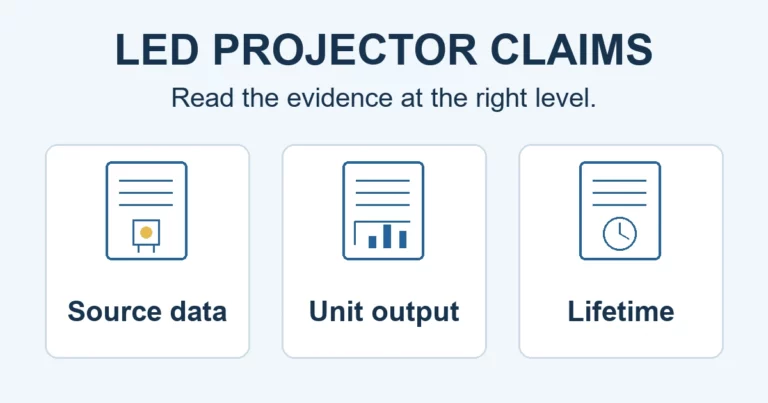
A credible LED projector light source claim needs evidence that answers the same question as the claim. A detailed component report can still leave a projector-level promise unsupported. For OEM brands and distributors, that distinction affects specification approval, sales wording, and the risks carried into a product launch.
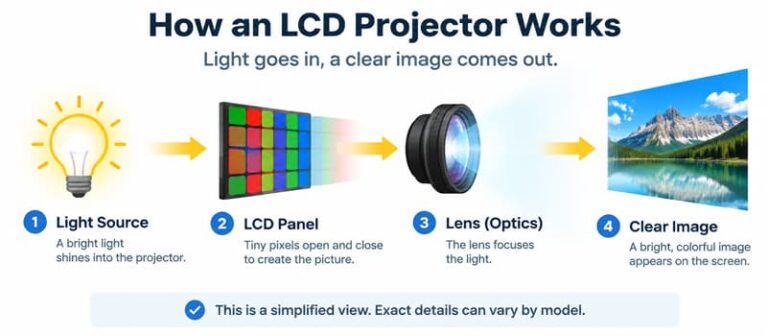
This article offers procurement guidance, not a unified test standard. Use the evidence check below to decide what a document establishes before approving a statement for your product literature. If you first need to separate imaging technology from illumination, see our LCD projector specification guide.
Match Each LED Claim to the Evidence It Needs
| Claim | Corresponding evidence | What it can support | What is still missing |
|---|---|---|---|
| The LED delivers a stated output. | Emitter or module photometric data with stated operating conditions. | Output of that component under those conditions. | Light delivered by the complete projector. |
| The projector delivers a stated brightness. | A whole-projector measurement report identifying its method and operating mode. | Measured light output for the tested setup. | Evidence for other modes or sustained operation. |
| The light source lasts a stated number of hours. | Lumen-maintenance results or projections with a defined threshold and conditions. | A conditional statement about retained light output. | A basis for complete-projector service life. |
| The product is covered for a stated period. | Current written warranty terms for the proposed purchase. | The coverage the seller offers, subject to those terms. | Coverage for any omitted failure or operating condition. |
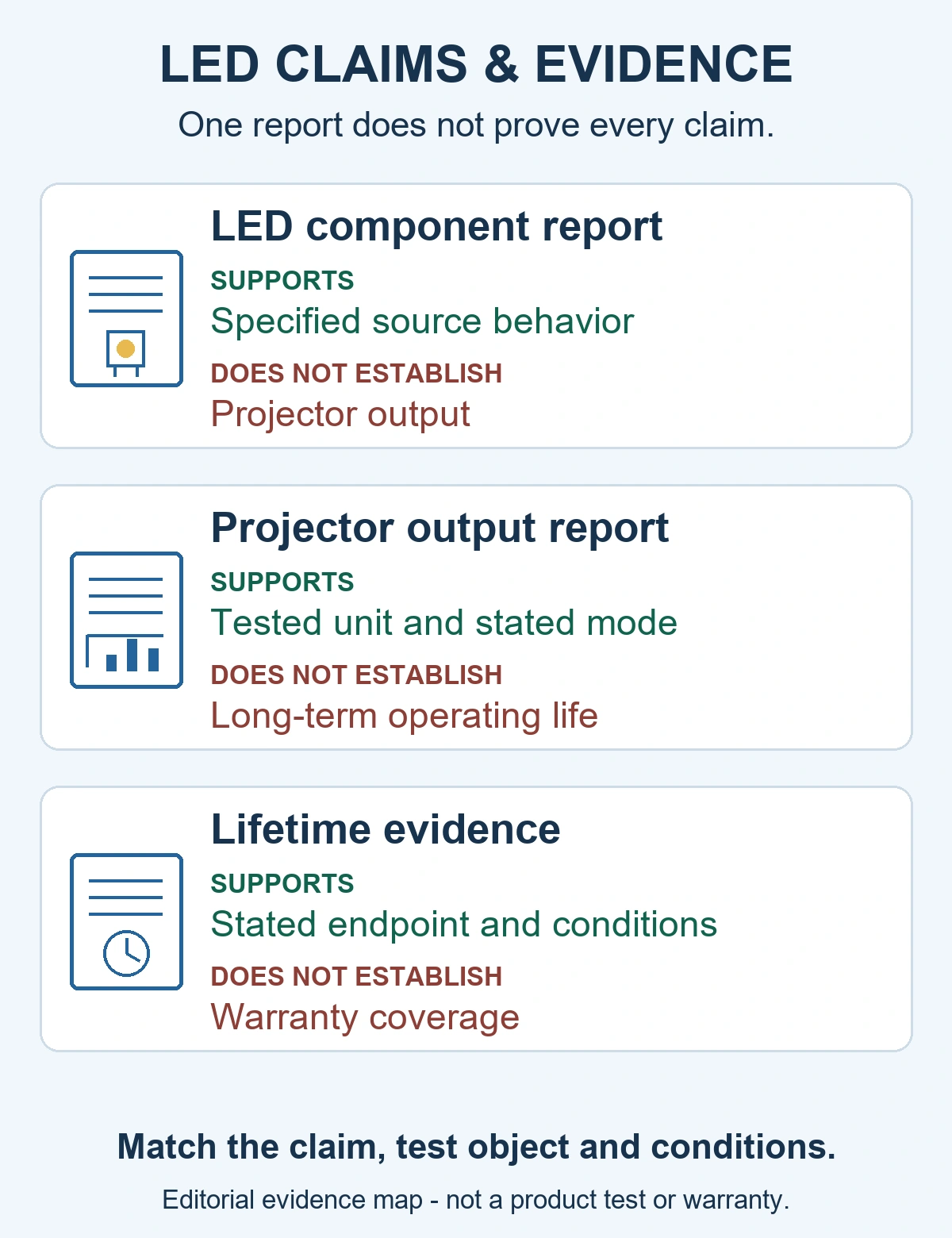
Does the Evidence Reach the Projected Image?
Start by locating the output being measured. An LED emitter, an illumination module, and the complete projector are different measurement subjects. A number associated with one does not become a verified number for another because both are expressed in lumens.
For DLP designs specifically, Texas Instruments describes projector output as dependent on source output, electrical input power, optical design, and the DLP active array. It also discusses the thermal load associated with increasing LED power. This DLP application note supports considering the complete design; it does not supply a universal conversion from LED specifications to projector brightness. See TI DLPA068C, Sections 1 and 5.
When a quotation presents LED output beside a projector brightness claim, ask what connects them. A component data sheet establishes component information. The projector claim needs its own measurement basis. Keep the evidence attached to the number it actually supports, and use our guide to comparing projector brightness claims for a separate discussion of brightness reporting.
Also distinguish a measured result from a promise of continued output. A report for one operating state does not, by itself, answer how the projector performs after extended use. If sustained output matters to the intended application, make that a separate acceptance question.
What Does a Lifetime Threshold Actually Describe?
A lifetime figure is incomplete without its endpoint. Cree LED defines L70 as the time until light output reaches 70% of its initial level. Its guidance identifies drive current and temperature as relevant conditions. An L70 statement therefore needs its threshold and conditions alongside the number; it is not a statement that a projector will operate without faults for that period. See Cree LED's XLamp lumen-maintenance guidance.
Separate the observed test duration from any projected duration. Ask which results were measured, which were calculated from those results, and what assumptions connect the projection to the proposed LED configuration. Record the method and version the supplier actually used. Do not relabel a projection as completed operating time.
Ask the supplier to explain the proposed wording in ordinary language. Is it describing light retention, a sudden failure, or useful operation of the whole product? Those outcomes require different evidence. An ambiguous LED life label can turn a limited technical result into a broader commercial assurance.
The DOE-hosted LED Luminaire Lifetime guide separates LED component behavior from complete-system reliability. Its context is lighting, and it is not a projector qualification standard. Our procurement inference is narrower: component lumen maintenance alone cannot establish the service life of a complete projector.
Keep Warranty Coverage in Its Own Decision
Warranty is a commercial commitment with its own scope. A light-retention projection cannot tell a distributor which failures are covered, which operating conditions are excluded, or what remedy is available. Review the actual terms offered for the purchase before turning technical language into customer-facing coverage language.
When technical evidence and warranty wording use different endpoints, preserve that distinction. An internal note could state: component light-retention evidence supplied; whole-projector service life not established; coverage requires review of the offered terms. This is an illustrative review note, not a statement about a TOUMEI model.
Approve the Statement at the Level the Evidence Supports
For each proposed sales statement, record the exact claim, the test object, the evidence supplied, its applicable conditions, and the remaining gap. A conditional result should retain the limitation that makes it accurate. Missing support identifies an open claim; it does not establish that the product performs poorly.
For example, component documentation may support a narrowly worded light-source statement while a projector output claim remains open. Approve them separately. A successful short sample session can answer observed behavior questions, while a long-term life claim still needs its own basis. For further whole-product evaluation, use our projector sample testing checklist.
Frequently Asked Questions
1. Can LED component lumens substantiate advertised projector brightness?
No. They describe a different measurement subject. Request evidence for the complete projector and keep component output labeled at the component level.
2. Does an L70 claim mean the light source suddenly stops working?
No. L70 describes a light-output retention threshold. It should not be rewritten as a guaranteed failure-free operating period.
3. Can a DLP application note validate an LCD projector claim?
Not directly. The TI note cited here concerns DLP designs. An LCD projector needs evidence relevant to its own design and claimed result.
4. Is an LED lighting lifetime guide a projector test standard?
No. It can help explain why component and system reliability differ, but it does not qualify a projector or establish its service life.
5. What should a distributor do when warranty coverage is shorter than a stated LED lifetime?
Assess the statements separately. Confirm the technical lifetime endpoint and read the offered coverage; one duration does not extend the other.
6. How should an OEM buyer compare measured and projected LED lifetime figures?
Ask for the actual test duration, the projected duration, and the method and operating conditions behind the projection. Keep measured results distinct from forecasts when approving the wording.
Discuss the Evidence Behind Your Proposed Product
Send TOUMEI your intended operating scenario, required operating mode, and existing LED lifetime evidence through our OEM/ODM projector inquiry page. These details can frame a sample discussion and identify which claims still need support.
References
All sources accessed October 28, 2026.
- Texas Instruments, TI DLP System Design: Brightness Requirements and Tradeoffs, DLPA068C, Rev. C, May 2022; PDF p. 2, Section 1, and p. 5, Section 5. Supports the DLP output and thermal-design discussion; no universal brightness conversion or TOUMEI performance evidence.
- Cree LED, XLamp LED Long-Term Lumen Maintenance, CLD-AP28, Rev. 4A, copyright 2025; exact issue date not shown. PDF p. 2 definitions and p. 4 operating conditions. Supports component lumen-maintenance interpretation; not projector lifetime or warranty. The older standard editions discussed in this note are not presented as current testing requirements.
- NGLIA / LED Systems Reliability Consortium, LED Luminaire Lifetime: Recommendations for Testing and Reporting, Third Edition, September 2014; PDF pp. 6-7, Section 1.3, and pp. 9-10, Section 2.1.1. Lighting-system reliability context hosted by DOE; not a projector test standard. Used to explain the evidence boundary between component behavior and complete-system life.