Color performance is rarely judged at the moment a projector is first powered on. In a demo room, the image looks bright, the saturation feels punchy, and the whites are clean—at least on day one. But long-term deployment is a different game, especially in B2B environments: museum galleries that run every day, training rooms that stay lit from morning to evening, showrooms that must reproduce brand colors consistently, and control rooms where visual fatigue is not an option.
After 10,000 hours of use, the most common complaint is not “the projector is darker.” People say things like: the image feels flat, white looks slightly tinted, reds don’t pop the same way, or two identical rooms no longer match. Those are color performance problems, and they tend to appear gradually, which makes them easy to underestimate until they become expensive.
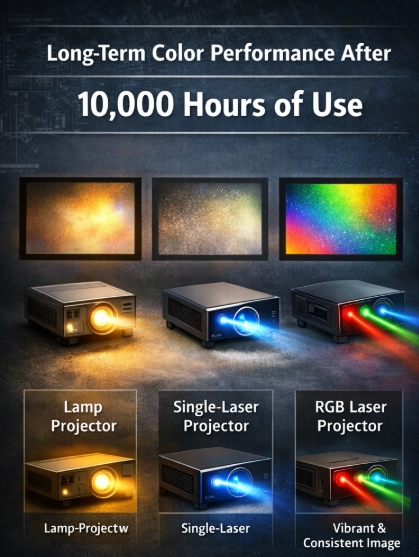
This technical long-form article explains what typically happens to color performance after long operational time across three mainstream light-source architectures:
- Lamp-based projection
- Single-laser projection (laser + phosphor conversion)
- RGB three-color laser projection(independent red/green/blue lasers)
The emphasis is on mechanisms and trends: what changes, why it changes, what users notice, and how engineering choices influence outcomes. Where useful, peer-reviewed color science and light-source reliability literature is referenced in an academic style.
Why “Color Over Time” Is a Harder Question Than “Brightness Over Time”
Color is a spectral problem, not just a calibration problem
Brightness is largely a single-axis metric. Even when brightness measurement methods differ, the idea is straightforward: lumen output declines with age.
Color performance, by contrast, is multi-dimensional. It includes white point stability, channel balance, color gamut, color volume, uniformity across the image, and how stable those properties remain under thermal and electrical drift. The root driver is the spectral power distribution (SPD) of the light engine and how the optical system shapes it.
Color science texts make a point that perceived color depends on both the light source spectrum and observer adaptation, not purely on “RGB settings.” A projector can retain reasonable luminance while its spectrum shifts enough to create a noticeable tint or reduce saturation. (Fairchild, Color Appearance Models, 3rd ed., 2013)
The human eye often notices color drift before it notices brightness loss
Human vision adapts strongly to luminance changes, particularly under steady viewing conditions. Color differences, especially in whites and skin tones, are often detected earlier. That’s why “my whites look a little warm” shows up in real installations even when a quick light meter check still reads acceptable brightness.
This is consistent with established findings in color technology and psychophysics: chromatic differences can be perceptually salient at relatively small magnitudes, depending on scene content and viewing context. (Berns, Principles of Color Technology, 3rd ed., 2000)
“10,000 hours” is not a single condition
A 10,000-hour system in a climate-controlled boardroom is not the same as a 10,000-hour system in a hot retail environment with dust and intermittent power cycles. Duty cycle, ambient temperature, ventilation, and maintenance practices all affect how the light engine ages.
So when we talk about “after 10,000 hours,” we’re really discussing a family of outcomes and their typical direction, not a single guaranteed endpoint.
Lamp-Based Projection After 10,000 Hours: Fast Decline, High Variability
Lamp-based projectors have supported professional use for decades, and the aging patterns are well known. The problem is that those patterns are not only about brightness. They are about spectral behavior and system variability.
What ages in a lamp system
In a typical high-pressure discharge lamp system, aging mechanisms include:
- Electrode wear and evaporation
- Changes in internal arc geometry
- Changes in gas pressure and plasma conditions
- Darkening or devitrification of lamp envelope materials over time
- Optical contamination downstream (reflectors, integrator rods, filters)
These effects can alter the lamp’s emitted spectrum and the system’s optical throughput, which impacts color.
Technical literature on discharge lamp behavior shows that spectral line intensities and arc characteristics vary as lamps age, and that these variations can influence correlated color temperature and color rendering performance. (For general discharge lamp spectral behavior: Waymouth, Electric Discharge Lamps, MIT Press, classic reference)
Color drift and “replacement discontinuity”
Even if a lamp system is recalibrated, it has a structural problem: lamp replacement introduces discontinuity. New lamps rarely match the spectral output of old lamps perfectly. That means a site that replaces lamps at different times across rooms or units can end up with visible mismatches.
In multi-projector blending applications, this matters a lot. You can match brightness, but matching color over time across units becomes labor-intensive. In practice, many teams accept drift and live with it until it becomes unacceptable.
Why color may degrade “unevenly”
Lamp spectra are not uniform “white” sources. As conditions change, certain regions of the spectrum can weaken more than others. In real viewing terms, it can look like:
- Slight changes in whites and grays
- Reduced saturation in certain colors (often deep red or deep blue in some setups)
- Increased difficulty hitting stable D65 or a chosen white target
- More frequent recalibration requirements
After 10,000 hours of cumulative operation, it is common that a lamp-based system has undergone multiple lamp changes. So the question is not merely “how does it age,” but “how repeatable is it after maintenance.” That repeatability is often poor.
Single-Laser (Laser + Phosphor) Systems: Slower Fade, Different Color Risks
Single-laser projection generally refers to using a laser diode (often blue) to excite a phosphor, producing broad-spectrum light that is then separated into color channels. This architecture is often called “laser phosphor” in engineering discussions.
What improves versus lamps
Laser diodes are solid-state emitters with high efficiency and generally better long-life characteristics than discharge lamps. They avoid many lamp problems:
- No arc instability
- No electrode erosion in the same sense
- No frequent lamp replacement cycles
- Often better long-term brightness stability per hour of operation
From an operational standpoint, this is already a major advantage for B2B customers who want predictable maintenance schedules.
The phosphor wheel (or phosphor element) becomes the aging focal point
In a laser phosphor system, phosphor materials can age via thermal stress, photobleaching effects, and surface degradation. Even small changes in phosphor conversion efficiency can shift the spectral output. A key detail here is that phosphor conversion does not merely scale brightness; it can change the shape of the spectrum.
Academic work on phosphor-converted systems notes efficiency droop and thermal quenching mechanisms that can impact output characteristics over time, particularly under high flux and temperature conditions. (General mechanism background: Schubert, Light-Emitting Diodes, 2nd ed., Cambridge University Press)
What “color drift” looks like in practice
In many single-laser systems, long-term drift is less dramatic than lamp systems, but it tends to be real. After thousands of hours, you may observe:
- Slight white-point movement, especially when thermal conditions vary
- Mild reduction in wide-gamut saturation compared with initial performance
- Some unit-to-unit variability, but usually lower than lamp replacement variability
- More stable performance within a single unit if operating conditions remain consistent
In a boardroom scenario, users may not notice until content includes reference colors: brand reds, skin tones, or clean gray gradients. In a museum or design visualization environment, drift becomes visible sooner.
Why “single-laser” can still be a good business choice
For many commercial applications, single-laser offers an attractive balance: reduced maintenance, strong brightness stability, and acceptable color stability for non-critical content. Where it can fall short is in applications that demand consistently wide gamut and stable primaries over very long timeframes.
RGB Three-Color Laser Projection: Why Its Aging Trend Often Looks Different
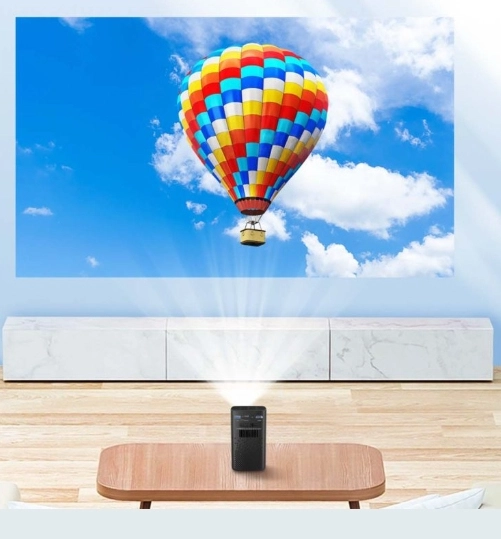
RGB three-color laser projection uses independent red, green, and blue lasers. This is a different spectral philosophy. Instead of generating a broad spectrum and filtering or splitting it, RGB lasers provide discrete narrowband primaries.
Why narrowband primaries matter for long-term color
Color coordinates and gamut boundaries are directly tied to the spectral peaks of the primaries. In systems with broad-spectrum sources, changes in spectrum shape can shift many colors at once. In an RGB laser system, each primary can be controlled independently. That makes it easier to maintain chromaticity targets over time, assuming the system has appropriate thermal and feedback control.
In research on display primaries and colorimetry, narrowband primaries are well known for enabling wide gamut and precise chromaticity control. (Poynton, Digital Video and HD, technical reference widely used in imaging engineering)
Aging mechanisms: lasers don’t “age equally”
It’s important not to oversell RGB as “no aging.” Laser diodes do degrade. Output power can decline and wavelength can drift with temperature and aging. But because RGB systems treat primaries independently, control strategies can compensate more effectively, particularly for white balance maintenance.
The practical outcome is often:
- More stable white-point control over time
- Better retention of color gamut shape
- Less dependence on phosphor conversion stability
- Potentially lower recalibration frequency in stable thermal environments
A real engineering trade: speckle and perception
One technical issue more closely associated with coherent laser light is speckle. Speckle is not strictly “color degradation,” but it affects perceived image quality and can interact with color perception in fine textures.
Speckle reduction strategies include optical diffusers, wavelength diversity, polarization diversity, and temporal modulation. There is substantial academic literature on speckle contrast and reduction in laser projection systems. (Goodman, Speckle Phenomena in Optics, Roberts & Company, 2007)
If a projector is designed well, speckle can be minimized to a level acceptable for intended applications. For B2B deployments, what matters is whether the system maintains stable perceived uniformity and does not become visually fatiguing over long viewing sessions.
What typically happens around 10,000 hours
In many RGB laser systems, 10,000 hours is not near end-of-life. Instead, it is closer to the “mid-life” region. That changes how users experience aging: the system might get slightly less bright, but it often maintains its color character and uniformity better than lamp-based systems and, in many cases, better than phosphor-converted single-laser systems.
This “aging gracefully” effect is one reason RGB three-color laser projection is attractive for environments where brand color fidelity, consistent visuals, or long-term deployment are priorities.
What Users Actually Notice After 10,000 Hours
The “white problem”
The most common real-world observation is white point drift. If whites no longer look neutral, the entire image feels wrong. This can happen even when the device is still bright enough.
White drift is also the most operationally annoying issue because it forces recalibration or demands acceptance of a degraded baseline.
Saturation loss is often content-dependent
Saturation loss tends to show up in:
- Brand colors
- Deep reds and blues in cinema content
- Color-coded visualization in training and simulation
- Fine gradients in product design reviews
A casual user watching typical mixed content might not notice quickly. A B2B client presenting consistent branded materials will.
Uniformity issues become more obvious on large screens
The larger the image, the more visible nonuniformity becomes—especially in UST deployments. Slight per-corner tint differences, edge falloff, and angle-related spectral changes become visible across big screen areas, particularly on solid-color slides and gray backgrounds.
The UST Factor: Why Ultra-Short-Throw Can Expose Color Weaknesses Faster
Ultra-short-throw (UST) projection is demanding. It compresses a wide image from a short distance, which requires steep angles and complex optics.
Why UST magnifies color nonuniformity
When the projection angle is steep, small spectral and polarization differences across the optical path can translate into visible uniformity changes. Screen material also matters: certain screen gains and microstructures interact with angle-dependent illumination.
So UST systems often live or die by uniformity management: optical design, light engine stability, thermal control, and calibration tools.
Where RGB three-color laser projection can help
Stable primaries and tighter channel control can improve long-term uniformity and reduce perceived drift, particularly when the system maintains consistent channel balance over time.
This is where a product like the TOUMEI S1 ultra-short-throw triple projector fits naturally in the technical discussion: UST + RGB architecture is a demanding combination, but also one where long-life color stability can translate into practical value for integrators and end users who want a stable image without frequent interventions.
Calibration Over Time: Why “Can Be Calibrated” Is Not the Same as “Stays Calibrated”
Calibration is an operational strategy, not a magic fix.
Calibration frequency as a hidden cost
In professional environments, recalibration has real cost: technician labor, downtime, scheduling, and sometimes content disruption. If color drifts frequently, the device is “technically capable,” but operationally inconvenient.
Drift that calibration cannot fully correct
If the spectral shape changes significantly (not just a scale factor), calibration can struggle. You can correct white point, but the gamut may shrink or distort. In that case, some colors cannot be restored to their initial appearance because the light engine no longer produces the same spectral basis.
This is one reason RGB systems, with stable primaries, can be operationally appealing: maintaining chromaticity targets requires less “compromise” as the engine ages.
Practical Decision Guidance for B2B Buyers
If your key risk is frequent maintenance and inconsistent replacements
Lamp systems bring predictable maintenance and replacement variability. If downtime is expensive, lamp systems are increasingly hard to justify in always-on environments.
If your key risk is gradual gamut shrinkage and white drift over very long use
Single-laser systems often perform well, but phosphor aging and thermal effects remain relevant. For many commercial cases, this is acceptable. For color-critical environments, it may create long-term operational burdens.
If your key risk is long-term brand fidelity and consistent visual identity
RGB three-color laser projection is often the most stable long-term path, provided the system is well engineered for thermal control, uniformity, and speckle management.
This is not about chasing the widest spec. It’s about the reality of multi-year deployment.
A Brief Note on Shenzhen Toumei Technology Co., Ltd.
Shenzhen Toumei Technology Co., Ltd. develops projection systems with a focus on laser-based imaging and long-term visual stability. The company’s work centers on integrating light engines, optical design, and practical deployment needs—particularly for professional applications where consistent image quality is expected over extended operating life.
In projects where “it still turns on” is not an acceptable definition of performance, the engineering focus shifts toward stability: stable color, stable uniformity, stable operation, and predictable behavior across years. Toumei’s three-color laser projection direction, including UST formats such as the TOUMEI S1 ultra-short-throw triple projector, aligns with those long-cycle deployment requirements.
Conclusion
After 10,000 hours, the story changes.
Lamp systems typically show the most variability, especially because replacements break continuity even when calibration is performed. Single-laser systems age more gracefully, but the phosphor conversion layer introduces its own slow drift that matters in color-critical environments. RGB three-color laser projection tends to keep its color character more stable over time because it starts with independent primaries and can maintain balance more predictably.
If you’re selecting projection technology for a professional environment, the decision should be framed around long-term behavior and operational reality, not only day-one specifications. That’s where total cost of ownership becomes visible.