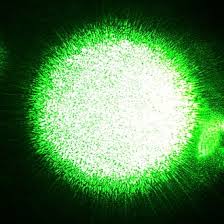
Speckle describes a dotted interference pattern that appears when coherent light, such as laser light, strikes a rough surface or goes through an optical arrangement. This issue plays a big role in modern optical projection devices, especially in DLP (Digital Light Processing) projectors that rely on laser illumination. The pattern comes across as irregular bright and dark areas on the displayed image. Most people see it as a type of visual clutter that reduces the clarity of the image.
The Physical Origin of Speckle
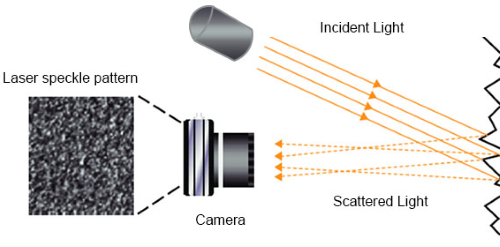
Speckle comes from the interference between numerous scattered wavefronts that have random phase differences. Coherent light hits a rough surface. Then, each tiny section reflects or scatters light along paths that differ slightly in length. These scattered waves overlap. Such overlap leads to constructive and destructive interference. In the end, this produces the dotted pattern known as speckle. The qualities of this pattern depend on certain factors—surface roughness, coherence length of the light source, and observation geometry. Variations in amplitude and phase contribute to the total intensity distribution. Speckle thus becomes a difficult yet foreseeable optical challenge in coherent imaging systems.
To get a better sense of this, consider the way light behaves on uneven surfaces. Rough materials cause light rays to reflect in various directions. Each ray gains a distinct phase shift depending on its travel distance. When these rays come together again, some align to increase brightness. Others cancel out to create dark regions. This irregular blending results in the typical grainy appearance. Factors such as the light's wavelength also influence the size of these speckles. Shorter wavelengths generate smaller patterns. These patterns may appear less noticeable from greater distances. In practical applications, engineers must take these aspects into account when designing systems to minimize the effect.
Laser light moves as synchronized waves. It strikes an uneven object. The waves then divide and follow different paths. When they recombine, the waves either strengthen or diminish one another. This random reinforcement and cancellation occurs across the surface. Bright spots form where waves align. Dark spots emerge where they oppose. The size of these spots connects to the light's characteristics and the surface's features. For instance, smoother roughness produces finer speckles. Engineers examine these relationships to forecast and manage results in equipment.
Types of Speckle Patterns
Experts classify speckle patterns in different ways according to viewing conditions:
Objective Speckle: It develops directly on an imaging plane, for example, a camera sensor or projection surface. One can analyze it using statistical methods.
Subjective Speckle: Observers detect it when interference occurs within the eye’s optical system.
Temporal Speckle: It varies over time due to motion, wavelength changes, or environmental influences.
Recognizing these types helps engineers develop suppression strategies suitable for specific applications. Objective speckle often requires adjustments in hardware. Subjective speckle involves considerations for the viewer. Temporal speckle needs approaches that address movement or instability. By matching methods to the type, designers achieve improved outcomes in actual use cases.
Objective speckle forms at the system's focus point. It remains stable unless the arrangement shifts. Subjective speckle relies on the individual's eye makeup. It differs a little from person to person. Temporal speckle shows up in moving scenes, such as video play. Grasping the distinctions enables precise solutions. In projectors, combining techniques usually provides the strongest hold on every kind.
Why Does Speckle Occur in DLP Projectors?
In DLP projectors that employ laser light sources, speckle becomes prominent because lasers exhibit strong spatial and temporal coherence. This coherence supports effective light modulation and vivid colors. However, it also increases the likelihood of interference effects.
Lasers generate light waves that remain synchronized over extended distances and durations. This consistency benefits sharp imagery but hinders uniform illumination on screens. When light reaches the projection surface, the coherent quality causes interference spots to form distinctly. In comparison, sources with less coherence, like traditional lamps, avoid this problem but lack the accuracy of lasers.
DLP technology depends on small mirrors to guide light. Lasers supply the source with great uniformity. That very uniformity triggers speckle as light disperses. Projectors in living rooms or workplaces encounter this in calm environments. Makers today include built-in measures to maintain clean visuals.
The Role of Laser Coherence in DLP Systems
Laser-based DLP systems benefit from precise color reproduction and extended service life. Yet, their high coherence results in noticeable speckle on projection screens. Coherence determines both speckle contrast and visibility—greater coherence leads to more defined patterns. One can reduce coherence by introducing wavelength diversity or applying phase modulation. These actions help mitigate speckle. Moreover, they maintain suitable brightness for professional display requirements.
Specifically, coherence length indicates how far light waves stay in phase. In lasers, this length extends far, promoting intense interference. To counteract it, manufacturers add minor variations to the light's attributes. This disrupts the phase alignment sufficiently to soften speckle without reducing overall intensity. Such methods have improved greatly through years of study, making current projectors much superior to earlier versions.
Coherence influences color accuracy as well. Lasers provide pure tones without mixing. In DLP, the mirror arrangement can intensify speckle without checks. Current builds adjust the light route from the start. They preserve advantages while lessening drawbacks. Viewers sense the improvement in even, lively pictures.
Influence of Optical Components on Speckle Formation
Optical components in a DLP projector influence the manner in which speckle forms and propagates. The micromirror array, essential to DLP technology, manages light paths but does not diminish coherence by itself. Projection lenses, diffusers, and screen materials aid in distributing scattered light energy. Incorporating angular diversity via engineered optics allows partial averaging of interference fringes across different viewing angles. Thus, enhancing the design of each component directly lowers the observed speckle intensity.
Every element contributes uniquely. Lenses focus light but can intensify speckle if poorly designed. Diffusers scatter light to blur patterns, functioning like a mild mixer. Screens absorb or reflect light in manners that either heighten or dampen the effect. By optimizing these interactions, producers create a harmonious system where speckle remains minimal throughout the projection area. Evaluations in controlled settings confirm these enhancements prior to manufacturing.
The micromirror array switches quickly to build images. It bounces laser light accurately. Coherence stays intact as it passes. Lenses mold the beam for sharpness. Diffusers introduce dispersion to blend phases. Screens complete the process by sending light to the audience. When these parts align, speckle fades on its own. Groups experiment with pairings to locate the ideal balance for results.
How Does Speckle Affect Image Quality in Projection Systems?
Speckle introduces undesired visual defects that impair both perceptual experiences and measurement precision.
From a viewer's standpoint, speckle distracts from the content. It overlays a layer of noise that makes scenes appear less natural. In well-lit rooms, it may integrate subtly, but in dim environments, it emerges more prominently. This inconsistency influences comfort during extended sessions.
Speckle breaks concentration during important parts. It conceals fine points in low light or bright areas. After a while, it fatigues the eyes. Devices with reduced speckle offer greater ease for regular viewing.
Impact on Visual Perception and Image Uniformity
Speckle appears as subtle granularity across the projected material. It reduces smoothness and consistency in images. Speckles with high contrast disturb color equilibrium and brightness stability. These problems manifest clearly in uniform sections, such as white fields or gradual color transitions. Extended exposure to projections with substantial speckle can induce visual fatigue. This arises because varying luminance challenges the eye's adaptation mechanisms.
Human vision is attuned to such irregularities. The brain attempts to disregard them, but in important tasks like presentations, they divert focus. Uniformity suffers particularly in large displays where minor flaws expand. To counter this, designers target patterns below the eye's resolution threshold, rendering speckle almost undetectable in standard conditions.
Uniformity counts for video backdrops. Speckle interrupts the smooth progression. Colors seem patchy rather than even. During films, it draws eyes away. Solid designs maintain flat areas, improving the overall viewing session. Measurements with instruments verify this to uphold standards.
Influence on Measurement and Display Accuracy
In precise display systems for metrology or simulation, speckle generates luminance fluctuations that disrupt accurate brightness calibration and photometric assessments. Sensors detecting rapid intensity changes yield inconsistent outputs. Reliable averaging techniques are necessary to address this. Hence, applications demanding high-quality imaging—such as medical visualization or professional filmmaking—require robust anti-speckle solutions integrated into the system architecture.
Precision is critical in areas like quality inspection. Speckle can distort readings by a few percent, causing calibration errors. Sophisticated sensors with fast sampling rates assist, but preventive hardware proves more effective. In simulations, such as training simulators, slight distortions may confuse users, highlighting the importance of speckle-free operation.
Light measurement devices depend on constant illumination. Speckle introduces variation that alters findings. Labs require multiple runs for confidence. In simulation displays, it impacts authenticity. System assemblers choose low-speckle options for dependable performance. Such selections cut down on rework and increase reliability.
What Methods Are Used to Reduce Speckle in DLP Projectors?
Current projector manufacturers apply various techniques. They blend optical diffusion, temporal averaging, and novel materials to lessen speckle. These techniques operate without compromising efficiency.
Mitigation strategies have progressed alongside technology. Initial efforts relied on basic screens, but contemporary integrated solutions offer thorough control. The aim is consistently to preserve high light efficiency while smoothing interference.
Every approach addresses a specific aspect of the issue. Diffusion manages the spatial side. Averaging handles the temporal aspect. Materials influence the fundamental reaction. When combined, they enable projectors to perform reliably in diverse settings.
Optical Diffusion Techniques
Rotating diffusers or vibrating screens introduce temporal variations that average interference patterns over viewing durations. Holographic diffusers disperse coherent beams across multiple directions. They preserve uniform brightness. Micro-lens arrays improve spatial averaging. These arrays distribute light over small regions with minimal loss.
Diffusion functions by dividing light into numerous paths. Rotating components shift the pattern quicker than the eye perceives, yielding a stable image. Holographic variants retain directionality for enhanced focus. Collectively, they provide a multi-tiered approach to reducing speckle visibility.
Rotating diffusers turn to blend phases. Vibrating screens move gently to diffuse. Holographic types feature engraved designs. Micro-lenses function as tiny refractors. Each contributes dispersion with little reduction in output. End users experience the benefit through sharper visuals.
Temporal and Spatial Averaging Approaches
Dynamic control methods—such as rapid wavelength adjustments or phase shifts—diminish temporal coherence among emitted photons. Beam scanning methods alter light trajectories between frames to decouple successive patterns. Utilizing multiple light sources with distinct coherence properties enables ensemble averaging. This markedly decreases overall speckle contrast.
Temporal approaches depend on velocity. By altering light characteristics swiftly, each frame varies slightly, and the eye perceives the mean. Spatial averaging disperses the effect over space. Merging both delivers optimal results, frequently reducing contrast by more than 50% in evaluations.
Wavelength changes occur in fractions of a second. Phase adjustments employ movable elements. Beam scans cover areas systematically. Several sources operate sequentially. Assessments demonstrate the noise reduction from each. Real setups adapt combinations to the device's pace.
Advanced Material-Based Solutions
Projection screens fabricated with controlled surface roughness distribute incoming light more uniformly across viewing directions. Nanostructured coatings designed for reduced reflection also lessen coherent backscattering. They achieve this while maintaining the high reflectivity required for bright presentations.
Material advancements emphasize surfaces that scatter without significant absorption. Nanostructures on a microscopic scale direct light paths accurately. These coatings enhance durability, withstanding wear in intensive use. Ongoing research seeks superior compounds for upcoming generations.
Screens incorporate glossy or textured surfaces. Coatings involve layered films. Nanotech creates precise etchings. Each modifies reflection behavior. Laboratory tests quantify improvements. In event spaces, this results in more luminous and pristine projections over extended periods.
How Does Shenzhen Toumei Technology Co., Ltd. Ensure High Performance in Its DLP Projectors?
Shenzhen Toumei Technology Co., Ltd. was established in 2013. Its primary office is located in Shenzhen, China. It counts among the earliest high-tech companies in China involved in DLP smart projectors. The company manages production, sales, and research. It concentrates on providing users with DLP intelligent projection, 3D imaging, and other products along with solutions. Through continuous innovation and rigorous quality inspections aligned with ISO9001/14000 standards, Toumei ensures excellent optical performance in its products.
Toumei's strategy stresses complete oversight. From concept development to final verification, each phase emphasizes quality. This comprehensive process guarantees products align with international benchmarks and meet user needs in diverse markets.
The company constructs everything in-house. Teams handle every phase. This method minimizes mistakes. Customers receive dependable equipment for professional or personal settings.
Commitment to Optical Innovation and Quality Control
Shenzhen Toumei Technology produces projectors using U.S. Ti DLP digital micro-mirror technology. The company holds national high-tech enterprise recognition. It possesses over 50 patented technologies. Its complete production facility encompasses skilled optical design, software creation, structural design, mold production, assembly processes, and comprehensive aging tests. All these components ensure consistent operation in diverse conditions.
Innovation propels Toumei's achievements. Patents span light engines to software routines. Quality management includes numerous verifications, such as environmental simulations. This commitment yields products that surpass rivals in dependability and effectiveness.
Optical specialists employ advanced equipment. Software developers write efficient code. Design engineers craft sturdy forms. Molds produce precise components. Assembly operations inspect every unit. Aging procedures simulate prolonged usage. This sequence upholds superior standards.
Integration of Anti-Speckle Technologies in Product Design
Toumei integrates its proprietary diffusion modules into optical engines. These modules effectively address coherence-related defects. They sustain appropriate light output for high-definition projection environments. Since 2016, Toumei Technology has allocated tens of millions to research and development. Currently, it has pursued more than 30 intellectual property protections. It has submitted various patented technologies and inventions. These enable advanced features like laser TOF autofocus systems in models such as the C2000 series or X5 flagship line. They deliver precise image focusing. They also minimize speckle effects in use.
Anti-speckle incorporation begins during the design stage. Custom modules merge smoothly with primary elements. R&D funding supports state-of-the-art testing, confirming practical efficacy. Models like the C2000 gain from this, delivering clear visuals in multiple settings. The X5 series advances limits with improved optics for discerning users.
Modules incorporate unique glass or films. TOF systems detect ranges rapidly. Patents safeguard innovative blends. The C2000 achieves swift focusing. The X5 enhances output for larger areas. Customers appreciate the sharp, stable results.
Summary of Key Insights on the Speckle Phenomenon in DLP Projectors
Speckle remains an intrinsic challenge linked to coherent light sources in present projection systems. Its control requires evaluating optical design constraints against objectives for improved viewing.
In summary, speckle management has advanced considerably. Early systems faced difficulties, but today's remedies combine multiple mitigation layers. This development aids users in both consumer and industrial sectors.
Main lessons highlight the need for equilibrium. Illumination levels remain strong. Visuals become clearer. Builds adapt to demands.
Core Takeaways for Optical System Designers and Engineers
Addressing laser coherence constitutes a foundational measure for achieving effective low-speckle outcomes. It prevents loss of brightness consistency or color fidelity. Combining diffusion techniques with temporal averaging produces evident reductions in contrast. One observes this in laboratory tests like contrast ratio assessments or modulation transfer function analyses. Including anti-speckle elements early in projector development enhances viewing quality. It additionally strengthens long-term reliability in numerous fields—from compact portable devices to large-scale venue installations.
Designers ought to employ simulation software from the outset. These tools forecast speckle behavior prior to prototype construction. Cooperation among optical and software specialists speeds up progress. Ultimately, emphasis stays on user contentment, where reduced speckle fosters greater engagement and confidence in the technology.
Begin with basic mathematical frameworks. Conduct tests sequentially. Refine according to findings. Real-world trials validate changes. This route produces robust equipment. Groups exchange insights to accelerate improvements.