You’ve probably noticed how many “mini projectors” have flooded Amazon over the last few years. Some of them deliver a surprisingly good experience for the price; others feel more like toys than real home‑cinema devices. For an Amazon seller, this difference usually isn’t about luck – it’s about the supplier you choose in China.
This guide walks through how to pick a portable projector supplier that actually works for Amazon FBA/FBM, step by step. It focuses on battery‑powered, compact projectors and is written from a factory‑side, B2B perspective, so you can avoid the usual traps and build a product line that survives beyond the first test batch.
Why Portable Projectors Are a Serious Amazon Opportunity
Portable projectors sit at a sweet spot between gadgets and home entertainment. They’re light enough to throw into a backpack, but powerful enough to turn a blank wall into a movie screen. That combination fits perfectly with trends like camping, van life, student dorms, rooftop movie nights, and small apartments.
On Amazon, this demand shows up as a dense list of compact projectors in the “video projectors” and “portable projectors” sub‑categories, with a wide range of prices and review scores. Look closely at the reviews and you’ll see a pattern: where the supplier delivered realistic specs and stable quality, the product earns a steady stream of 4–5‑star ratings; where the supplier cut corners on brightness, battery, or OS performance, returns and 1‑star reviews pile up quickly.
If you want to build a portable projector brand on Amazon that lasts more than one season, you need more than “a factory that can ship boxes.” You need a partner that understands how these products are actually used and what Amazon customers will complain about if you get it wrong.
What Amazon Sellers Really Need from a Portable Projector Supplier
When you talk to suppliers, most will promise “high quality, low price.” That’s not very helpful. For Amazon sellers, there are a few specific capabilities that separate a good portable projector supplier from a risky one.
FBA‑friendly operations
If your supplier has never shipped to an FBA warehouse, you will be teaching them at your own expense. A more reliable partner already understands:
How to pack units so cartons meet Amazon’s size and weight limits.
How to apply FNSKU labels and outer carton labels correctly.
How to follow shipping instructions to different FBA locations.
Getting these details wrong can mean refused deliveries or re‑labeling fees, which directly eats your margin. Experienced suppliers can share carton specs, sample labels, and past FBA shipping experience up front.
Proven portable projector lineup
You don’t want a supplier that just added one mini projector to a catalog of random gadgets last month. Look for factories that:
Treat projectors as a main product line.
Offer multiple portable models (different brightness, battery size, and price levels).
Can explain which models fit camping, dorms, bedroom use, or office portability.
For example, some Chinese manufacturers maintain a dedicated “Portable Projectors” lineup with several compact, battery‑powered models rather than a single generic SKU. That usually signals real focus and experience in this niche.
Transparent, realistic specifications
There’s a big difference between “marketing lumens” and realistic ANSI lumens. The same goes for native resolution versus “supports 4K input.” As an Amazon seller, you need numbers that match what customers will see on their wall, not just what looks impressive in a title.
Ask suppliers for:
ANSI brightness values (not just “brightness: 12,000 lm”).
Native resolution.
Realistic battery playback time at standard brightness.
OS version and CPU/RAM/storage details.
If a supplier avoids detailed answers and only repeats marketing claims, treat that as a warning sign.
OEM/ODM potential for later
You don’t need a fully custom projector on day one. In fact, it’s usually better to start with a standard model and prove demand first. But you do want the option to differentiate your product later through:
Custom logo and color accents.
Personalized boot logo and UI theme.
Branded packaging and user manuals.
Minor hardware tweaks once volumes justify it.
Factories that already run OEM/ODM projects can show you how they moved other clients from standard wholesale to deeper customization in stages.
Export experience and basic compliance
Portable projectors sit in a regulated space: they are electronic devices with wireless modules and light sources. To ship smoothly into the US and EU, you’ll eventually need documentation such as CE, FCC, and RoHS. Suppliers used to export work are familiar with this and can provide test reports or share which labs they work with.
How Portable Mini Projectors Differ from Standard Home Projectors
If you’ve sold bigger home projectors before, it’s easy to assume portable models are just smaller boxes. In reality, usage patterns and customer expectations can be quite different.
Built‑in batteries and mobility
A typical portable projector includes an internal battery designed for roughly one to two full movies on a single charge. People want to carry it to a friend’s apartment, a rooftop, a backyard, or a campsite and use it without hunting for power outlets. That means your supplier must balance brightness, power consumption, and battery size carefully.
In real Amazon reviews, you’ll often see comments like “Battery only lasts one episode” or “Watched a full movie with battery to spare.” Those reactions directly reflect whether the supplier’s design matches real‑world use.
Compact size and weight
Portable projectors need to be genuinely easy to carry. That usually means a small footprint, weight under roughly 1–1.5 kg, and a shape that sits comfortably on a small table or tripod. Photos in your listing should show the device in someone’s hand or next to familiar objects for scale; this only works well if the product really is compact.
Flexible mounting and viewing angles
Some popular portable projectors include built‑in stands or gimbal‑style mounts that let users tilt the projector towards a wall, ceiling, or tent without extra accessories. These small details can become key differentiators in Amazon reviews, especially for bedroom and “watching movies in bed” scenarios.
Brightness tuned for darker environments
Few people use portable projectors in bright afternoon sunlight. Most usage happens in darker rooms, tents, or at night outdoors. Because of this, realistic brightness in the 300–600 ANSI lumen range can be acceptable if expectations are set correctly and colors stay vivid. Overselling brightness is what causes customers to complain “too dim even with lights off.”
Streaming‑friendly OS
Portable projectors are often used as “all‑in‑one” devices, not just as dumb HDMI screens. Many models run Android, Google TV, or similar systems with built‑in apps for YouTube, Netflix, and other streaming platforms. A supplier that invests in a smooth, up‑to‑date OS and stable Wi‑Fi/Bluetooth support can save you a lot of trouble with app crashes and connectivity complaints.
The Specs That Really Matter (and How to Talk About Them)
Let’s go a bit deeper into the most important specifications for portable projectors and how to evaluate them during supplier conversations and sample testing.
Brightness: ANSI vs. “marketing lumens”
On Amazon, you’ll see plenty of mini projectors claiming 10,000 or even 20,000 lumens, which is not realistic for this category. What you need is ANSI lumens, a more standardized way of measuring brightness.
When you test samples:
Compare images side by side in a dark room with the same content.
Ask your supplier how they measured brightness and whether they can share test methods.
Avoid building your listing around inflated numbers; long‑term, honest brightness claims usually lead to better review profiles.
Native resolution
Native 1080p has become a strong selling point for portable projectors in the mid‑range price brackets, while 720p is increasingly seen as entry‑level. Upscaled or “supported” resolutions do not impress customers once they see pixelation up close.
Always ask:
“What is the native resolution of the display chip?”
“Is this model using true 1080p or scaling from a lower resolution?”
Battery capacity and real playback time
Battery specs in mAh are only half the story. Customers care about “How long can I watch?” more than “How big is the battery?”
When you evaluate a sample:
Play a full‑length movie over Wi‑Fi at typical brightness and see how long the device lasts.
Note whether brightness drops or the unit overheats towards the end.
Use this real‑world figure in your planning and listing copy, even if it’s less impressive than marketing numbers.
Size, weight, and build
Ask suppliers for exact dimensions and weight, then check whether the product feels truly portable in hand. Look at:
How stable it sits on tables and tripods.
Whether there’s a lens cover or protective design for travel.
Build quality of buttons, ports, and focus ring.
Customers will notice if the product feels flimsy, especially when they carry it around constantly.
OS, connectivity, and updates
Before you commit to a model, spend time using its OS as a normal buyer would: connect to Wi‑Fi, sign into YouTube, cast from a phone, pair Bluetooth speakers, and so on. Ask the supplier:
How often they push firmware updates.
Whether they can fix bugs after launch.
If they have different OS options for different regions.
Laggy menus, unstable Wi‑Fi, or unreliable casting are some of the fastest ways to generate angry reviews, even if the image itself is decent.
Noise and thermal behavior
Fan noise might seem like a small detail until you try to watch a quiet movie scene with a loud whine in the background. During testing:
Run the projector for at least 60–90 minutes and pay attention to fan noise.
Touch the casing around ventilation areas to check how hot it gets.
Ask whether the supplier has done long‑term aging tests on this model.
Types of Portable Projector Suppliers You’ll Meet in China
Once you start sourcing, you’ll encounter a mix of brands, trading companies, and factories. Knowing who you’re talking to helps you set expectations.
Big consumer brands
Some well‑known projector brands in China produce portable models and sometimes cooperate with overseas partners. However, they usually prefer to sell under their own brand and keep tight control over distribution, which makes them less suitable for typical Amazon private‑label sellers.
Trading companies
Trading companies often show up first on B2B marketplaces. They can be useful when you need:
Very low MOQs.
A mix of different electronics from one supplier.
But their control over product design and QC is limited. Models may change without warning if they switch sub‑suppliers, and long‑term consistency can become a problem for Amazon listings that rely on stable reviews.
Specialized projector factories
Specialized projector factories focus mainly on projectors (DLP, LCD, or laser), usually with in‑house R&D and more advanced testing equipment. Many are located in Shenzhen and other electronics hubs and already have export experience with B2B buyers and online sellers.
These factories typically:
Offer a portfolio of portable and home projectors.
Support both standard wholesale and OEM/ODM projects.
Have clearer processes for aging tests, certifications, and after‑sales.
For serious Amazon sellers planning to build a brand, this type of supplier is usually the most sustainable choice.
A Practical Sourcing Workflow for Amazon Sellers
Instead of trying to “guess” the best supplier from a list, use a simple sourcing process. This reduces risk and lets you compare factories in a structured way.
Step 1: Research the Amazon landscape
Start inside Amazon:
Identify top portable projectors in your target price range.
Read at least 30–50 reviews per product, focusing on repeated complaints and praise.
Note which features and specs appear repeatedly (1080p, built‑in battery, Wi‑Fi, noise level, etc.).
This gives you a realistic picture of what customers expect and what they dislike.
Step 2: Build an initial supplier list
Use B2B marketplaces and factory sites to collect about 8–10 potential suppliers that:
Show multiple portable models on their site or catalog.
Mention export or cooperation with global clients.
Provide reasonably detailed specs rather than one‑line descriptions.
Step 3: Shortlist 3–5 serious candidates
From that list, narrow down to suppliers that can:
Answer detailed questions about brightness, resolution, and battery performance.
Share information about their testing process and certifications.
Offer MOQs that match your budget for the first batch.
At this point, a short video call or factory introduction can help you judge how professional and responsive they are.
Step 4: Order comparable samples
Pick one or two portable models from each shortlisted supplier, keeping the specs as similar as possible (for example: 1080p, internal battery, smart OS). This makes it much easier to compare performance.
Test each sample by:
Watching the same movie or video clips in a dark room and in a dim room.
Checking focus uniformity across the screen.
Using Wi‑Fi and Bluetooth for at least an hour.
Listening carefully for fan noise.
Step 5: Check FBA readiness and documentation
Before you pick a winner, ask your candidates to:
Provide carton dimensions, weights, and packaging photos.
Show example labels for FNSKU and outer cartons.
Share available certifications (CE, FCC, RoHS) and indicate which models they cover.
Suppliers that handle these questions confidently are less likely to surprise you with last‑minute issues when it’s time to ship.
Step 6: Run a small FBA test batch
Choose one or two models from the best‑performing supplier and launch a small FBA batch – for example 50–200 units. Monitor:
Sales velocity.
Review quality and common feedback themes.
Actual return rate over the first 1–3 months.
Use this data to decide whether to:
Scale that model.
Adjust the listing promises.
Or go back to your shortlist for a different option.
Step 7: Plan OEM/ODM upgrades after validation
Once you have a “hero SKU” that sells consistently and earns good reviews, you can work with the factory on deeper customization:
Color accents and cosmetic tweaks.
Branded packaging focused on your Amazon audience.
Custom software touches like boot logos or language presets.
Doing this after validation, instead of at the very beginning, keeps your risk manageable and your cash flow healthier.
What a Reliable Portable Projector Factory Looks Like in Practice
To make the ideas above more concrete, it helps to picture what a mature projector factory looks like when it serves both B2B buyers and e‑commerce sellers.
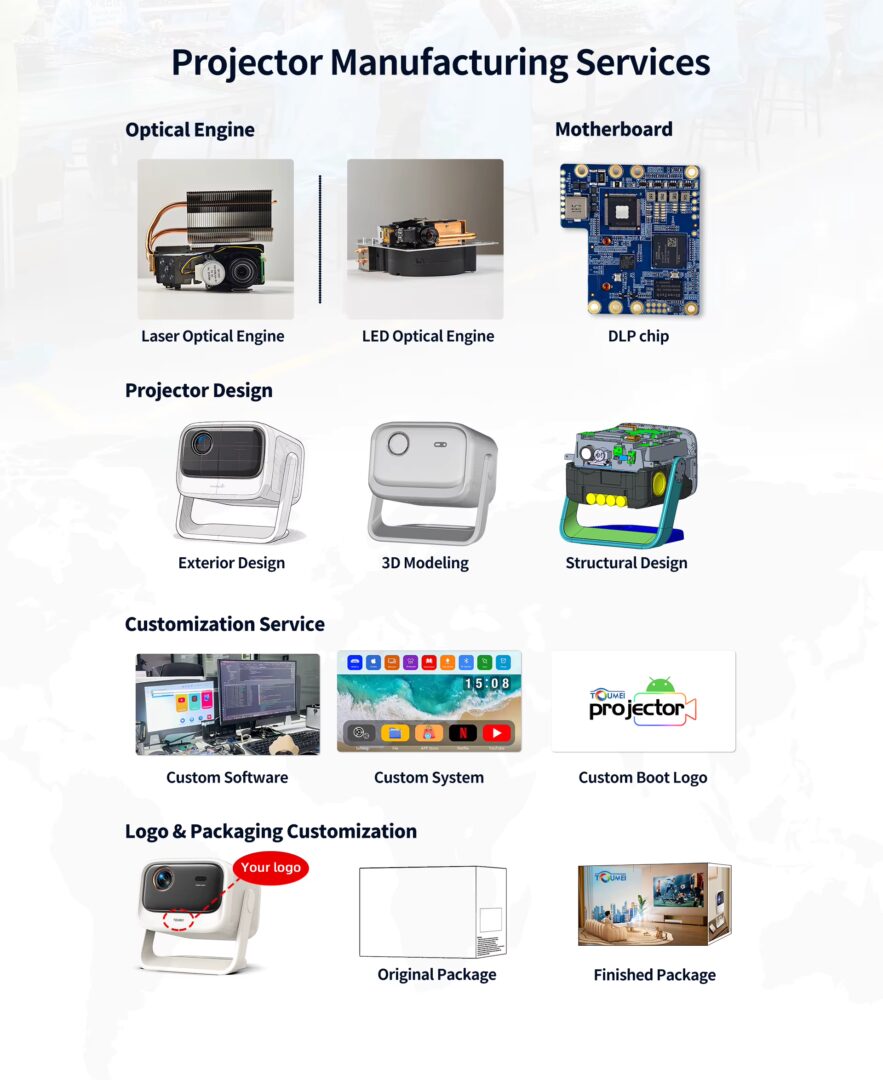
A typical example is a Shenzhen‑based DLP projector manufacturer that runs its own brand while also supplying portable and smart projectors to overseas partners. Such a factory usually maintains a dedicated collection of portable projectors – compact, battery‑powered models with Wi‑Fi, Bluetooth, and HDMI – aimed at scenarios like travel, dorms, and bedroom use. From the outside, you might encounter these units under the factory’s brand name on retail channels, and under private‑label names on Amazon and local marketplaces.
Behind the scenes, the same factory offers a structured path for partners: starting with standard wholesale of existing portable models, then, once sales data looks solid, moving into OEM/ODM projects. That may include tweaking cosmetics, adjusting specs for a particular price band, or co‑developing new models over time. Toumei, for instance, is one of the DLP projector manufacturers in Shenzhen that combines in‑house production, R&D, and a portfolio of portable and smart projectors, and works with B2B clients through wholesale and OEM/ODM channels.
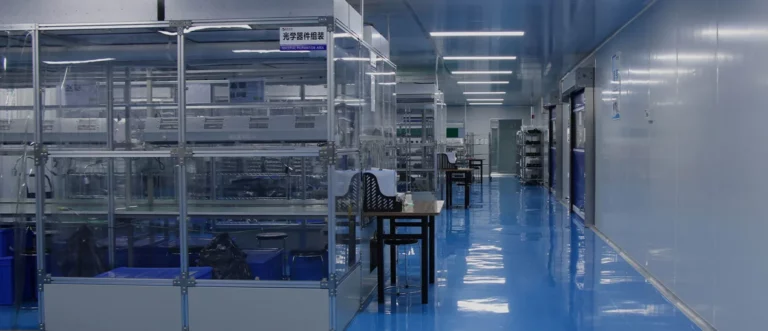
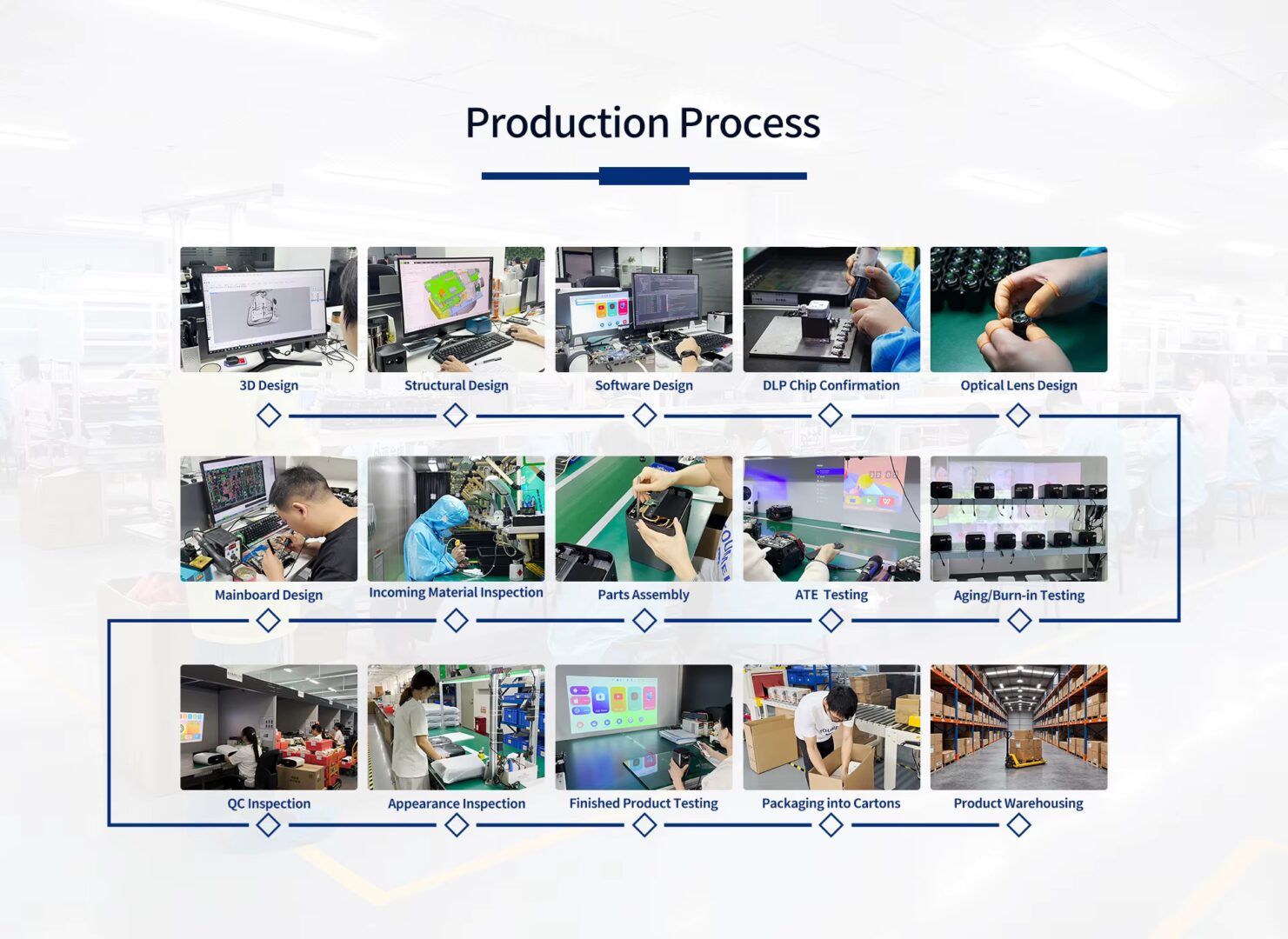
Factories operating at this level tend to have clear testing procedures (like aging tests where each projector runs for hours before shipment), organized documentation, and dedicated B2B teams – all of which are strong signals when you’re trying to identify the “best” portable projector supplier for your Amazon business.
Conclusion
Choosing the right portable projector supplier is not a one‑time decision; it’s a process of testing, learning, and building trust. If you follow a structured approach – focusing on real‑world specs, sample performance, FBA readiness, and customer feedback – you’ll be in a much stronger position to turn a small test batch into a long‑term, review‑friendly product line on Amazon.
Yes, portable projectors can be a good first product if you understand their limitations and choose your supplier carefully. They work best when you position them honestly for dark rooms, dorms, camping and casual movies, not as a “4K cinema replacement.”
For serious sourcing, it’s better to contact at least 8–10 suppliers, then narrow down to 3–5 that look professional and projector‑focused. From those, you order samples and select 1–2 factories to run real test orders with.
Many export‑ready factories accept pilot orders of 50–200 units per model for Amazon sellers, especially on existing standard models. Once you move into deeper OEM/ODM projects or new tooling, MOQs typically rise to 500–1,000 units per configuration.
At a minimum, you should expect your supplier to support CE for Europe and FCC for the US, as well as RoHS for hazardous substances. For some retail channels and higher‑end projects, additional safety marks (such as UL or equivalent) may be required.
Ask very specific questions: carton size and weight, how they normally place FNSKU labels, whether they’ve shipped directly to FBA warehouses before, and if they can share example packing photos. Suppliers with FBA experience answer these quickly and often have standard packing templates ready.
The most common mistake is choosing a supplier based only on the lowest quoted price and the “brightest” marketing numbers. That often leads to poor brightness, loud fans, unstable firmware, and high return rates that destroy your listing’s ranking.
Yes. On paper, many mini projectors look similar, but real‑world tests often reveal huge differences in brightness, focus uniformity, battery life, fan noise, and software stability. Testing samples side by side is the only reliable way to compare factories before committing to a larger order.
For battery‑powered portable projectors used in dark rooms or at night outdoors, a realistic range of around 300–600 ANSI lumens can work well. Much more important than the number is whether the image looks clean and watchable in your actual test environment.