Introduction: Why “Who Is the Best Projector Company?” Is the Wrong Question
This question lands in our inbox at Toumei almost every month: “Which company actually makes the best projectors right now?”
Sometimes it comes from a family choosing their first home projector; sometimes it is from a distributor who already sells TVs and now wants to build their own projector line.
The problem is that they are all asking the same question, but they rarely need the same answer.
A hardcore home‑cinema fan, a price‑sensitive first‑time buyer, and a brand owner who needs an OEM factory will not end up with the same “best” projector company.
If you only read rankings and reviews, you will see familiar names: XGIMI, Epson, Sony, JVC, BenQ, Optoma, Hisense, Anker Nebula, and more.
If you stand on the factory side in Shenzhen, you see a different landscape—where OEM/ODM manufacturers do the design, development, and mass production work behind many of those logos.
This article tries to combine both views: what the testing labs say, and what we see every day as a DLP smart projector OEM factory.
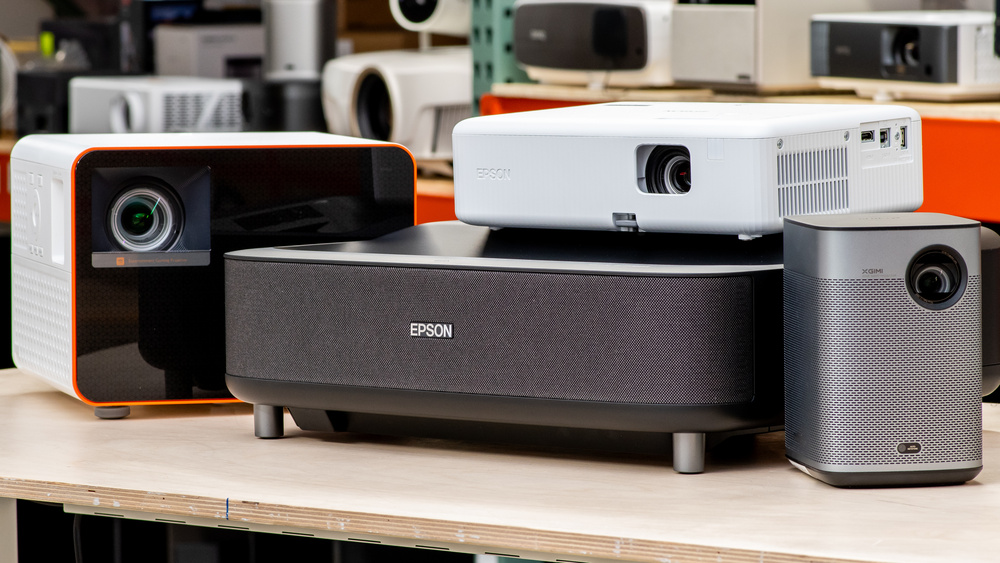
Best Consumer Projector Brands in 2026 (From Lab Tests and Reviews)
If you are an end user buying one projector for your home or office, you will mostly deal with retail brands, not factories.
Across major 2026 reviews and guides, a few groups keep showing up at the top.
Premium home theater: Epson, Sony, JVC
Independent tests still recommend high‑end Epson, Sony, and JVC models for dedicated dark‑room home theaters.
They offer bright 4K or 4K‑enhanced images, strong contrast, and accurate color, and are often paired with big fixed screens in serious cinema rooms.
From what integrators tell us, these brands are also easier to sell into custom‑install projects because installers already trust them and know how they behave over years of use.
Strong value and gaming: BenQ, Optoma, ViewSonic
For people who want a good picture without going into very high budgets, BenQ, Optoma, and ViewSonic are safe names to start with.
Reviews often highlight their decent brightness, color, and input lag at mid‑range prices, which makes them attractive for mixed living‑room use and console gaming.
We also see many overseas customers measuring their “mid‑range” OEM ideas against popular BenQ and Optoma models, because these are what they physically see in local shops.
Smart and portable: XGIMI, Hisense, Anker Nebula
On the smart‑projector and portable side, XGIMI and Hisense have several models that show up in “best projector” and “best 4K” lists, while Anker’s Nebula line remains a go‑to pick for outdoor use.
Recent testing names XGIMI’s high‑brightness DLP models among the top overall 4K projectors, and Nebula’s Mars‑series outdoor projectors are still praised for combining battery power with usable brightness.
When we talk to first‑time smart‑projector buyers, these are often the reference points they bring up: “something like XGIMI,” “similar to a Hisense laser TV,” or “a portable Nebula‑style unit but with our own brand.”
If you are a consumer, picking from these brands, based on your room, budget, and content type, will get you very close to the “best” projector for your personal situation.
Before You Pick a Brand: Four Questions to Ask Yourself
Instead of asking “Which company is the best?,” it is usually more helpful to ask four simpler questions first.
What is your main use case?
Home cinema in a dark room
Casual movies and streaming in a bright living room
Business presentations or classrooms
Outdoor movie nights and camping
Gaming‑focused use
What do you care about most?
Brightness for non‑dark rooms
Color accuracy and contrast for movies
Portability and battery for outdoor use
Low input lag for gaming
Noise level if the projector sits close to you
What budget level are you really comfortable with?
Under roughly 1,000 USD
Mid‑range
Premium 4K or laser systems
Are you an end user—or do you actually represent a brand, importer, or distributor?
End users should focus on retail models and service networks.
B2B buyers need to think about OEM/ODM, firmware control, and long‑term supply instead of just “which logo is best.”
From our side as a factory, the fourth question changes the conversation completely.
We regularly find that someone who starts by asking about “the best projector company” actually needs to understand OEM versus ODM, sample testing, certification, and after‑sales support more than they need another top‑10 list.
For Brands and Distributors, “Best Projector Company” Usually Means “Best OEM/ODM Partner”
Most consumers know front‑facing names like Epson or XGIMI, but very few think about where the actual hardware comes from.
A lot of projectors are designed and built by OEM/ODM factories in China and then shipped under different international brands.
From the factory side, when we hear “best projector company,” we translate it into a different question:
“Which partner can design, build, certify, and support the kind of projector I want to sell for the next few years?”
A strong projector OEM/ODM manufacturer is usually evaluated on these points:
Focus and specialization
Does the factory specialize in projectors and optical systems, such as Texas Instruments DLP engines, or does it treat projectors as just one SKU among many unrelated gadgets?R&D and engineering depth
Are there in‑house optical, hardware, mechanical, and software teams who can tune brightness curves, improve heat management, and integrate smart OS platforms, or is it mostly trading plus simple re‑branding?Production scale and quality control
How big is the factory, what is the real monthly capacity, and do they run standardized SMT/assembly lines and full testing on each unit?
Do they have CE, FCC, and RoHS certifications and experience passing audits from large customers?Flexibility in business models
Can they support both OEM (your design, their manufacturing) and ODM (their platforms, your brand) in a flexible way—letting you start with smaller batches, then scale up if the product performs well?Export experience, logistics, and support
Do they understand your market’s certification, labeling, and warranty expectations?
Can they advise on reasonable specs and help you avoid overpromising to your end users?
In daily work, this is where we see a clear line between short‑term trading and a long‑term projector brand.
Price and lumen numbers matter, but after the first one or two seasons, most serious customers talk more about firmware stability, batch consistency, and how fast problems are handled when they do occur.
A Shenzhen Case: Toumei as a DLP Smart Projector OEM Factory
Shenzhen has become one of the most active hubs for smart projectors and DLP‑based display products, with multiple factories serving both domestic Chinese brands and overseas partners.
Toumei (Shenzhen Toumei Technology Co., Ltd.) is one of those factories, focused specifically on DLP smart projectors.
According to its own materials, Toumei was founded in 2013 and is described as one of the earlier Chinese high‑tech enterprises dedicated to the DLP smart projector segment.
The company is headquartered in Shenzhen and operates a production base of roughly 38,000 m², with a monthly capacity in the tens of thousands of units.
Toumei works around Texas Instruments DLP chips, covering ANSI brightness ranges from about 600 to over 2,500 ANSI lumens and resolutions from native 1080p to 4K‑class platforms.
Its projectors can integrate autofocus, automatic keystone, obstacle avoidance, smart screen alignment, wall‑color adaptation, MEMC, and Android‑ or Google‑based smart TV systems, depending on customer needs.
Instead of focusing on selling to end users directly, the company positions itself as a projector OEM/ODM partner for home theater, business, education, outdoor, art and exhibition, and hospitality scenarios.
On its site, Toumei presents several product series—such as C, M, S, V, X, and Q—as starting points that can be branded and customized for different markets and price points.
How Toumei Actually Works With OEM and ODM Clients
On paper, OEM and ODM are simple definitions; in real projects, there is a lot of messy detail.
Here is how these models usually look from inside a factory like ours.
OEM: Your design, our manufacturing
In OEM mode, brands or distributors come with fairly clear ideas: industrial design, target specs, and brand language are mostly decided, and they need a factory to turn this into a stable production line.
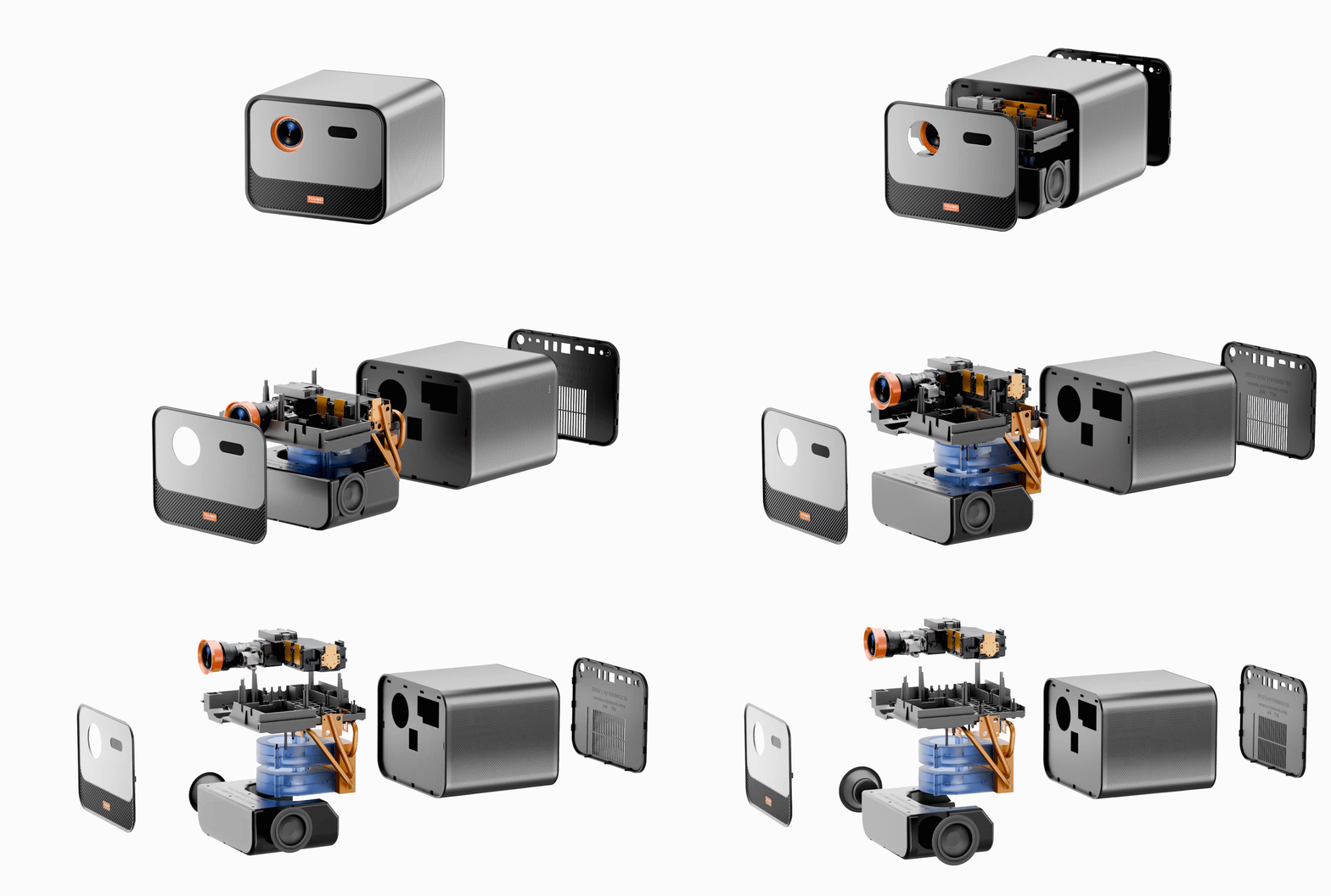
Toumei’s role is to validate the design, select suitable DLP engines and mainboards, finalize thermal and optical structures, and then run pilot and mass production with full testing.
This path makes sense for customers who already have some projector experience or a strong internal product team but want a manufacturing specialist in DLP smart projectors.
ODM: Our platform, your brand
ODM is more common for partners who know their market and channels but do not have a projector R&D team.
Toumei develops projector platforms—including optical engines, hardware, and software—and customers choose one as a base, then customize appearance, feature mix, software details, and branding.
This can significantly shorten time‑to‑market, because the platform has already gone through multiple rounds of internal and external testing.
It also lets buyers pick a realistic balance between performance, feature set, and cost instead of trying to design everything from scratch.
What the day‑to‑day looks like from the factory side
Most of our daily work is not glamorous.
We sit in video calls with overseas customers, tweak brightness curves for their preferred screen size, argue about fan‑noise targets versus heat, and run the same aging tests again and again on sample units.
When first‑time buyers contact us, many start by asking about unit price and lumen numbers.
After their first one or two projects, almost all serious partners come back talking about something else: firmware stability, image consistency between batches, and how quickly we can trace and fix issues when a small percentage of units misbehave in the field.
From our side, this is usually the moment when someone stops being “just a trading customer” and starts building a real projector brand.
At that point, the “best projector company” for them is the one that will still pick up the call three years later, not just the one that quoted the lowest price at the beginning.
So, Which Company Really Makes the Best Projectors?
If you are an individual buyer, it is reasonable to say that brands like XGIMI, Epson, Sony, JVC, BenQ, Optoma, Hisense, and Anker Nebula are among the safest places to start in 2026, depending on whether you care more about cinema‑level picture quality, gaming, or portability.
Matching these brands’ strengths with your room, content type, and budget will usually matter more than debating which logo is “number one.”
If you are a brand owner, importer, or distributor, the “best projector company” is almost never just a name on a retail box.
It is the OEM/ODM partner that can help you design realistic products, navigate certifications, keep batches consistent, and support you through multiple generations of devices.
From that angle, specialized DLP smart projector factories in Shenzhen—Toumei included—are part of the answer to “who makes the best projectors,” even if consumers never see our name on the front of the device.
If you are exploring OEM or ODM projector projects, you can learn more about Toumei’s platforms, cooperation models, and support on the official site and its OEM/ODM overview page.
There is no single “best” company for everyone; it depends on whether you care more about cinema‑level image quality, price, gaming, or portability. For most buyers, matching a trusted brand with the right room, content type, and budget matters more than chasing one “number one” logo
Major 2026 reviews consistently highlight XGIMI, Epson, Sony, JVC, BenQ, Optoma, Hisense, and Anker Nebula as strong options for different use cases. These brands cover premium home theater, high‑value mid‑range models, and smart/portable projectors.
Independent tests still recommend high‑end Epson, Sony, and JVC models for dedicated dark‑room cinema setups. They deliver bright 4K or 4K‑enhanced images with strong contrast and accurate color, and are popular with custom installers.
BenQ, Optoma, and ViewSonic are frequently praised for balancing brightness, color performance, and low input lag at mid‑range prices. This makes them popular for living‑room movie nights and console gaming on a budget.
XGIMI and Hisense repeatedly appear in “best projector” and “best 4K projector” lists thanks to their bright smart DLP and laser models. Anker’s Nebula line, especially Mars‑series units, remains a go‑to choice for outdoor and battery‑powered use.
You should clarify your main use case (home cinema, living‑room streaming, business, classroom, outdoor, or gaming) and what you value most, such as brightness, color accuracy, portability, input lag, or noise. You also need to decide on a realistic budget and whether you are an end user or a brand/distributor, because that completely changes which “best projector company” you should look for.
For B2B buyers, the “best projector company” is usually the best OEM/ODM partner, not the retail logo on the box. The key is finding a factory that can design, build, certify, and support your projector line reliably over several years.
Toumei (Shenzhen Toumei Technology Co., Ltd.) is a Shenzhen‑based OEM/ODM factory focused on DLP smart projectors rather than direct retail sales. Founded in 2013, it runs a large production base, develops DLP platforms from about 600 to 2,500+ ANSI lumens and up to 4K‑class resolution, and works with brands worldwide on home, business, education, outdoor, and hospitality projector projects.