UST projectors for distributors need a complete selling plan: a defined customer, a tested product-and-screen offer, and a service model that works after the sale. A premium price alone does not establish demand or profit. Before committing inventory, check what the customer will receive, what each sale will cost to fulfill, and who will handle setup and support.
This guide focuses on launching a UST offer through a distribution channel. For platform and customization discussions, use TOUMEI's projector OEM/ODM project review. Keep technical sample approval and commercial launch approval as separate decisions.
Define the Offer Before Setting a Selling Price
Start with one customer situation you can demonstrate and support. For example, a home entertainment dealer may offer a projector with a specified screen and local installation. An online distributor may sell the projector alone with clearly defined setup requirements. These offers have different costs and responsibilities, even when they use the same projector.
Record the exact model, hardware and software configuration, included accessories, screen if supplied, installation scope, training, and support contact. Confirm placement and screen requirements from the selected model's documentation and sample evaluation. Avoid advertising a universal screen size, room fit, light-source life, or smart feature across the whole UST category.
TOUMEI's S2 UST projector product page provides a starting point for a model discussion. Obtain a configuration-specific quotation and installation information before building a local sales package.
Calculate Contribution Per Sale and Launch Costs Separately
Build the calculation from actual quotations and local costs. Use the same currency and a consistent tax basis throughout. A useful planning calculation is:
Contribution per completed sale = net sales revenue − costs that vary with that sale.
Include the projector, screen and accessories you supply, freight, applicable import costs, channel and payment fees, delivery, installation, training, and an allowance for returns and service based on your own evidence. Avoid counting a cost twice if it is already included in another quotation. If the service allowance is still unknown, show it as an assumption and test a range; do not substitute an invented industry defect rate.
Track demonstration units, staff training and other one-time launch spending separately. Contribution is not net profit: fixed operating costs and launch spending still need to be covered. A positive result on paper is a condition to investigate, not a guarantee of a successful launch.
| Decision | Record before committing inventory |
|---|---|
| Selling package | Exact projector configuration; screen and accessories; installation and training included or excluded. |
| Economics | Net selling revenue, variable costs, service assumptions and contribution per sale; launch spending listed separately. |
| Delivery responsibility | Named owner for site checks, setup, user instruction, returns, repairs, replacement parts and firmware questions. |
| Commercial pilot | Channel, review date, evidence to collect, and agreed conditions to expand, change or pause the offer. |
Put Installation and Support Responsibilities in the Offer
Decide who confirms the customer's intended setup before an order is accepted. Specify who supplies the screen, checks placement, performs installation and explains routine operation. If those services are excluded, make that clear before purchase rather than leaving the customer to discover the gap.
Agree how a customer reaches support and how the distributor escalates a hardware, software or installation issue. Record the evidence needed for diagnosis, repair arrangements, spare-parts ordering, and who bears the relevant costs. Product warranty, local service labor, transport and customer returns need their own agreed terms.
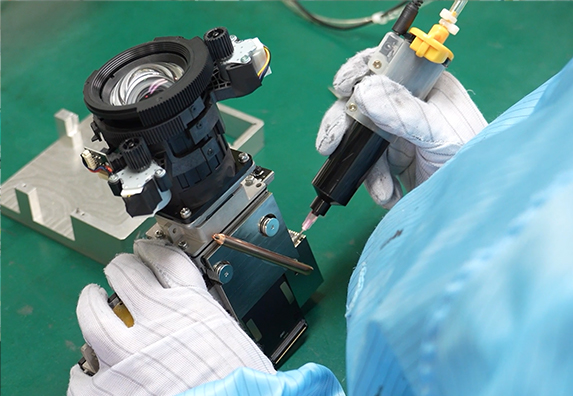
TOUMEI offers a one-year warranty and can provide spare parts. Confirm the applicable service process and cost allocation for your project. The assembly image illustrates component work; it does not identify the selected UST configuration or establish its certification or measured performance.
Approve Sales Claims for the Exact Configuration
Keep a claim sheet alongside the quotation. For each advertised feature or performance number, record the applicable model, version, supporting document and approval. Ask for destination-specific compliance documentation and confirm its scope. TOUMEI can assist with certification requirements for the relevant country and configuration; do not present that assistance as blanket certification for every market.
AOSP or a customized operating system does not by itself establish platform certification or permission to supply particular apps. The official AOSP documentation distinguishes devices running derivatives of the source code from devices identified as Android-compatible through the compatibility program. [1] Confirm any platform or app authorization separately before using it in sales material.
Discuss AOSP and TOUMEI custom OS options for the selected platform. Do not describe a configuration as officially Google TV certified until that configuration and its authorization evidence have been verified. Apply the same discipline to power, product-life and environmental claims: use supporting documentation rather than general claims about sustainability.
Use a Commercial Pilot to Decide Whether to Expand
A technical sample evaluation asks whether the configuration meets agreed requirements. A commercial pilot asks whether your channel can sell, deliver and support the defined offer at workable economics. Passing the first does not establish the second.
Before the pilot, set a review date and your own decision criteria. Record completed sales, inventory sold, actual fulfillment and installation time, setup questions, support workload, return reasons, and contribution after observed costs. Separate inquiries and demonstrations from completed sales. Do not claim that an inquiry, a sample approval or a shipment proves customer demand.
Expand only when the agreed commercial and delivery conditions are met. Adjust the package when support effort or installation costs undermine the offer. Pause when essential product claims remain unresolved or the tested economics do not support the launch. Set thresholds from your business requirements; there is no default margin or pilot quantity promised here.
Prepare a TOUMEI Distribution Project Brief
Send the destination country, sales channel, customer setup, proposed product-and-screen package, estimated quantities, customization requests and launch date. Include the documents and local service responsibilities you need confirmed. TOUMEI has 15+ years of DLP projector development and manufacturing experience, with in-house R&D.
Samples can be requested separately from the production MOQ of 120 units. For established models, production dispatch is within 14 days after the configuration is confirmed and the agreed payment is received. Confirm customized-project milestones separately; this is not an arrival-date commitment.
Use the projector sample testing checklist for technical acceptance, then contact TOUMEI to review a UST distribution project or request a sample. Bring your channel assumptions as well as the product requirements so the discussion can address the complete offer.
References
[1] Android Open Source Project, AOSP frequently asked questions: relationship to the Android Compatibility Program. Page updated June 17, 2026; accessed November 6, 2026. Supports the distinction between using AOSP-derived source and Android compatibility. It does not verify any TOUMEI configuration or app authorization.