Lately, more of our overseas partners are asking us the same question: Is it still worth selling low-cost LCD projectors, or is it time to switch to DLP and laser models? We see this dilemma every day in our Shenzhen factory. Many Amazon sellers come to us after experiencing 10% or even 15% return rates on their budget models. They are tired of seeing their profit margins erased by “dust on screen” complaints or negative reviews about loud fan noise. In 2026, the sourcing market is no longer about finding the absolute cheapest unit; it is about finding a way to reduce return risk and build a brand reputation that lasts. Choosing a specialized laser projector manufacturer in China is the most direct way to solve these quality issues before they ever reach your customer’s doorstep.
Why Serious Buyers Are Moving Away from Cheap LCD Projectors
The primary pain point we hear from purchasing managers isn’t the cost of the goods—it’s the cost of the returns. In the US and European markets, consumers have become savvy. They are tired of projectors that claim “10,000 lumens” but look washed out the moment a lamp is turned on. They are frustrated with units that lose focus at the edges or develop black spots because the optical engine wasn’t properly sealed.
From our work with overseas buyers, we have seen that a high return rate is the fastest way to lose an Amazon listing’s organic ranking. When we analyze returned units from the market, the failures are consistent: weak brightness, loud fans that drown out the movie, and unstable software. By switching your sourcing strategy to a specialized laser projector factory in China, you are moving away from “toy-grade” hardware and toward a more reliable product platform. Laser and DLP technology allows you to offer the brightness and durability that justify a 400to800 price point, where the competition is less about price and more about the user experience.
Why Laser and DLP Projectors Are the Practical Choice for 2026
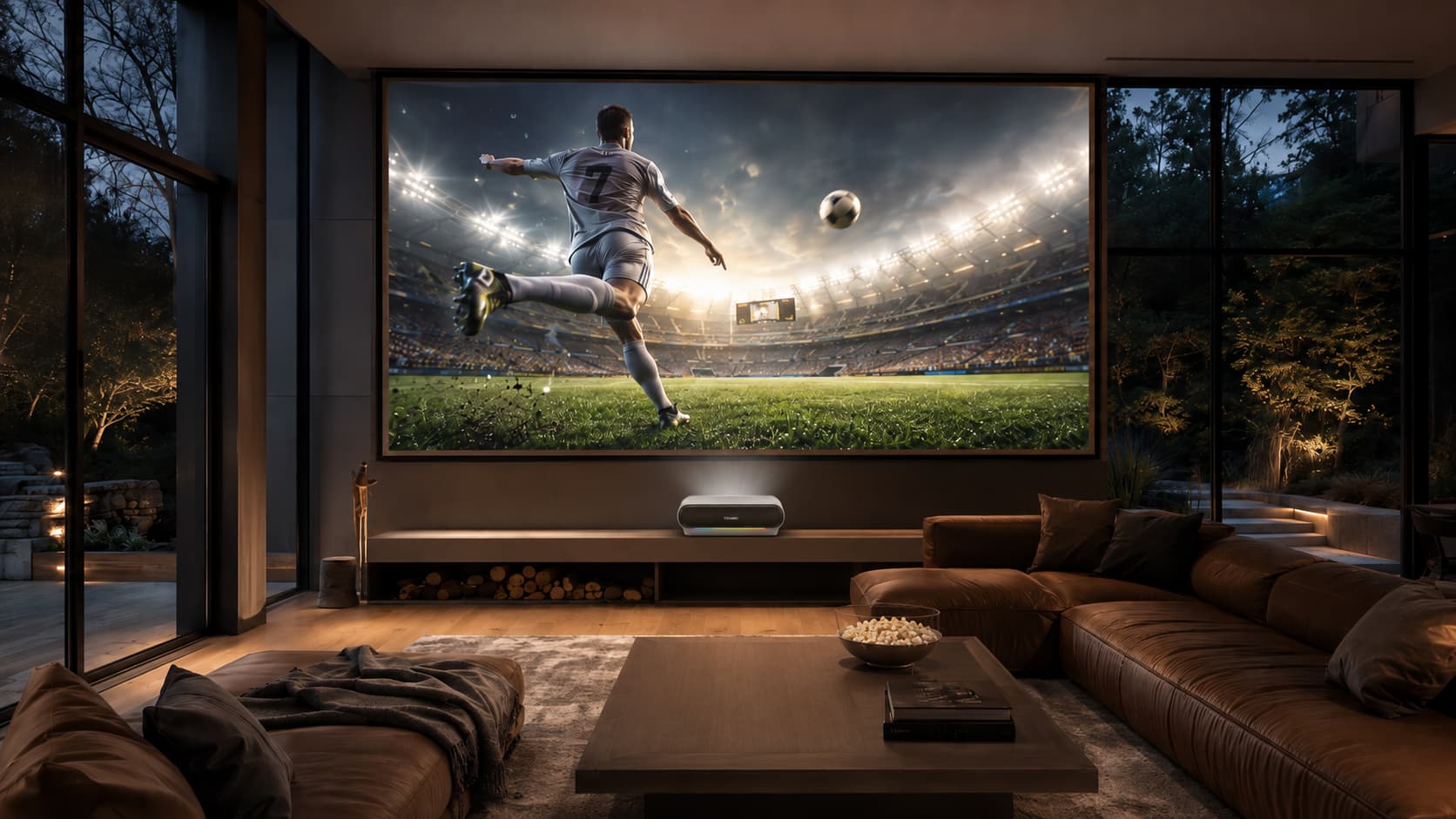
To understand why laser technology is becoming the default for serious brands, you have to look at how the hardware actually performs in a customer’s living room. Traditional LED units have hit a wall; to make them brighter, you need bigger fans and bigger boxes. This makes them noisy and bulky—the two biggest complaints in home theater reviews.
Laser light sources, specifically ALPD and RGB laser technology, are much more efficient. We can now support higher ANSI brightness in a more compact form factor. This means your customers get a “TV-like” image from a projector they can fit on a bedside table. Furthermore, our DLP laser projector manufacturing process uses a more enclosed optical engine design. While no unit is 100% airtight, this mechanical design significantly reduces the risk of dust entering the light path compared to open-frame LCD models. For a brand owner, this transition means a cleaner image, a quieter fan, and a product that stays in the customer’s home instead of being shipped back to an FBA warehouse.
Why China Remains the Strongest Base for Laser Projector Sourcing
A common question we get is whether the China projector supply chain is still the best option in 2026. The answer lies in the concentrated supply chain here in the Shenzhen and Dongguan region. Within a short drive of our factory floor, we have our Tier-1 partners for optical lenses, PCBAs, laser diodes, and high-precision mold makers.
This proximity is what allows us to iterate so quickly. If a buyer needs a structural change for a new model or a software tweak for a specific market, our engineers can coordinate with component suppliers in person the same day. This speed is something you simply cannot find in other manufacturing hubs. Whether you are looking for a quick private-label launch or a full ODM project with custom tooling, the infrastructure here in China provides the flexibility to scale your business while keeping lead times manageable.
What a Real Laser Projector Manufacturer in China Should Offer
Distinguishing between a real laser projector factory in China and a trading company is the most important part of your sourcing journey. A true manufacturer is defined by their engineering depth and their ability to control the assembly environment.
Optical Assembly and Dust Control
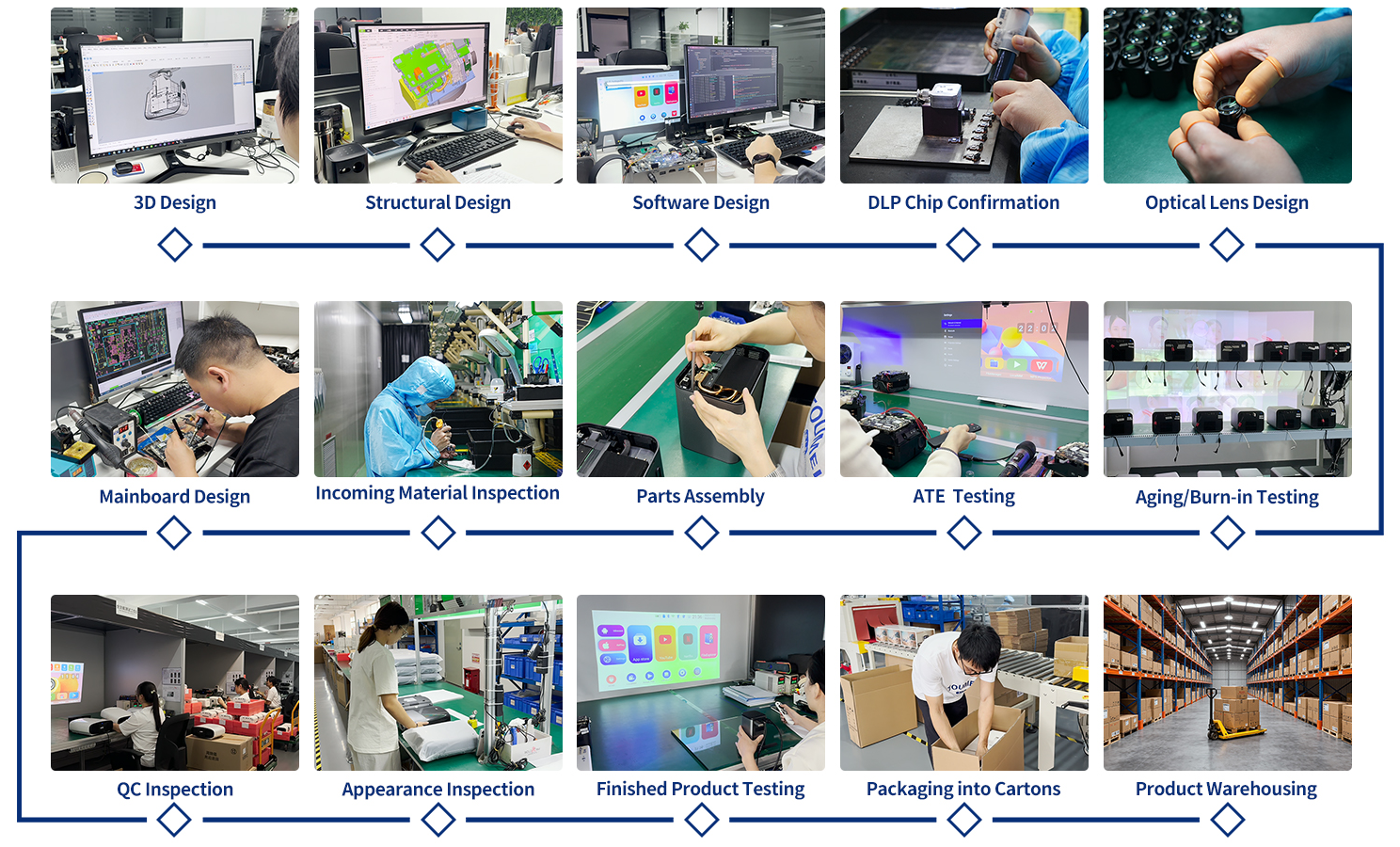
Laser and DLP units are highly sensitive. Even a microscopic speck of dust on the DMD chip or the laser diode during assembly will show up as a black spot on the screen. This is why we maintain controlled dust-free assembly areas for all critical optical engine processes. We monitor humidity, temperature, and air particles 24/7. When you are vetting a supplier, ask for a live video walkthrough of their cleanroom. If they are assembling projectors in a standard open warehouse, they cannot guarantee a clean optical path.
In-House Engineering and Thermal Management
Laser engines generate intense heat in a small area. If a factory doesn’t have its own thermal engineers, the projector will either overheat or have a fan that sounds like a jet engine. We help the laser diode stay within a stable temperature range by optimizing internal airflow and using high-efficiency heat sinks. This supports the long service life—often over 20,000 hours—that premium customers expect.
Real-World Quality Control (QC) Details
A 9/10 factory doesn’t just “check” the units; we put them through a rigorous testing protocol. Our QC process includes:
- 9-Point Brightness Inspection: We measure ANSI lumens at nine different points on the screen to ensure brightness uniformity.
- Focus Uniformity Check: We test the focus at the center and all four corners to avoid the “blurry edge” issue.
- Color Calibration: Every batch is calibrated to ensure color accuracy matches the technical brief.
- Wi-Fi and Bluetooth Stress Test: We test connectivity at various distances to ensure stable streaming.
- Firmware Version Verification: We double-check that the correct, localized software version is installed before packing.
- Remote Control Response Test: Every remote is tested for responsiveness and pairing stability.
- Carton and FNSKU Barcode Check: For Amazon sellers, we verify that every barcode is scannable and placed correctly according to FBA rules.
OEM/ODM Laser Projector Options for Amazon Sellers and B2B Brands
Portable Laser Projectors
These are compact, often battery-powered units for camping or travel.
- Buyer Concerns: Battery life, wireless casting, and size.
- Customization: We provide custom colors, branded carrying cases, and retail-ready packaging.
Home Cinema Laser Projectors
Designed as a primary living room device with 1080P or 4K resolution.
- Buyer Concerns: Real ANSI lumens, contrast ratios, and fan noise.
- Customization: Custom remote controls, sound tuning for built-in speakers, and premium textures.
Smart Projector Platforms
The most popular choice for Amazon private labels. These units come with integrated streaming apps.
- Buyer Concerns: App compatibility, OTA updates, and UI speed.
- Customization: We customize the boot logo, the launcher UI, and optimize the firmware for your target market.
Short-Throw and UST Laser Projectors
Ultra Short Throw (UST) units project a 100-inch image from just inches away.
- Buyer Concerns: Optical precision, heat dissipation, and screen compatibility.
- Customization: Usually involves full ODM development for a unique industrial design.
Typical OEM/ODM Project Timeline for Laser Projectors
- Project Brief and Material Readiness (1 Week): We select the platform and check component lead times.
- Sample Preparation and Testing (1–2 Weeks): Standard models can often be prepared in 3–7 days.
- Customization Design (2 Weeks): Finalizing your logo, packaging, and UI specs.
- Pilot Run and Golden Sample (2 Weeks): We produce a small batch to confirm everything is perfect before mass production.
- Mass Production (30–45 Days): The actual manufacturing time.
- AQL Inspection and Loading (1 Week): Final checks and logistics coordination.
Certifications and Documents for Developed Markets
Importing laser hardware is a high-scrutiny process. We prepare all technical files to ensure smooth delivery:
- FDA Accession Numbers: Mandatory for the US market. We provide the laser safety reports required for customs.
- FCC/CE/RoHS/UKCA: We maintain base reports and help you apply for co-licensed versions under your own brand name.
- FBA-Ready Documentation: We ensure all labeling and warning marks meet Amazon’s strict consumer safety laws.
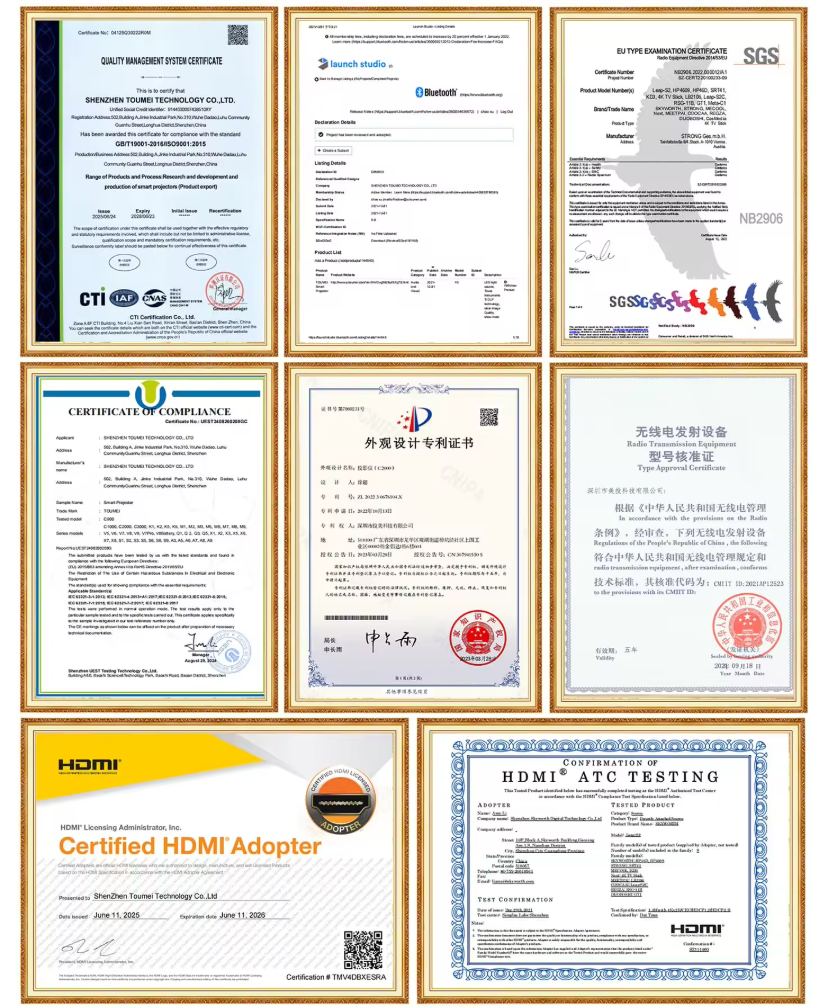
How to Verify a Real Laser Projector Factory in China
In an industry full of salespeople, you need to verify the engineering depth.
- Ask for Technical Change Records: A real manufacturer has a history of firmware updates and hardware revisions.
- Review the Aging Test Room: Every unit should be running for 48 hours straight. If you don’t see an aging room, they aren’t testing properly.
- Check BSCI/ISO9001 Reports: These third-party audits verify that the factory actually exists and follows quality standards.
Common Mistakes When Choosing a Laser Projector Supplier
- Choosing Based Only on Price: If it’s too cheap, they are using b-grade laser diodes or skipping the cleanroom.
- Ignoring Fan Noise: High return rates are often caused by projectors that are too loud to use in a small room.
- No After-Sales Protocol: You need to know exactly how they handle the occasional DOA (Dead on Arrival) unit before you pay the deposit.
Buyer Checklist Before Placing an Order
- Physically tested a sample in a living room environment (not just a showroom).
- Confirmed real ANSI lumen data with a 9-point test report.
- Tested fan noise levels under normal movie playback.
- Verified Wi-Fi and streaming app compatibility in your target country.
- Reviewed carton marks, FNSKU labels, and safety warnings.
- Discussed spare parts or DOA replacement support.
- Approved the “Golden Sample” as the mass production benchmark.
- Confirmed the FDA/FCC certifications are valid for your specific model.
- Verified the software UI translation is natural and accurate.
- Confirmed the lead time for both the first order and future repeat orders.
Conclusion
The projection market in 2026 is no longer about who can sell the cheapest box; it is about who can provide a reliable product platform. By partnering with a dedicated laser projector manufacturer in China, you are securing the technical foundation of your business and reducing your sourcing risk. We provide the engineering depth and manufacturing transparency required to succeed in a demanding global market.
If you are planning a private-label laser projector launch or comparing projector OEM factories in Shenzhen, we are ready to help. We can review your target price, brightness needs, and launch schedule to find the right fit. Contact us today to request a quotation, check sample availability, or start an OEM/ODM project discussion.
Yes. We can help you review your target price and brightness needs to decide if a high-end laser engine or a mid-range DLP platform is better for your brand.
MOQ depends on the model. Many private-label projects start from 500 units, while full ODM projects with new tooling usually require 2,000+ units.
Absolutely. We provide the dieline for your designers or can handle the layout for you, ensuring all legal and safety text is included.
We provide OTA (Over-The-Air) update support. If a bug is found or an app needs an update, your customers can download the fix directly on the projector.
You will need FDA (for laser), FCC (for US), and CE/RoHS/UKCA (for Europe/UK). We provide all the base reports to make this process easy.
We use controlled dust-free assembly areas for the optical engine and conduct final "black screen" tests to ensure no artifacts are visible.