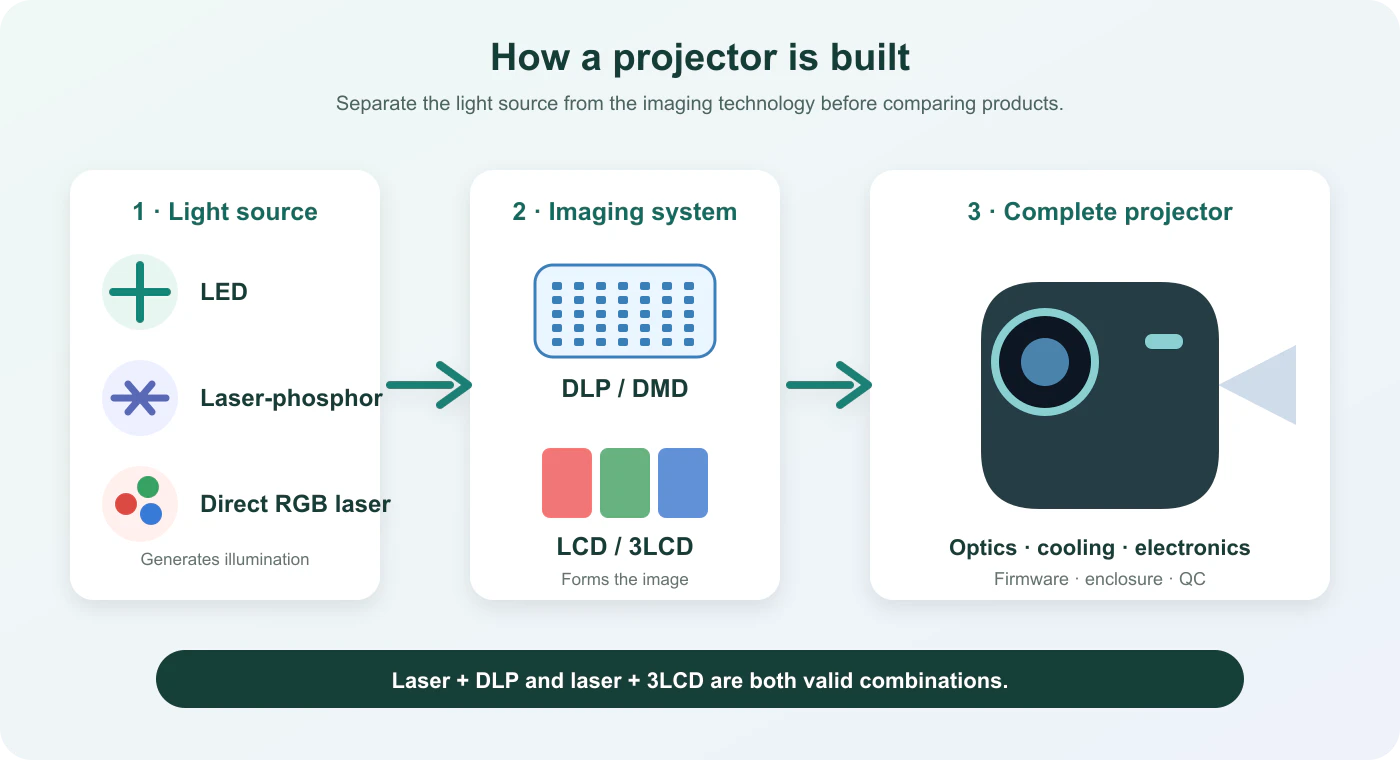
A laser projector uses a laser-based light source. DLP and LCD describe how a projector forms the image. That means a projector can be both laser and DLP, or both laser and LCD. Asking “Is laser better than DLP?” mixes two different parts of the system.
For a buyer, the better question is: Which combination of light source, imaging technology, optics, cooling, firmware and product design fits the market you plan to serve? This guide explains the architecture first, then turns it into a practical comparison and sample-testing plan for brands and distributors.
What Is a Laser Projector?
A laser projector replaces a conventional lamp or LED illumination system with one or more laser-based light sources. The light still has to pass through an imaging system and projection optics before it reaches the screen.
Common implementations include:
- Laser-phosphor: a laser excites a phosphor material, and the system uses the resulting light to form the required colors.
- Direct RGB laser: separate red, green and blue laser sources generate the three primary colors.
- Hybrid designs: a product may combine laser and other solid-state light sources, depending on the optical architecture.
“Laser” alone does not tell you the imaging technology, real measured brightness, color performance, resolution, throw ratio, noise or long-term stability. Those outcomes depend on the complete design and the operating mode.
How DLP Forms the Image
Texas Instruments explains that a DLP system centers on a digital micromirror device (DMD) covered with microscopic mirrors. The DMD, controller and power-management components work with an illumination system and optics to modulate light into an image. 1
The DMD is therefore an imaging component. It does not require one specific light source. TI describes DLP projection systems that support laser or LED illumination, which is why both laser DLP and LED DLP products exist. 2
In a single-chip DLP design, color can be produced through sequential illumination. The exact light-source and color architecture matters: a lamp-and-color-wheel design, an LED design, a laser-phosphor design and a direct-RGB-laser design should not be treated as interchangeable simply because each uses DLP imaging.
How LCD and 3LCD Form the Image
LCD projectors use liquid-crystal panels to control the light that forms the image. In a three-chip 3LCD architecture, the optical system separates red, green and blue light, sends the channels through three LCD panels and recombines them before projection.
Epson’s description of its 3LCD systems is a useful real-world example: the company uses three LCD chips and also sells projectors that pair 3LCD imaging with laser illumination. 3 A 3LCD laser projector is therefore both an LCD projector and a laser projector.
Architecture does not automatically establish superiority. A buyer still needs the exact model specification, measured output, lens behavior, thermal design, calibration and sample results.
Laser vs DLP vs LCD: Use the Right Comparison
The first comparison should separate imaging technology from light source.
| Question | DLP | LCD / 3LCD | LED | Laser |
|---|---|---|---|---|
| What is it? | An imaging technology built around a DMD and supporting electronics | An imaging technology built around one or more LCD panels | A solid-state light source | A laser-based light source |
| What does it mainly control? | How incoming light is modulated into pixels | How light passing through the panels is modulated into an image | How illumination is generated | How illumination is generated |
| Can it be combined with another column? | Yes; DLP can use LED or laser illumination | Yes; LCD/3LCD can use lamp, LED or laser illumination, depending on the design | Yes; often paired with DLP or LCD imaging | Yes; commonly paired with DLP or 3LCD imaging |
| What should a buyer verify? | DMD and controller configuration, native imaging resolution, color architecture and optical design | Panel architecture, alignment, light path, color behavior and optical design | Measured output, thermal management, color calibration and operating mode | Laser-phosphor or direct RGB architecture, measured output, thermal management, speckle behavior and calibration |
This structure prevents a common purchasing error: comparing a complete “laser projector” with a bare “DLP” label as though the terms describe equivalent categories.
Three Laser-Projector Architectures Buyers Commonly Encounter
1. Laser-Phosphor DLP
In a laser-phosphor design, laser energy excites a phosphor material. The optical system then manages the resulting light and directs it to the DLP imaging path. This architecture is used across different product classes because it can support solid-state operation without requiring separate direct laser sources for all three primary colors.
For sourcing, ask:
- Which laser-phosphor architecture and DLP chipset does the proposed platform use?
- What output is measured at the complete projector, in which picture and power mode?
- How are focus, color and brightness checked after thermal stabilization?
- Which cooling parts and filters, if any, require maintenance?
- Which components are fixed on the existing platform, and which can be modified?
Do not infer color gamut, lifetime or maintenance intervals from the phrase “laser-phosphor” alone. Request the proposed model’s data and test conditions.
2. Direct RGB Laser DLP
A direct-RGB system uses separate red, green and blue laser sources. It can support a wide color range, but system performance depends on optical alignment, control, thermal behavior and calibration. Coherent laser light can also make speckle visible under some combinations of projector, screen and viewing condition.
RGB laser should therefore be evaluated as an engineering package, rather than a premium label. Test the actual screen types and viewing distances expected in the target market. Record whether a visible artifact changes with content, screen material or viewing position.
For a deeper comparison, see RGB Laser vs Laser Phosphor: Color, Optics and Cost and Laser Speckle in DLP Projectors: Causes and Reduction Methods.
3. Laser 3LCD
A laser 3LCD projector combines a laser-based illumination system with three LCD imaging panels. Epson product documentation, for example, lists both a laser diode light source and a three-chip 3LCD projection system in the same projector. 4
This is direct evidence that “laser” and “LCD” are not competing labels. Buyers considering a 3LCD platform should verify panel alignment, color and white light output, lens requirements, size, service plan and suitability for the installation.
Do Laser Projectors Always Produce a Better Image?
No single light-source label guarantees a better picture. A laser platform may offer useful operating characteristics, but the result on screen still depends on several linked decisions:
- Measured light output: use the complete-projector measurement and keep the test method, configuration and mode attached to the number.
- Color performance: compare the defined color space, calibration mode and test result, rather than relying on “vivid” or “cinema color.”
- Native imaging system: identify the DMD or panel configuration and distinguish accepted input formats from the image formed on screen.
- Lens and focus consistency: evaluate the center, edges and corners at the intended throw distance and image size.
- Contrast and black level: test in a controlled room with the intended screen; dynamic marketing ratios are not enough for a sample decision.
- Thermal stability and noise: run the unit long enough to observe focus drift, fan behavior, color changes and unexpected shutdowns.
- Artifacts: check rainbow sensitivity where relevant, RGB-laser speckle, motion behavior and visible nonuniformity.
ISO’s public catalogue says ISO/IEC 21118:2020 specifies information for data-projector specification sheets and includes measurement conditions for items such as light output, contrast, uniformity, noise and power consumption. 5 Ask which method and edition support a supplier’s claim, and request the result for the proposed configuration.
For brightness-specific review, use ANSI Lumens Explained: How to Compare Projector Brightness.
Match the Architecture to the Product Brief
Start with the use case and sales position, then ask the supplier to recommend a platform. A specification assembled from the highest number in every column may produce a product that is too large, too expensive or too difficult to cool for its intended channel.
| Product-brief question | Why it changes the recommendation |
|---|---|
| Where will the projector be used? | Ambient light, duty cycle, placement and screen conditions affect the required optical system. |
| What retail tier is the brand targeting? | The light source, DMD or panels, lens, memory, wireless hardware and enclosure all affect cost. |
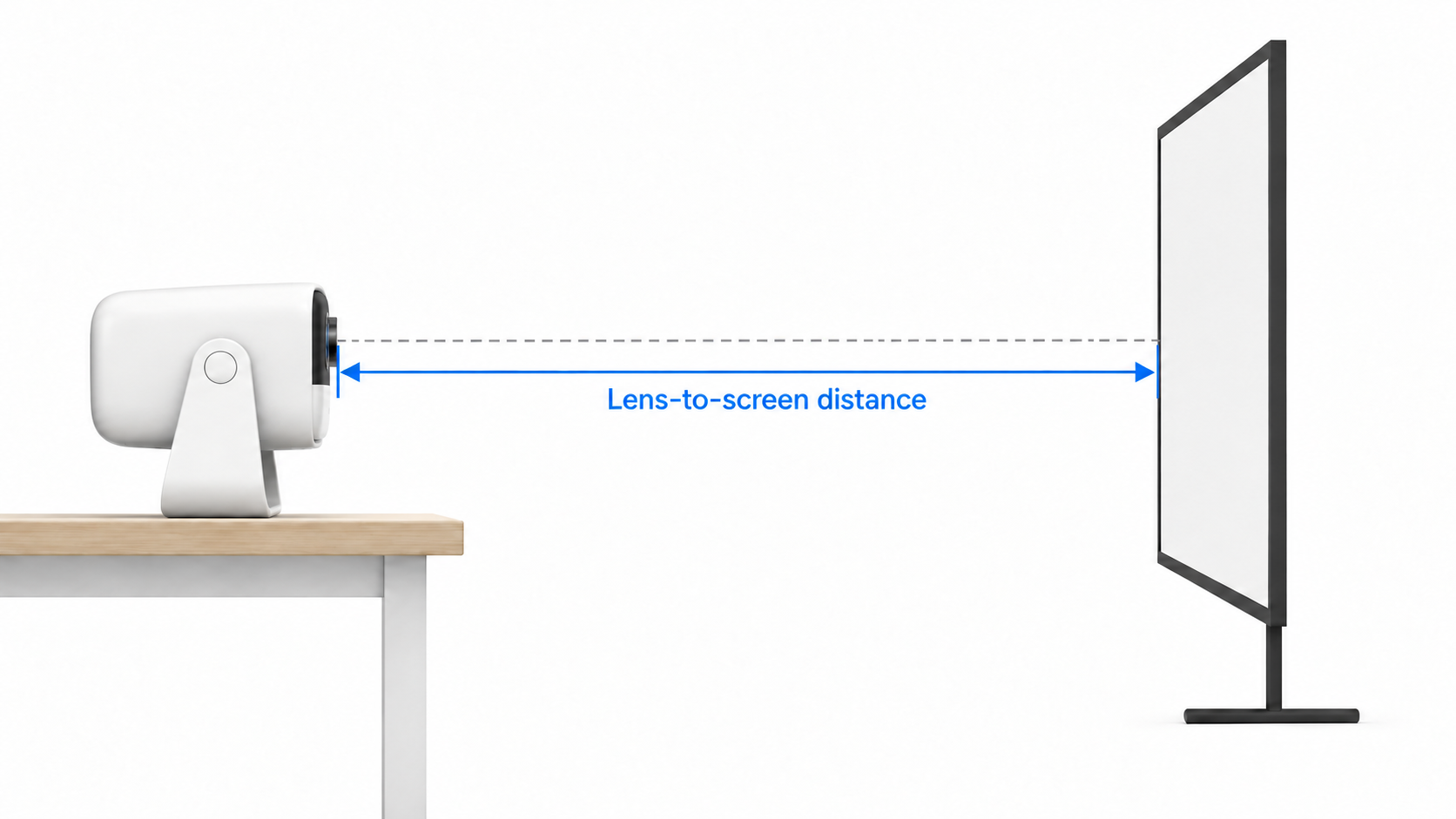
| What image size and throw distance are required? | These determine lens and placement requirements and influence real-room brightness. |
| Must the product be portable? | Optical-engine size, heat-sink volume, fan design, adapter and battery requirements compete for space. |
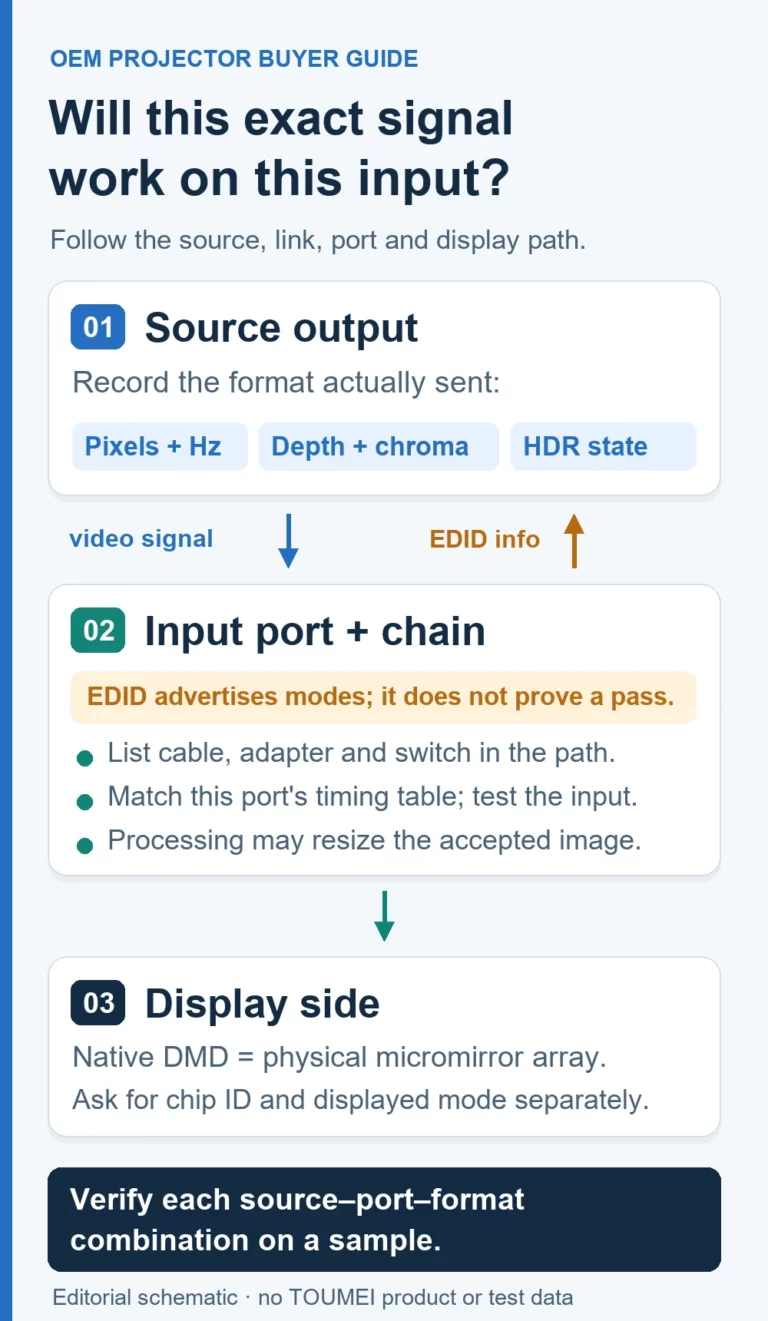
| Which sources and applications must work? | HDMI timing, wireless protocols, firmware, DRM and app authorization are separate requirements. |
| What will the brand claim on the listing and packaging? | Each measurable claim needs a method, applicable configuration and supporting evidence. |
What Should an OEM Buyer Specify?
Send the supplier a brief that connects the customer offer to a testable configuration. Include:
- Destination market and expected retail position.
- Primary use case, room conditions, image size and throw distance.
- Preferred light-source and imaging architecture, if already decided.
- Required resolution and accepted input formats.
- Brightness claim and the measurement evidence you expect.
- Required ports, wireless functions, audio and control features.
- User-interface language, startup branding, firmware and OTA requirements.
- Logo, color, packaging and accessory changes.
- Required destination-market documents for the final brand and configuration.
- Estimated sample and production quantities.
TOUMEI’s recommended route is to begin with an existing developed model and define the changes needed for the target market. Mainboard, housing, 3D-model and structural requests should be evaluated against that platform. This keeps the sample tied to a known optical, thermal and mechanical design.
TOUMEI supports OTA and firmware work on applicable projects. Do not assume that Google TV, Google services, Netflix, DRM or another licensed platform is included. Authorization and permitted marketing language must be established separately for the selected product.
Sample Tests Before a Purchase Order
A laser-projector sample should prove the offer your brand intends to sell. Record the sample identifier, hardware configuration, firmware, adapter, remote and accessories before testing.
Use repeatable conditions for the following checks:
- Image and optics: center-to-corner focus, uniformity, color, shadow detail, visible artifacts and supported placement.
- Brightness evidence: stated method, mode, power source, image size, report and result for the proposed configuration.
- Thermal behavior: startup, warm-up, sustained operation, focus stability, fan behavior and surface-temperature concerns.
- Connections: required HDMI sources, wireless paths, audio routes, input switching, standby and reconnection.
- Software: first-run flow, menu languages, brand assets, settings retention, firmware version, OTA and documented recovery route.
- Physical configuration: enclosure finish, label, ports, adapter, remote, packaging and accessories.
- Documents: model and adapter identifiers, configuration, destination, brand name and the scope of each applicable report or certificate.
Approve the unit only when the recorded configuration and unresolved issues are clear. See the full Projector Sample Testing Checklist for Private-Label Brands for a reusable approval record.
From Sample to Production Control
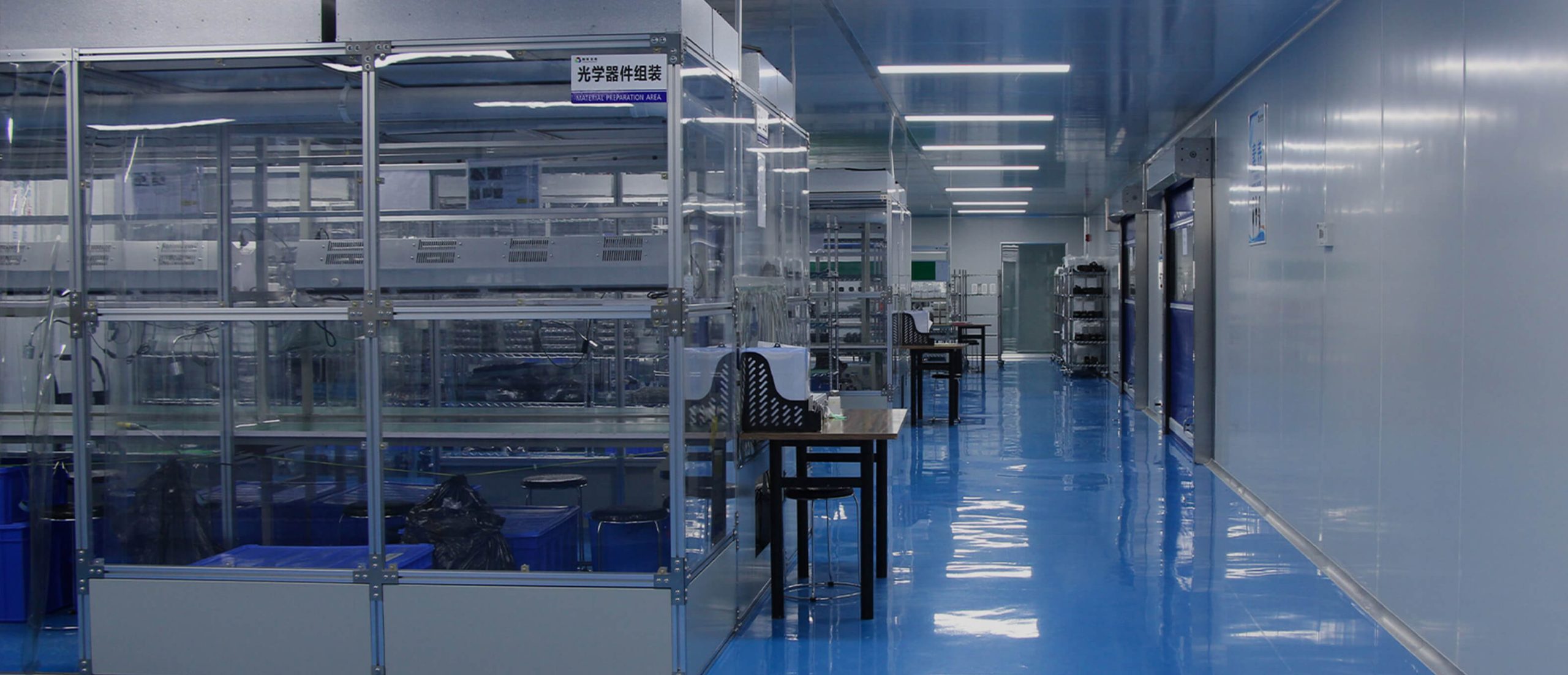
TOUMEI’s current process includes design review, DLP chip confirmation, incoming-material inspection, parts assembly, ATE, aging or burn-in, QC, appearance inspection and finished-product testing. The exact control plan, sample size and acceptance limits should be agreed for the selected model and order.
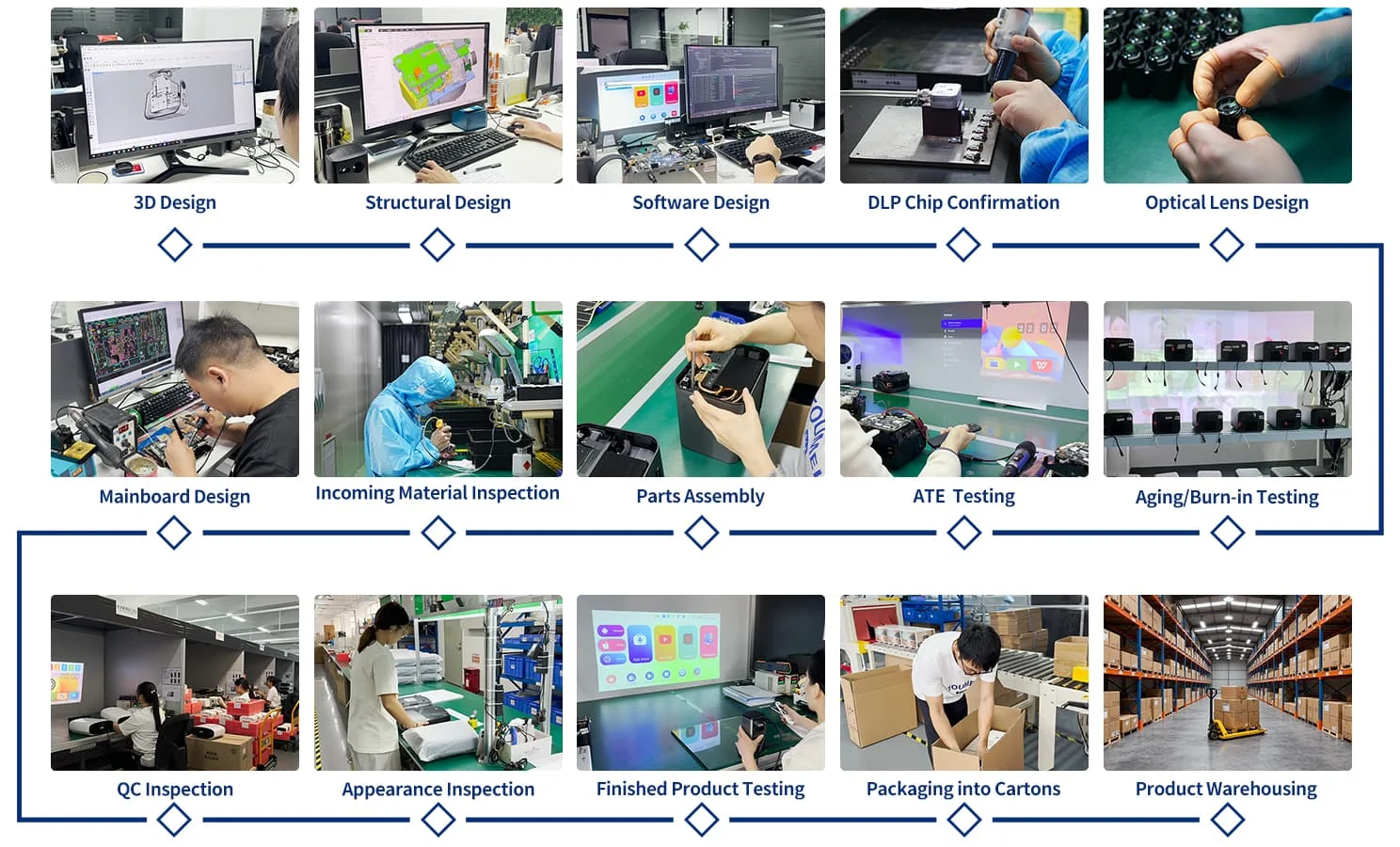
For a suitable existing developed model, TOUMEI’s current commercial starting points are:
- Typical MOQ: 100 units.
- Sample timing: within 7 days for an already developed model, after the sample configuration is confirmed.
- Production shipment: within 15 days for an already developed model, subject to the confirmed order and configuration.
- Customization priority: modifications based on an existing developed platform.
Treat these as project-starting terms, not a promise for every configuration. New structural work, new tooling, material availability, documentation, branding scope and test requirements can change the plan. Confirm the applicable schedule and responsibilities in writing.
A Practical Laser-Projector Buying Decision
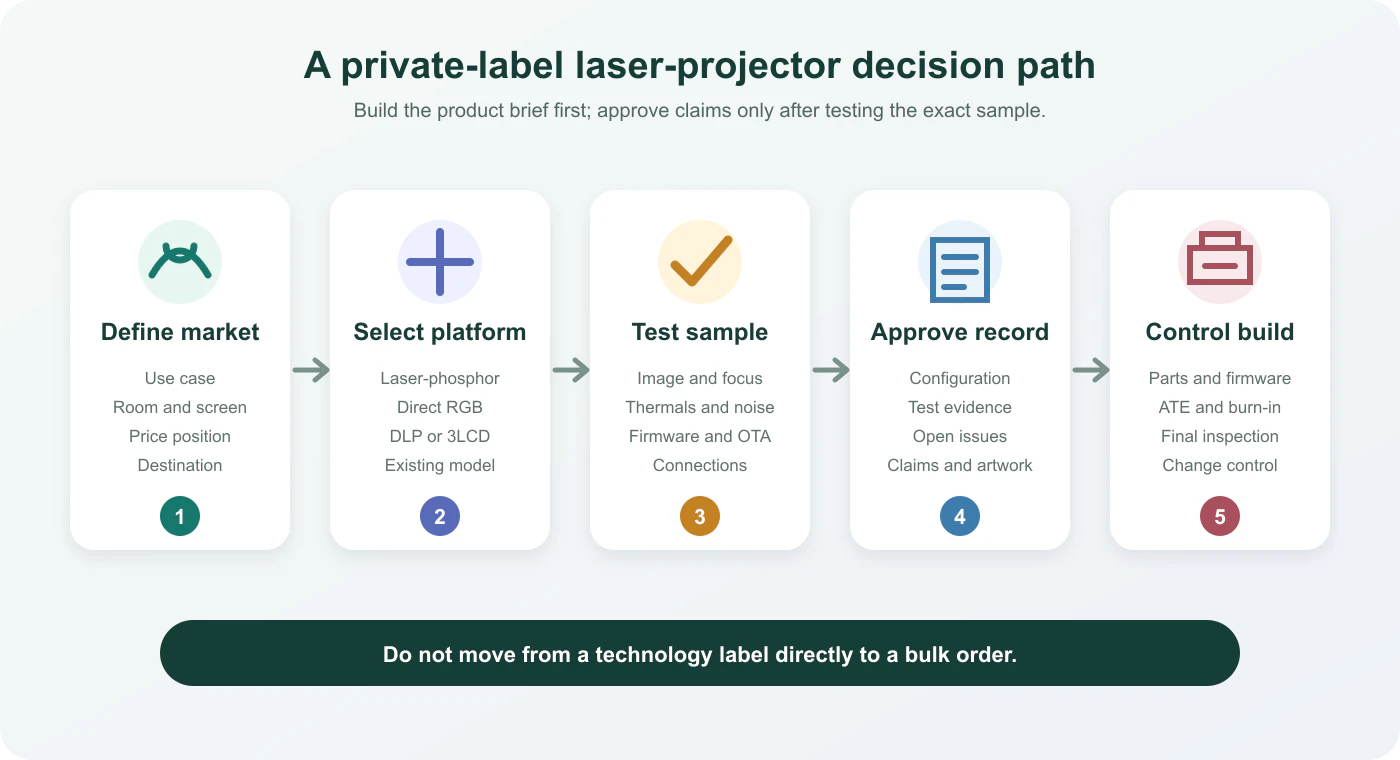
Choose the architecture by working through four decisions:
- Define the customer and room. State the image size, ambient light, placement, duty cycle and price position.
- Choose the complete platform. Compare laser-phosphor DLP, direct-RGB DLP, laser 3LCD or an LED alternative as finished systems.
- Test the exact sample. Verify image, thermals, noise, firmware, connectivity, documents and packaging under agreed conditions.
- Control the approved configuration. Identify the reference unit and version, close open issues and define how later changes will be reviewed.
The label “laser” can narrow a search, but it cannot complete a sourcing decision. The product succeeds when its optical architecture, electronics, software, mechanical design and production controls work together for the intended market.
Discuss a Laser or LED Projector Sample
TOUMEI is a Shenzhen projector manufacturer with more than 10 years of DLP development and manufacturing experience and in-house R&D. The company supports laser and LED optical-engine projects, with the recommended starting point being an existing developed platform.
Send your target market, expected retail range, use case, image size, throw distance, software requirements, branding scope and estimated order quantity. TOUMEI can review the brief against available platforms and identify the information needed for a sample decision.
Contact TOUMEI on WhatsApp to discuss a projector sample. Ask the team to confirm the proposed architecture, configuration, applicable documents, sample timing and production terms before you publish product claims.
Frequently Asked Questions
Is a laser projector the same as a DLP projector?
No. Laser describes the light source; DLP describes an imaging technology. A projector can use a laser light source with a DLP imaging system, so it can be both.
Can an LCD projector use a laser light source?
Yes. Commercial products combine laser illumination with three-chip 3LCD imaging. The light-source and imaging labels describe different layers of the projector.
Is RGB laser always better than laser-phosphor?
Not for every product. Direct RGB laser and laser-phosphor designs have different optical, thermal, calibration, artifact, cost and packaging considerations. Compare the exact platforms under the intended conditions.
Does every laser projector have visible speckle?
Speckle visibility depends on the laser architecture and the combination of projector, screen, content and viewing conditions. Test the proposed sample with the screens and viewing distances expected in the target market.
What should a private-label buyer test first?
Confirm the exact hardware and firmware, then test image quality, brightness evidence, thermal stability, noise, required connections, OTA, branding, documents, packaging and accessories. Record the conditions and results.
Can TOUMEI customize an existing laser-projector platform?
TOUMEI recommends beginning with an existing developed model. Branding, firmware, OTA, packaging and suitable platform-level changes can be discussed against the selected model. Mainboard, housing and structural changes require a project-specific review.
What is the MOQ for an existing TOUMEI platform?
The typical MOQ is 100 units. Confirm the selected model, configuration, branding scope and destination requirements before treating the quantity as final.
References
Sources accessed September 18, 2026. Manufacturer pages explain their own technology or named products; they do not establish the performance of a TOUMEI model. The ISO source is the public catalogue and preview, not the complete paid standard.
- Texas Instruments: Display and projection digital micromirror devices. Used for the DMD, controller and light-modulation explanation.
- Texas Instruments: Home cinema, business and education DMDs. Used to confirm that DLP imaging supports laser and LED illumination.
- Epson: Projection technologies. Used for Epson’s description of three-chip 3LCD imaging.
- Epson QL3000 3LCD laser projector. Used as a named example combining a laser light source with 3LCD imaging.
- ISO: ISO/IEC 21118:2020 catalogue entry. Used for the standard’s scope and listed measurement topics.